The phrase is fifteen hundred years old. The book is not. For most of that time there was no list of thirty-six anything — and the text everyone quotes today was printed on rough paper in 1941 and picked up at a street stall for small change.
First it was a phrase about one general
The oldest trace of "the thirty-six stratagems" is not a book but a jibe. The Book of Southern Qi, compiled in the sixth century, records the line "Of Sir Tan's thirty-six stratagems, running away was the best one" — a dig at Tan Daoji, a general of the Liu Song who died in 436 and who had a reputation for extracting his army intact rather than fighting battles he could not win.
Read it in context and it is faint praise at best. But the number stuck. "Thirty-six stratagems, retreat is best" became a stock idiom in Chinese, the way "discretion is the better part of valour" did in English — a thing people said, with no list behind it.
Fourteen centuries with no list
This is the part that surprises people. Between the sixth century and the twentieth, no canonical Thirty-Six Stratagems circulated the way the Art of War did. Sun Tzu was copied, annotated by Cao Cao, taught in the imperial military examinations, printed in the Song Seven Military Classics. The thirty-six had none of that apparatus, for the simple reason that there was nothing to annotate.
The collection as we know it — thirty-six named moves, each a four-character phrase, arranged in six groups — is anonymous, and nobody can date it confidently. It is generally placed late, in the Ming or the Qing, by a compiler who took a very old idiom and did the obvious thing: filled in the thirty-six.
Six sets of six, reasoned in the I Ching
Whoever the compiler was, they were not careless. The thirty-six are arranged by the situation they suit, in six sets of six: winning stratagems for when you hold the advantage, enemy-dealing for when you are evenly matched, then attacking, chaos, proximate — for close quarters and alliances — and finally the desperate set, for when you are losing. The arc runs from strength to ruin, which is why the list is far easier to learn than thirty-six loose idioms.
Each entry is terse: a four-character name, a line or two of gloss, then a commentary that argues the move in the yin-yang language of the I Ching and points to a historical case. That commentary is what makes it a book rather than a list — and it is also what places the compilation late, since it reads as a scholar reasoning about received idioms rather than a soldier writing from a camp.
1941: rough paper, and a stall in Chengdu
The text everyone now quotes has a startlingly recent and modest provenance. It goes back to an undated handwritten manuscript picked up at a book stall in Binzhou — today Binxian in Shaanxi. The manuscript was a miscellany: its opening portion dealt with health and longevity practices, and the thirty-six stratagems, with their military glosses, sat at the back.
In 1941 that material was set in type and printed on coarse paper by a printing shop in Chengdu, under the bare title Thirty-Six Stratagems, the cover marked "secret military treatise." Sometime around 1943 a collector who wrote as Shu He bought a copy of that booklet from a street stall in Chengdu. He thought little of it for years. In September 1961 he described it in an article in Guangming Daily, and later donated his copy to the People's Liberation Army's political academy. An annotated edition followed, and the thirty-six finally had the book that the phrase had been promising for fourteen hundred years.
It is worth being precise about the geography, because it is easy to garble: Binzhou is where the manuscript surfaced, Chengdu is where it was printed and later bought.
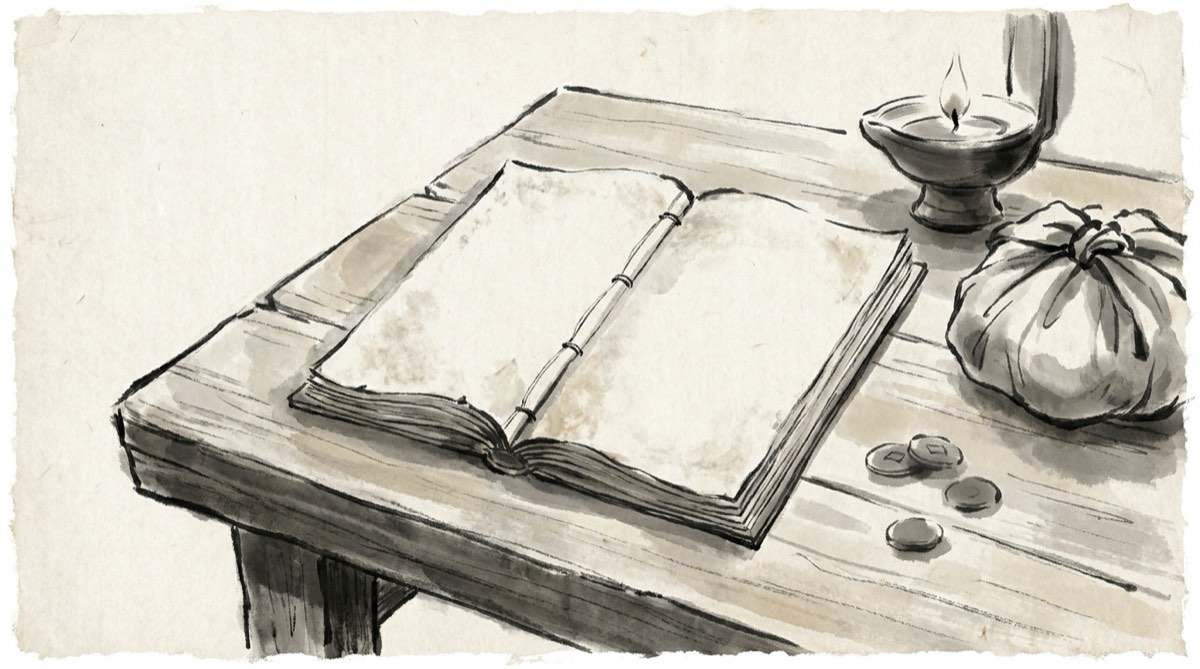
An artist's impression. The 1941 edition was a thin booklet on rough paper, its cover marked simply "secret military treatise" — the kind of thing sold from a mat on the pavement.
Does the provenance spoil it?
It matters, and we say it plainly rather than letting the reader assume otherwise: the Thirty-Six Stratagems is not an ancient treatise on a par with the Art of War. It is a late, anonymous compilation whose modern fame dates from the 1940s and 1960s. A People's Daily overseas edition put it sharply — street-stall literature that became a national classic.
What it is not is fraudulent. Nobody claimed a false author or forged a lineage. The stratagems themselves are genuinely old: the events they name — besieging Wei to rescue Zhao, the empty fort, crossing the sea by deceiving the heavens — are drawn from real episodes in Chinese history and were already common idioms long before anyone gathered them into six neat sets. The compiler's contribution was arrangement, not invention.
So read it for what it demonstrably is: an unusually well-organised index to two thousand years of Chinese strategic thinking, assembled late and anonymously, and none the worse for it. It is a better teaching tool than most genuinely ancient books, precisely because someone sat down and put it in order.
From a jibe to a canon
d. 436Tan Daoji, the Liu Song general remembered for withdrawing an army intact.
6th centuryThe Book of Southern Qi records "Of Sir Tan's thirty-six stratagems, running away was the best" — the phrase's first appearance.
Ming or QingAn anonymous compiler assembles thirty-six named stratagems into six sets, with I Ching commentary. The date is not settled.
undatedA handwritten manuscript containing it surfaces at a book stall in Binzhou (now Binxian, Shaanxi), bound in with health-and-longevity material.
1941Printed on coarse paper by a Chengdu printing shop, the cover marked "secret military treatise".
c. 1943The collector writing as Shu He buys a copy from a street stall in Chengdu.
September 1961Shu He describes the booklet in Guangming Daily; his copy later goes to the PLA's political academy. Annotated editions follow.
todayQuoted worldwide, and routinely mistaken for a companion volume to Sun Tzu written in the same era.
Where this comes from
Principal sources: the Book of Southern Qi, "Biography of Wang Jingze", for the phrase and for Tan Daoji; the standard published account of the received text's provenance — the Binzhou manuscript, the 1941 Chengdu printing, and Shu He's September 1961 article in Guangming Daily — together with the annotated editions that followed. Dating of the compilation itself is unsettled and this page says so. A 2009 claim that Sui-dynasty jade slips push the collection back a thousand years is not established and is left out.