Two pillars of Chinese strategic thought, free to read and use. Sun Tzu's Art of War sets the philosophy of winning without fighting; the 36 Stratagems distil it into 36 memorable moves — each a chengyu with a real historical origin and a surprisingly modern application.
Take every small advantage that falls in your path. Alongside your main aim, scoop up the minor, undefended gains a careless opponent leaves lying around — many small takings add u...
Sun Tzu's Art of War (孙子兵法) is a 2,500-year-old treatise whose ideas — know your enemy, win before you fight, adapt to the terrain — shape strategy far beyond the battlefield. The 36 Stratagems (三十六计) are a separate, later collection of concrete tactical moves, each a four-character idiom with a story behind it. Together they are the philosophy and the playbook. Read them here in full, in five languages, and put them to work with the interactive tools.
The man behind the book
Who was Sun Tzu?
A general who may never have existed, a book that outlived every empire that read it, and a bundle of bamboo slips dug out of a Shandong hillside in 1972 that settled an argument two thousand years old.
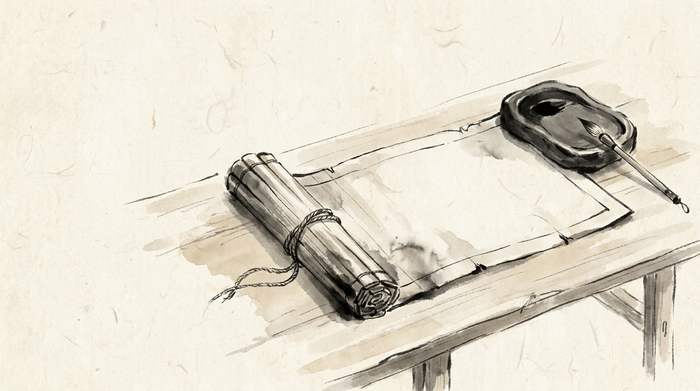
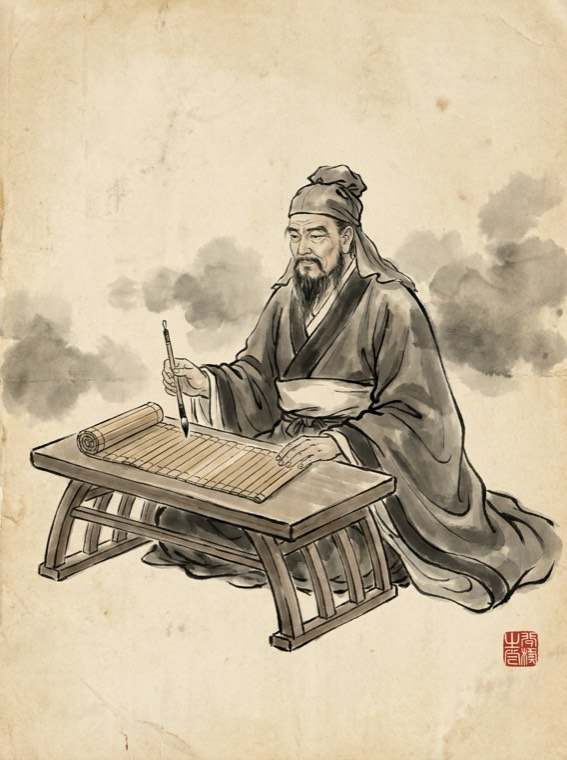
Sun Wu at his writing table — an artist's impression. No portrait made from life survives, and none was ever likely to: the earliest account of him was written some four centuries after he is said to have lived.
A stranger from Qi
Almost everything told about Sun Tzu comes from a single source: the Records of the Grand Historian (史记), completed by Sima Qian around 100 BCE — some four hundred years after the man is supposed to have lived. In it he is Sun Wu (孙武), courtesy name Changqing, born in the eastern state of Qi during the Spring and Autumn period, who travelled south to the rising state of Wu and sought an audience with its king, Helü. He arrived carrying thirteen chapters on the conduct of war.
That is the whole of the biography. No family, no birth year, no account of his death. For a figure whose name is now known on every continent, the documentary record is astonishingly thin — and that thinness is where the trouble starts.
The drill in the palace courtyard
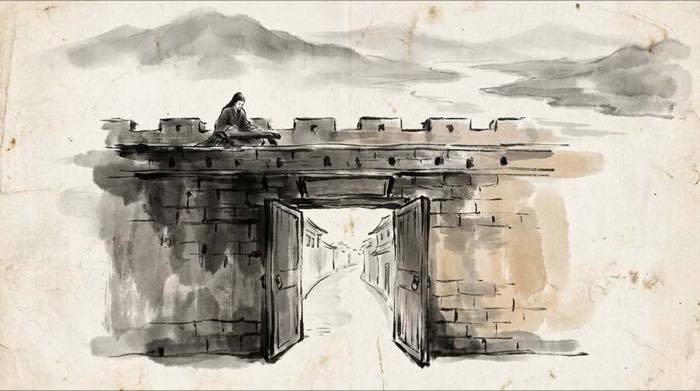
The one story everyone knows is Sima Qian's. King Helü, having read the thirteen chapters, asked whether the theory could be demonstrated — on women. Sun Wu accepted, and a hundred and eighty palace ladies were assembled in the courtyard. He appointed the king's two favourite concubines as company commanders, explained the drill, and gave the order.
They laughed. "If instructions are unclear and orders not explicit," Sun Wu said, "it is the general's fault." He explained again, carefully, and gave the order a second time. They laughed again. "If instructions are clear and orders are still not carried out, it is the fault of the officers" — and he ordered the two favourites beheaded. The king shouted down from his terrace that he was satisfied and needed no execution. Sun Wu replied that a general in the field is not bound by every command of his sovereign, and had them killed. The drill that followed was performed in perfect silence, every turn exact.
It is a chilling story, and almost certainly not a factual one. Its shape is that of a parable, and its lesson is doctrinal: discipline outranks favour, and a commander who cannot be overruled mid-campaign is worth more than one who can. Read it as the argument Sima Qian wanted to make about command, not as reportage.
506 BCE: the campaign that made the reputation
The success case that the ancient world actually pointed to was the war between Wu and Chu. Chu was the great power of the south; Wu was a smaller, newer state on its flank. In 506 BCE a Wu army marched inland, won a decisive engagement at Boju (柏举), and did what no one expected — it took Ying, the Chu capital. Sima Qian credits Sun Wu, alongside the exiled Chu nobleman Wu Zixu, with the strategy that made Wu strong enough to do it.
Here the record turns awkward. The Zuo Zhuan — the detailed chronicle closest in time to these events, and our best source for the period — describes the Boju campaign at length and never once mentions Sun Wu. Wu Zixu is there. The commanders are named. The strategist whose book the world would go on to read for two and a half thousand years is absent from the account of his own greatest victory.
Did he exist at all?
That silence bothered readers for a very long time. From the Song dynasty onward, Chinese scholars argued openly that Sun Wu was an invention — that the thirteen chapters were a later compilation, assembled during the Warring States period when the kind of mass infantry warfare the book describes actually existed. Others noticed a second Sun in the record: Sun Bin (孙膑), a strategist of the fourth century BCE, and proposed that he was the real author, or even that the two men were one man doubled by confusion.
The argument could not be settled, because both candidate books could not be compared. Sun Bin's own military treatise was listed in Han-dynasty catalogues and then vanished; by the Tang it was gone, and it stayed gone for roughly two thousand years.
1972: the hillside at Yinqueshan
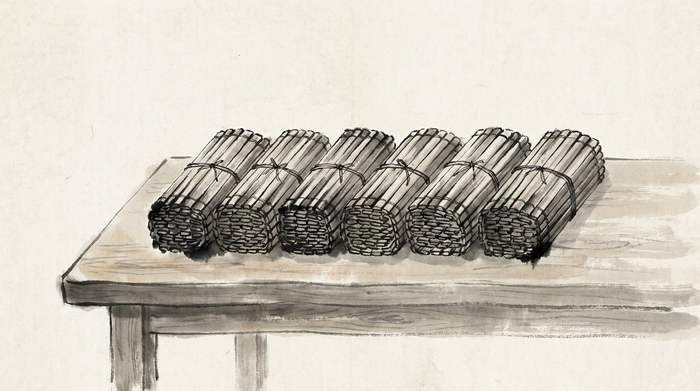
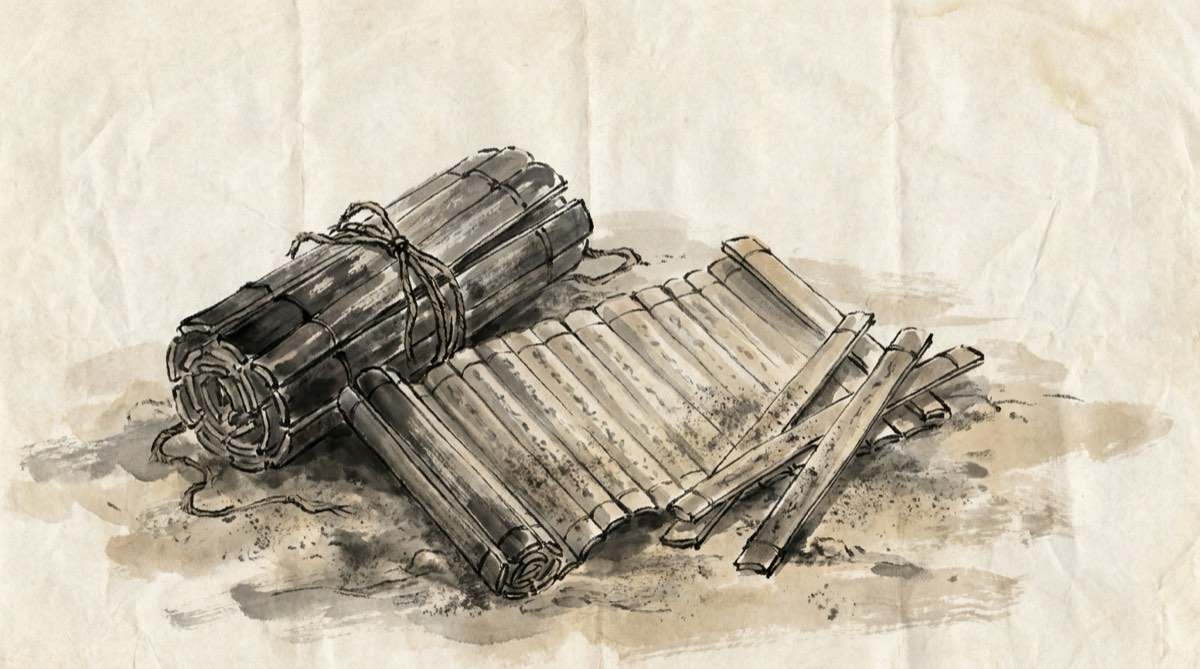
In April 1972, construction work at Yinqueshan — "Silver Sparrow Mountain" — on the edge of Linyi in Shandong province exposed two tombs of the Western Han, sealed in the second century BCE. Inside, among the grave goods, were thousands of bamboo slips: narrow strips of bamboo, written on in ink, once bound with cord into rolls and long since collapsed into a jumble.
When the slips were cleaned, sorted and read, they contained a copy of Sun Tzu's Art of War — and, alongside it, the lost military treatise of Sun Bin. Both books, in one tomb. Two separate texts, by two separate men, buried together some eighteen hundred years before anyone thought to doubt that both had existed.
The find ended the authorship argument in a single stroke. It also handed scholars something they had never had: a copy of the Art of War written down more than a thousand years earlier than any manuscript previously known, including passages that had not survived into the received text. Yinqueshan remains the single most important discovery in the book's history.
Han-dynasty bamboo slips — an artist's impression of the kind of find made at Yinqueshan in 1972.
How the book travelled
The Art of War survived because soldiers kept editing it. Around 200 CE the warlord Cao Cao — himself one of the most capable commanders in Chinese history — wrote a commentary on it, trimming and glossing the text; his is the earliest that survives, and it shaped every edition after. In 1080 the Song court gathered the book into the Seven Military Classics, making it required reading for officers sitting the imperial military examinations. The version most people read today descends from a collected edition carrying the notes of eleven such commentators.
It reached Japan early, and by the sixteenth century it was being flown into battle: the warlord Takeda Shingen took his famous fūrinkazan banner — "swift as the wind, silent as the forest, fierce as fire, immovable as the mountain" — directly from the book's seventh chapter. Europe met it late. A French Jesuit in Beijing, Jean Joseph Marie Amiot, published the first European translation in 1772; Lionel Giles produced the English translation in 1910 that became the scholarly standard, and Samuel B. Griffith's 1963 version carried it into modern Western military thinking. The business world arrived last, from the 1980s onward — the most recent of a very long line of readers.
What the argument leaves us
The honest summary is this. A man called Sun Wu probably served the state of Wu in the late sixth century BCE, though the best chronicle of the period does not mention him. The thirteen chapters that carry his name reached something close to their present form by the Warring States period, and may well contain a core that is genuinely his. The palace-drill story is almost certainly a parable. Sun Bin was a different person, and we know that for certain only because of a construction crew in Shandong in 1972.
None of that uncertainty has cost the book a single reader. What survives is not a biography but an argument — that war is a matter of calculation before it is a matter of courage, that the best victory costs nothing, and that the ground you are standing on decides which move is right. That argument has been tested, in earnest, for two and a half thousand years, and it has not yet been retired.
The long road of a short book
late 6th c. BCESun Wu is said to enter the service of King Helü of Wu, carrying thirteen chapters on war.
506 BCEWu defeats Chu at Boju and takes the capital, Ying — the campaign later credited to his strategy.
2nd c. BCETwo tombs are sealed at Yinqueshan with copies of both Sun Tzu's and Sun Bin's treatises inside.
c. 100 BCESima Qian writes the only ancient biography of Sun Wu — including the palace-drill story.
c. 200 CECao Cao annotates the text — the earliest commentary to survive, and the shape of every edition since.
1080The Song court makes it one of the Seven Military Classics — required reading for officers.
16th c.Takeda Shingen carries a line from chapter seven into battle as the fūrinkazan banner.
1772The Jesuit Amiot publishes the first European translation, in French.
1910Lionel Giles publishes the English translation that becomes the scholarly standard.
April 1972The Yinqueshan slips are excavated — proving Sun Tzu and Sun Bin wrote two different books.
Where this comes from
Principal sources: Sima Qian, Records of the Grand Historian (史记), "Biographies of Sun Tzu and Wu Qi", c. 100 BCE; the Zuo Zhuan for the Wu–Chu war; and the published excavation reports on the 1972 Yinqueshan Han bamboo slips. Where the ancient record disagrees with itself — Sun Wu's existence, his part at Boju, the palace drill — this page says so rather than choosing the better story.