Sima Qian says Sun Wu arrived carrying thirteen. The Han imperial catalogue lists eighty-two. What survived is thirteen — shaped, along the way, by a warlord who thought the text was too long.
Thirteen, or eighty-two?
Sima Qian is specific: the stranger from Qi turned up at the Wu court with thirteen chapters, and the received text has thirteen. That ought to settle it. Except that the bibliographic treatise of the Book of Han, cataloguing the imperial library, lists something much larger under Sun Tzu's name — eighty-two pian and nine scrolls of diagrams.
So what were the other sixty-nine? The most economical reading is that a compact thirteen-chapter core attracted a much larger body of associated material — expansions, worked examples, diagrams — which the Han library shelved together under one title, and which later fell away. The bamboo slips excavated in 1972 fit that picture: they contained the thirteen, and further related chapters that never made it into the text we read. Which parts are original and which accreted is not settled, and anyone who tells you otherwise is guessing.
The shape of the argument
Read in order, the thirteen are not a grab-bag of maxims. They are an argument that moves outward from the desk to the battlefield and back to the desk.
It opens with arithmetic. Laying Plans weighs five fundamentals and reckons the odds before anyone marches; Waging War then prices the whole enterprise and concludes that speed beats perfection, because a long campaign ruins the state that launched it. Only after establishing the cost does chapter three, Attack by Stratagem, deliver the line everyone quotes — that subduing the enemy without fighting is the height of skill. It is a conclusion, not a slogan, and it closes with knowing yourself and your opponent.
The middle chapters are about position and timing: make yourself unbeatable first (Dispositions), then understand momentum (Energy), then go where the enemy is not (Weak and Strong). Manoeuvring supplies the lines a Japanese warlord would later fly on a banner — swift as wind, still as forest, fierce as fire, immovable as mountain. Variations argues for adapting, including when not to obey an order.
Then it gets practical and physical — marching, reading ground signs, six kinds of terrain, nine kinds of position and the psychology each produces. Attack by Fire covers special methods and ends with a warning against making war in anger. And the last chapter is not a battle at all: Use of Spies, an argument that foreknowledge is the cheapest thing a state can buy, and that begrudging a spy his reward, when a campaign costs thousands of lives, is the height of inhumanity.
Note where it begins and ends. Calculation, and intelligence. Both are about knowing rather than fighting — which is the book's whole case, stated structurally.
A warlord with an editing pen
Around the year 200 the text acquired its most consequential reader. Cao Cao — a formidable commander in his own right, and the eventual founder of the state of Wei — wrote a commentary on it, the earliest that survives. He did not simply gloss it. By his own account he found the transmitted material verbose and pared it back to what he judged essential.
That matters more than it first appears. The thirteen chapters as they now read passed through the editorial judgement of a third-century general deciding what a soldier actually needed. Every later edition builds on his. When you read Sun Tzu, some of the concision you are admiring may be Cao Cao's.
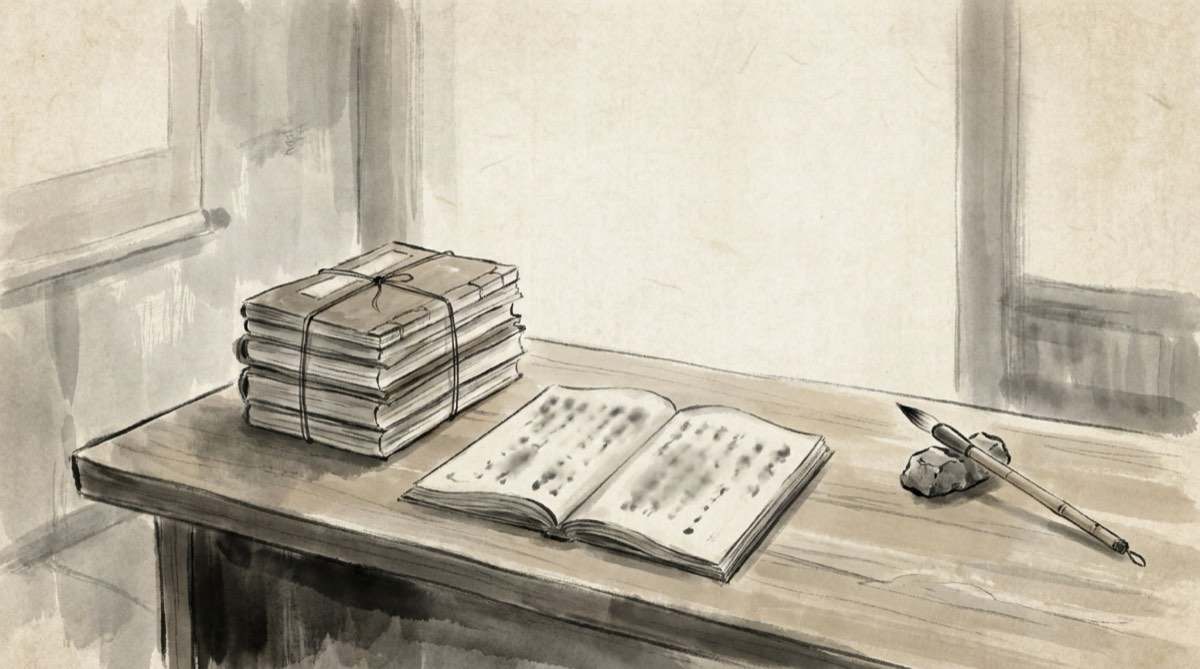
Thread-bound volumes on a scholar's table — an artist's impression. For most of its life the Art of War travelled as a commented text: what a reader held was rarely Sun Tzu alone.
Eleven commentators, two lineages
After Cao Cao the commentaries multiplied — Li Quan, Du Mu, Du You, Jia Lin and Chen Hao in the Tang; Mei Yaochen, Wang Xi, He Yanxi and Zhang Yu in the Song. A Southern Song printing gathered eleven of them around the text in a single edition, the Sun Tzu with Eleven Commentaries, and for most readers thereafter that was the book: thirteen chapters surrounded by eleven centuries of argument about what they meant.
Meanwhile the Song court took a different path. In 1080 it fixed a version of the text inside the Seven Military Classics, the syllabus for the imperial military examinations — an official recension, standardised for candidates.
The two lineages do not read identically. Wordings differ, and so, quietly, do the translations built on them: some famous discrepancies between English versions come down to which base text the translator sat with. Modern critical editions collate both against the 1972 slips, which are older than either by more than a thousand years.
Why read it as thirteen chapters
The Art of War is the most quotable book in the strategic canon, and that is the problem. Lifted out of its chapter, "subdue the enemy without fighting" sounds like a platitude about being clever. Left where it sits — immediately after two chapters costing out what a war does to a state — it reads as what it is: an economic argument. The same goes for the fire chapter's closing warning, which lands only because it follows a chapter of methods for burning an enemy's camp.
That is the case for reading the thirteen in order at least once, rather than collecting the famous lines. Each chapter here carries its essence, its key lines in the original with a translation, and how it is applied today — in five languages. Start at chapter one; it is shorter than you think.
How thirteen chapters reached you
c. 100 BCESima Qian records that Sun Wu presented thirteen chapters to the king of Wu.
2nd c. BCEA copy buried at Yinqueshan — the thirteen, plus related chapters absent from the received text.
1st c. CEThe Book of Han's catalogue lists eighty-two pian and nine scrolls of diagrams under Sun Tzu's name.
c. 200 CECao Cao writes the earliest surviving commentary and, by his own account, condenses a text he finds verbose.
TangLi Quan, Du Mu, Du You, Jia Lin and Chen Hao add their commentaries.
1080The Song court fixes a recension inside the Seven Military Classics, the military-examination syllabus.
Southern SongSun Tzu with Eleven Commentaries is printed — the text ringed by eleven centuries of argument.
todayCritical editions collate both lineages against the 1972 slips — older than either by a millennium.
Where this comes from
Principal sources: Sima Qian's Records of the Grand Historian for the thirteen chapters; the bibliographic treatise of the Book of Han for the eighty-two pian and nine scrolls of diagrams; Cao Cao's Brief Explanation of Sun Tzu, the earliest surviving commentary; the Southern Song Sun Tzu with Eleven Commentaries; and the Song Seven Military Classics of 1080. Whether the thirteen are the original core or a selection from a larger body is not settled, and this page does not pretend otherwise.