作战
War is ruinously expensive, so speed beats perfection: win quickly, never drag a campaign out, and live off the enemy's supplies to spare your own.
- What this chapter says
- Key lines
- Applied today
- Related stratagems
- Chapters that share ground with this one
What this chapter says
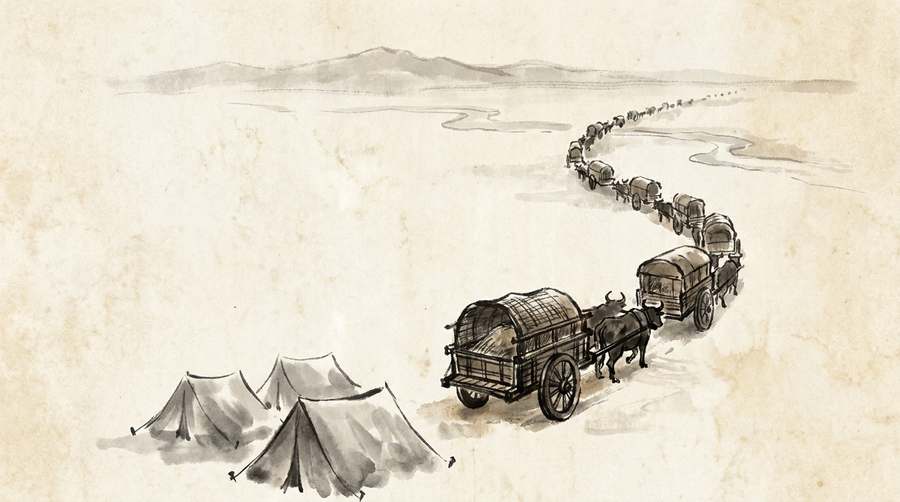
Sun Tzu turns to cost. A large army in the field devours the treasury daily — provisions, transport, and equipment ruin the state long before the enemy does. A protracted war blunts weapons, dampens morale, exhausts strength, and tempts other powers to strike while you are spent. Therefore what matters is a swift victory, not a clever, drawn-out one: 'though we have heard of stupid haste in war, cleverness has never been seen associated with long delays.' The wise general also feeds his army from captured supplies rather than shipping everything from home, because one cartload taken from the enemy is worth twenty of one's own. Economy and speed, not endurance, decide who can afford to win.
Key lines
From 十一家注孫子, the Eleven Commentators edition. The Chinese is verbatim from that text; the English beneath each is ours.
- 曹操 久則不利。兵猶火也,不戢將自焚也。 Length brings no advantage. War is fire: not banked, it burns the one who lit it.
- 孟氏 貴速勝疾還也。 What is prized is a swift win and a swift return.
- 梅堯臣 上所言皆貴速也。速則省財用、息民力也。 Everything said above prizes speed. Speed spares the treasury and rests the people's strength.
- 何氏 孫子首尾言兵久之理,蓋知兵不可玩、武不可黷之深也。 Sun Tzu speaks of the logic of protracted war from beginning to end — so deeply does he know that arms must not be toyed with, nor force abused.
- 張預 久則師老財竭,易以生變,故但貴其速勝疾歸。 Protracted, the army ages and the treasury empties, and change comes easily — hence only a swift win and a swift return are prized.
- 杜牧 攻取之間,雖拙於機智,然以神速爲上,蓋無老師、費財、鈍兵之患,則爲巧矣。 In taking a position, clumsy speed beats clever delay: no worn army, no drained treasury, no blunted weapons — and that is the real skill.
- 孟氏 雖拙,有以速勝。 Clumsy, yet it has the means to win quickly.
- 陳皥 所謂疾雷不及掩耳,卒電不及瞬目。 As the saying goes: thunder so sudden there is no covering the ear, lightning so quick there is no blinking.
- 梅堯臣 拙尚以速勝,未見工而久可也。 Even clumsiness wins by speed; skill sustained over time has never been seen to.
- 王晳 晳謂久則師老財費,國虛人困,巧者保無斯患也。 Xi says: protracted war ages the army and drains the treasury, empties the state and exhausts the people. No skilful commander is safe from that.
- 何氏 速雖拙,不費財力也;久雖巧,恐生後患也。後秦姚萇與符登相持,萇將苟曜據逆萬堡,密引符登。萇與登戰,敗於馬頭原,收衆復戰。姚碩德謂諸將曰:「上慎於輕戰,每欲以計取之;今戰旣失利,而更逼賊,必有由也。」萇聞而謂碩德曰:「登用兵遲緩,不識虛實;今輕兵直進,徑據吾東,必苟曜與之連結也。事久變成,其禍難測。所以速戰者,欲使苟曜竪子謀之未就,好之未深耳。」果大敗之。武后初,徐敬業舉兵於江都,稱匡復皇家。以盩厔尉魏思恭爲謀主,問計於思恭。對曰:「明公旣以太后幽縶少主,志在匡復,兵貴拙速,宜早渡淮北,親率大衆,直入東都。山東將士知公有勤王之舉,必以死從,此則指日刻期,天下必定。」敬業欲從其策,薛璋又說曰:「金陵之地,王氣已見,宜早應之。兼有大江設險,足可以自固,請且攻取常、潤等州,以爲王霸之業,然後率兵北上,鼓行而前,此則退有所歸,進無不利,實良策也。」敬業以爲然,乃自率兵四千人,南渡以擊潤州。思恭密謂杜求仁曰:「兵勢宜合,不可分。今敬業不知并力渡淮,率山東之衆以合洛陽,必無能成事。」果敗。 Speed, though clumsy, spends nothing; skill drawn out breeds later trouble. Illustrated with Yao Chang against Fu Deng, where Yao read a subordinate's defection from the enemy's uncharacteristic speed of advance.summary, not a translation
- 張預 但能取勝,則寧拙速,而無巧久。若司馬宣王伐上庸,以一月圖一年,不計死傷,與糧競者,斯可謂欲拙速也。 If it wins, prefer the clumsy and quick to the clever and slow. As when Sima Yi attacked Shangyong, planning in one month what would have taken a year, disregarding the losses and racing his own supply — that may be called wanting clumsy speed.
- 曹操 六斛四㪷爲鍾。𦮼,豆稭也。秆,禾藁也。石者,一百二十斤也。轉輸之法,費二十石得一石。一云:𦮼音忌,豆也。七十斤爲一石。當吾二十,言遠費也。 Six hu four dou make a zhong. 萁 is bean stalk; 秆 is straw. A shi is one hundred and twenty jin. By the law of transport, twenty shi are spent to deliver one. (Another reading gives 萁 the sound ji, meaning beans; seventy jin make a shi.) 'Worth twenty of ours' speaks of the cost of distance.
- 杜牧 六石四㪷爲一鍾。一石,一百二十斤。𦮼,豆稭也。秆,禾藁也。或言:𦮼,秆藁也。秦攻匈奴,使天下運糧,起於黄腄、瑯琊負海之郡,轉輸北河,率三十鍾而致一石。漢武建元中,通西南夷,作者數萬人,千里負擔饋糧,率十餘鍾致一石。今校《孫子》之言「食敵一鍾,當吾二十鍾」,蓋約平地千里轉輸之法,費二十石得一石,不約道里,蓋漏闕也。黄腄,音直瑞反,又音誰,在東萊。北河,卽今之朔方郡。 Gives the measures — six shi four dou to a zhong, a hundred and twenty jin to a shi — then the historical costs of transport: Qin's campaign against the Xiongnu, where thirty zhong delivered one shi, and Han Wudi's opening of the southwest, where ten-odd zhong delivered one. He reads Sun Tzu's 'twenty to one' as the rate for a thousand li over level ground, not counting difficult roads.summary, not a translation
- 李筌 遠師轉一鍾之粟,費二十鍾方可達軍。將之智也,務食於敵,以省己之費也。 Hauling one measure of grain to a distant army costs twenty to deliver. The general's wisdom is to eat off the enemy and spare his own.
- 孟氏 十斛爲鍾。計千里轉運,道路耗費,二十鍾可致一鍾於軍中矣。 Ten hu make a zhong. Reckoning transport over a thousand li, with wastage on the road, twenty zhong will deliver one zhong to the army.
- 王晳 曹公曰:「𦮼,豆稭也。秆,藁也。石者,百二十斤也。轉輸之法,費二十乃得一。」晳謂上文「千里饋糧」,則轉輸之法,謂千里耳。𦮼,今作「萁」。秆,故書爲「芉」,當作「秆」。 Lord Cao says: '萁 is bean stalk; 秆 is straw; a shi is a hundred and twenty jin; by the law of transport twenty are spent to get one.' Xi says the passage above, 'provisioning over a thousand li', is what the law of transport refers to — a thousand li, no more. 萁 is now written 萁; 秆 was anciently written 芉, and should be written 秆.
- 張預 六石四𣁳爲鍾。一百二十斤爲石。𦮼,豆稭也。秆,禾藁也。千里饋糧,則費二十鍾、石,而得一鍾、石到軍所。若越險阻,則猶不啻。故秦征匈奴,率三十鍾而致一石。此言能將必因糧於敵也。 Six shi four dou make a zhong; a hundred and twenty jin make a shi. 萁 is bean stalk, 秆 is straw. Provisioning over a thousand li costs twenty zhong or shi to land one at the army. Cross difficult ground and it is worse still — so when Qin campaigned against the Xiongnu it took thirty zhong to deliver one shi. This is why a capable general lives off the enemy.
Applied today
Prolonged, cash-burning campaigns — price wars, endless roadmaps — exhaust you and invite disruption while you're spent. A decisive, faster win usually beats a drawn-out pursuit of the 'perfect' one.
Sustained conflict is costly for everyone involved, and bystanders may exploit both sides' exhaustion. Where you can, resolve a dispute quickly rather than letting it grind on out of pride.