以逸待劳
Don't rush to the enemy — make the enemy rush to you. Hold rested, fed, and dug in, and let their march, hunger, and impatience do half your fighting.
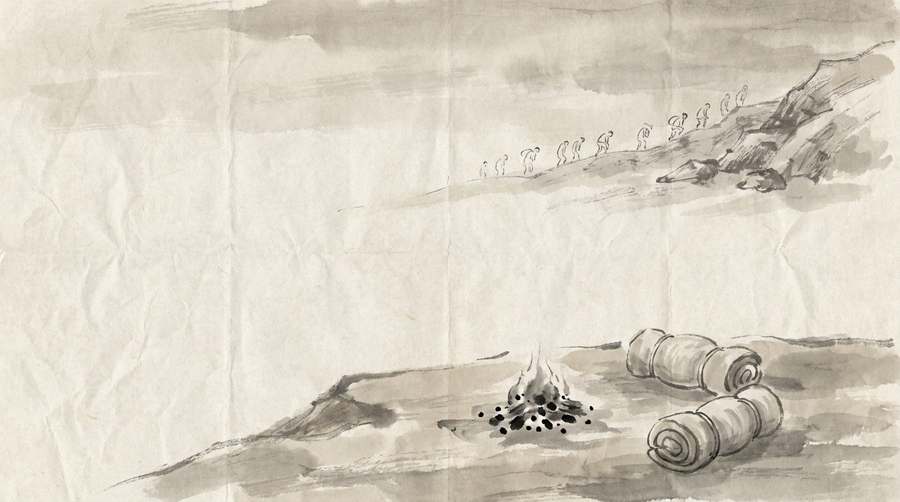
The principle
Force has a cost that mounts with distance and time. An army that must come to you spends itself on the march, on supply, and on the nerves of waiting for a fight that won't begin. You spend nothing. By choosing the ground and the moment, you convert the enemy's initiative into their exhaustion, then strike when the gap between your freshness and their fatigue is widest. The discipline it demands is patience: the temptation is always to act, when waiting is the stronger move.
Historical origin
The maxim is stated almost verbatim in Sun Tzu's Art of War (ch. 7, 'Maneuvering'): 'meet the near with the far, the rested with the toiling, the full with the hungry.' Its classic application is Sun Bin's Maling campaign (341 BCE): retreating before the Wei general Pang Juan, Sun Bin reduced his army's cook-fires each night to feign mass desertion, luring the over-confident Wei force into a forced night march — then ambushed the exhausted column at Maling. Recorded in the Records of the Grand Historian.
Applied today
Let a rival burn cash racing to be first in an unproven market. Sit out the costly education phase, watch what actually sticks, then enter rested with a better product once they've exhausted themselves proving demand.
When the other side needs the deal by a deadline and you don't, time is your ally. Stay calm and unhurried; their pressure to close mounts by the day while yours stays at zero.
In practice
Invented scenarios showing this stratagem at work — illustrations, not reports of real events.
Nine months of maintenance
One team fine-tuned early, stood up its own serving stack, and spent nine months keeping it alive. The other shipped nothing for two quarters, then wired a hosted endpoint into the same product in three weeks, on a base model that had meanwhile improved past the fine-tune. The first team's work was not wasted so much as overtaken, and it was overtaken while being maintained.
Use it In a fast-moving capability market, delay is a position — build the thin layer you can replace, not the deep one you must carry.
Let someone else teach the market
The first entrant spent two years and most of its funding explaining to buyers why the category was needed at all. A later competitor spent nothing on that argument. It arrived once the question had shifted from whether to buy to which one to buy, and competed only on the second question, with its budget intact.
Use it Entering after the market is educated is cheaper — arrive rested where the pioneer arrives spent.
The third candidate
Two contenders spent four months briefing against each other in meetings everybody could read. A third said very little, kept delivering, and answered questions only when they were asked of her. By the time the decision was made, the panel's main concern was finding somebody the team would still willingly work with. Neither of the first two had spent any energy on that question.
Use it In a visible contest the quiet third option gains by default — protect your working relationships while rivals spend theirs.
They waited for the third night
The intrusion did not begin on the first night of the cutover, when the room was full and everyone was alert. It began at three in the morning on the third, after two days without proper sleep, when a tired engineer approved a change that would have been questioned on Monday. Nothing about it was sophisticated. It was scheduled against a rota rather than a system.
Use it Roster fresh reviewers through long changes — an adversary times the move to your fatigue, not to your architecture.
In the treatise
The two works are separate books, roughly a thousand years apart. A chapter link is a reading aid grounded on the line quoted beneath it — not a derivation.