围魏救赵
Don't meet a strong enemy head-on where they are concentrated. Strike the weak point they must defend, and they will abandon their attack to protect it.
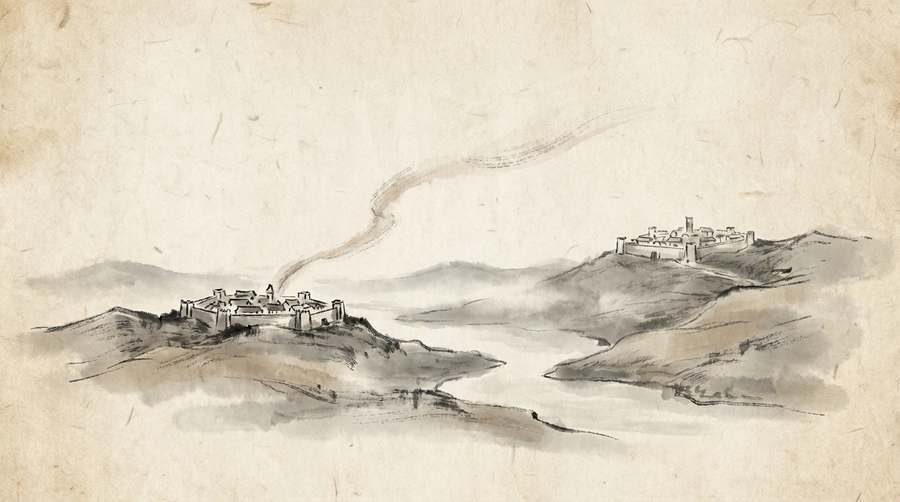
The principle
The stratagem redirects force instead of matching it. A besieging army is committed and over-extended; its home base is exposed. Rather than relieve the siege by fighting the strongest point of the enemy, you threaten what they cannot afford to lose. The enemy must react on your terms — marching back tired and disordered, to be met on ground you have chosen. The principle generalises far beyond war: never attack strength directly when you can force it to abandon its advantage by threatening a vulnerable, higher-priority target elsewhere.
Historical origin
353 BCE, Warring States period. The state of Wei, under general Pang Juan, besieged Handan, capital of Zhao. Zhao appealed to Qi. The Qi strategist Sun Bin advised general Tian Ji not to march to Handan, but to attack Wei's own lightly-defended capital, Daliang. Pang Juan was forced to abandon the siege and race home; Sun Bin ambushed his exhausted army at Guiling and routed it. Recorded in Sima Qian's Records of the Grand Historian (《史记·孙子吴起列传》).
Applied today
A challenger can't beat an incumbent in its core market. Instead of attacking there, it launches in an adjacent segment the incumbent must defend (or in the incumbent's most profitable niche), forcing it to divert resources and dilute its core advantage.
When a counterpart is dug in on one issue, don't push harder on it. Open a second front on something they value more, and their rigidity on the first issue suddenly becomes negotiable.
In practice
Invented scenarios showing this stratagem at work — illustrations, not reports of real events.
The document nobody deleted
Answer quality was poor and every proposal involved the model: a larger one, a fine-tune, a longer context window. A quieter engineer sampled fifty failed answers instead and found forty-one had retrieved the same superseded policy document, which nobody had removed when it was replaced. Deleting one file did more than any model change would have. The model had attracted the attention because the model was the interesting part.
Use it When answers fail, sample the retrieved context before you touch the model — retrieval failures look exactly like reasoning failures.
Attacking somewhere else entirely
A larger rival was steadily taking the firm's main accounts, and defending them directly was unaffordable. The firm instead launched aggressively into a segment the rival depended on for cash. Within two quarters the pressure on the original accounts eased on its own, because the resources applying it had been recalled to defend something else.
Use it Relieve pressure by threatening what your opponent must protect, rather than reinforcing where you are weakest.
Fighting somewhere other than the inbox
Finance staff were receiving convincing invoice mails faster than the filters could learn them, and adding rules changed nothing. The team stopped defending the inbox and went after what the campaign depended on: the lookalike domains and the relay behind them, reported and re-reported daily. The mails thinned within a fortnight because the ground they were sent from kept collapsing underneath.
Use it Attack what a campaign depends on — its domains and relays — rather than adding one more filter rule.
In the treatise
The two works are separate books, roughly a thousand years apart. A chapter link is a reading aid grounded on the line quoted beneath it — not a derivation.