趁火打劫
When a rival is already consumed by an internal crisis, that is the moment to press — not out of cruelty, but because their strength is turned inward and cannot answer you.
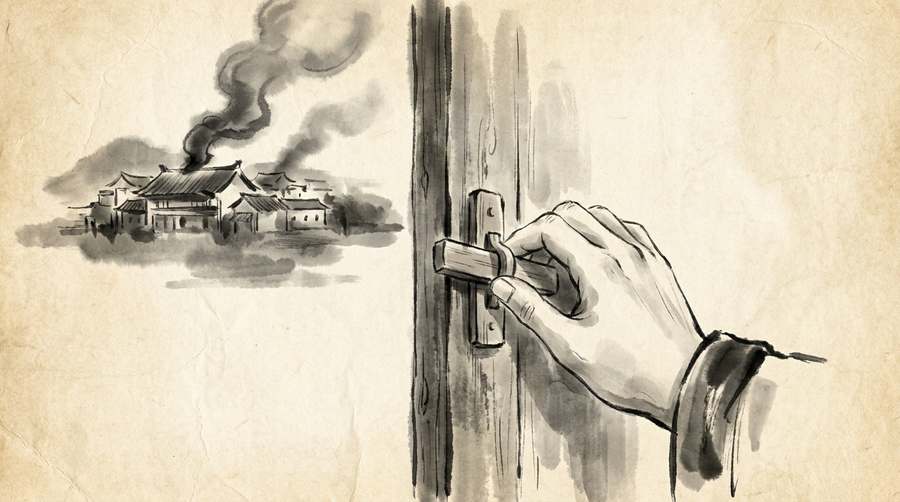
The principle
Every organisation has a fixed capacity to respond; a crisis consumes it. While a rival fights a fire — a scandal, a failed launch, a leadership feud — their attention, cash, and credibility are all committed inward. The stratagem is timing, not aggression: the same move that would be repelled on a normal day meets no defence today. The ethical line matters, though — this is about seizing a genuine opening, not manufacturing someone's misfortune, and reputations remember which one you did.
Historical origin
The principle is stated in Sun Tzu's Art of War (ch. 1): 'when he is in disorder, crush him.' The textbook historical case is Yue's destruction of Wu (473 BCE). King Goujian of Yue, once defeated and humiliated by Wu, waited through years of Wu's famines and its ruinous campaigns for hegemony in the north; when Wu was hollowed out, Goujian struck and extinguished it. Recorded in the Records of the Grand Historian and the Zuo Zhuan.
Applied today
When a competitor is mired in a recall, data breach, or funding crunch, that's the window to hire their best people, court their nervous customers, and take share — while their leadership is fully absorbed internally.
When a project or team is visibly failing and no one wants to touch it, a capable person who steps in calmly can gain outsized trust — value rises fastest exactly where others have fled.
In practice
Invented scenarios showing this stratagem at work — illustrations, not reports of real events.
The help that arrived during the outage
The status page acknowledged a problem at nine in the morning. By noon customers were receiving password-reset mails that read as a considerate response to the news, and the support line was competing with a number that was not the company's. The second wave was not run by whoever caused the first. It was run by people who simply read the status page.
Use it Name your single incident channel before you need it, so nobody else gets to offer your customers help first.
The offer that arrived too fast
Within days of a public setback, three approaches arrived: an acquisition at a steep discount, an expensive bridge facility, and a consultant promising a fast turnaround. All were framed as help and all were priced for desperation. The owners took none of them, and found ordinary terms available two months later once the panic had passed.
Use it Recognise when an offer is priced for your distress rather than your value, and buy time before deciding.
The migration they mentioned
An operations manager explained, helpfully, that the replacement platform had slipped two quarters and the current one would need extending. The revised quote arrived the next morning, twenty per cent higher and on a shorter term. Nothing about the value had changed overnight. What had changed was that the supplier now knew the buyer had nowhere else to go.
Use it Keep your own timeline pressure out of the room — a counterparty who learns you cannot leave will price that knowledge.
In the treatise
The two works are separate books, roughly a thousand years apart. A chapter link is a reading aid grounded on the line quoted beneath it — not a derivation.