隔岸观火
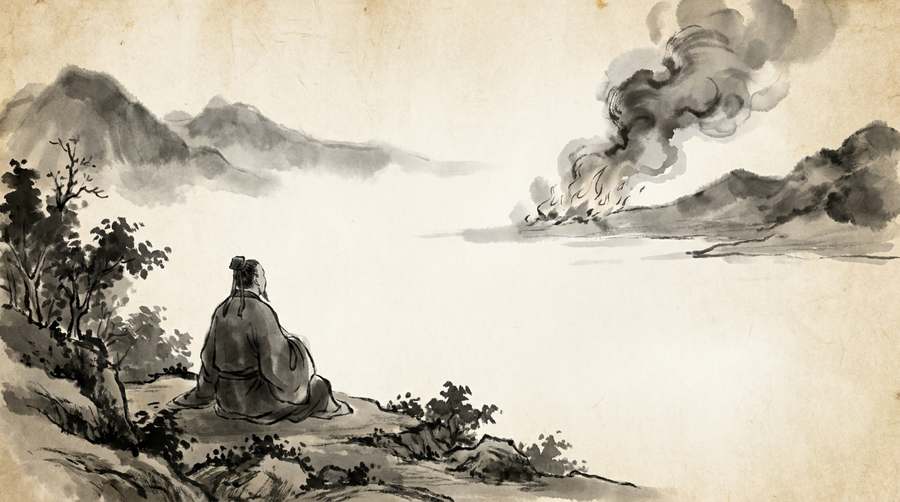
When your enemies are turning on each other, do not intervene — intervention would only unite them against you. Wait on the far bank; let their conflict burn down their own strength, then deal with what remains.
The principle
An outside threat makes rivals close ranks; remove it and their own frictions surface. When enemies are already fighting each other, the strongest move is often to do nothing visible — because your interference would give them a common cause and heal the very split working in your favour. Patience here is active, not passive: you watch, you keep options open, and you time your entry for after their conflict has spent them, not during it. The failure is meddling too early and gluing your enemies back together.
Historical origin
The classic case is Cao Cao's restraint in 207 CE, seven years after the Battle of Guandu. Having crushed Yuan Shao, Cao Cao declined to chase Yuan's surviving sons into Liaodong, against his officers' urging. His strategist Guo Jia reasoned that pursuit would force the warlord Gongsun Kang and the Yuan brothers to unite in fear — but left alone, their mutual suspicion would do the work. It did: Gongsun Kang killed the Yuan brothers himself and sent their heads to Cao Cao. Recorded in the Records of the Three Kingdoms.
Applied today
When two competitors enter a price war or public feud, resist joining. Hold your margins and your reputation, let them exhaust each other, and pick up the customers and talent that flee the wreckage.
When two colleagues are locked in a turf fight, taking a side usually makes you a target of both later. Stay useful and neutral; when it resolves, you're the one left standing and trusted.
In practice
Invented scenarios showing this stratagem at work — illustrations, not reports of real events.
Two providers, one adapter
Two providers spent a year undercutting each other on token pricing, and each announcement produced an internal proposal to migrate. The team migrated to neither. It kept one adapter, two providers configured, and a failover it had actually tested. When the discounting stopped and prices converged, the teams that had chased every cut were still finishing the previous migration.
Use it Keep a tested provider abstraction and let rivals subsidise each other — chasing every price move costs more than it saves.
The price war next door
Two competitors cut delivery fees to nothing and spent a year buying the same price-sensitive customers from each other. A third firm declined to match, kept its margins, and quietly hired from both as their budgets tightened. When the discounting ended, it was the only one of the three still able to fund a product roadmap.
Use it When rivals are destroying each other over the same ground, the winning move is often to not join in.
Someone else's week to lose
Two members of the same industry group reported an identical intrusion pattern within a fortnight of each other. A third firm, untouched, spent the following week doing nothing about its roadmap and everything about the one exposed service both reports had named. When the campaign reached it a month later, the door described in both reports was no longer there.
Use it Treat a peer's incident as your own early warning — the interval before it reaches you is the only free time you get.
Two offers shouting at each other
Two providers spent a year outbidding each other on three-month introductory rates, each of which expired into something entirely ordinary. A household that chased every switch spent its weekends on forms and identity checks for a difference measured in a few dollars a month. A neighbour who did nothing finished the year within a rounding error of them, and still had the weekends.
Use it Weigh what a switch costs in effort against what it actually returns — activity and advantage are not the same thing.
In the treatise
The two works are separate books, roughly a thousand years apart. A chapter link is a reading aid grounded on the line quoted beneath it — not a derivation.