借刀杀人
When you want a rival gone but cannot or should not act yourself, arrange for a third party to do it — supply the reason, the means, or the opportunity, and let someone else hold the knife.
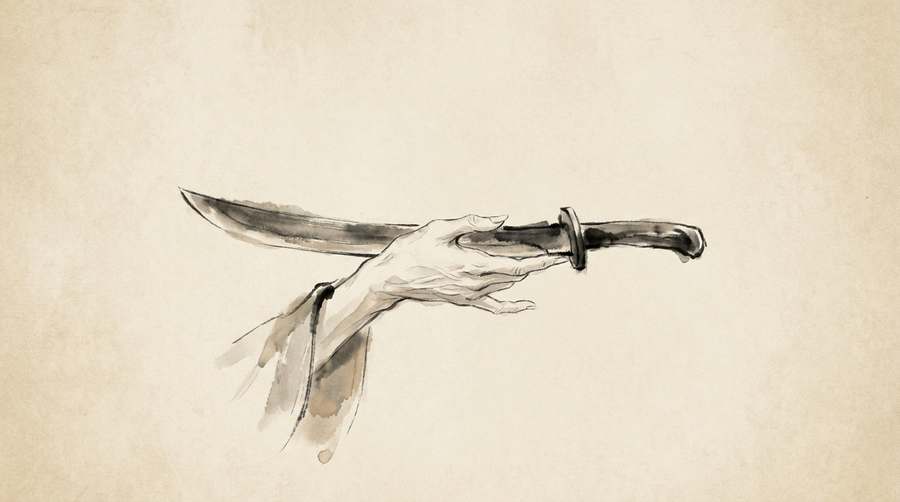
The principle
Some ends are better achieved through another's hand: it spares your strength, keeps your own reputation clean, and turns another party's motives into your instrument. The work is not force but arrangement — identify who already has reason to act, then remove their hesitation by feeding them information, opportunity, or provocation. Read defensively, this is the stratagem to fear most: when two parties push you to move against a third, ask who benefits if all three of you are weakened. The one holding the knife is rarely the one who wins.
Historical origin
A documented case is the death of Wu Zixu (484 BCE). The great statesman-general had made Wu powerful, but the state of Yue — secretly rebuilding to destroy Wu — bribed the Wu minister Bo Pi to poison King Fuchai against him. Fuchai, manipulated, ordered Wu Zixu to take his own life. Yue never lifted a blade against Wu's finest mind; it borrowed Fuchai's hand. A decade later Yue destroyed Wu. Recorded in the Records of the Grand Historian.
Applied today
Rather than attack a rival's proposal yourself, surface the objection a regulator, auditor, or key customer will inevitably raise — and let that third party's standard do the work, keeping your own hands clean.
Beware being the borrowed knife. When someone feeds you outrage and a convenient target, ask what they gain from your action — you may be the hand, not the beneficiary.
In practice
Invented scenarios showing this stratagem at work — illustrations, not reports of real events.
Independent, with context
The group was asked to run an independent comparison of two shortlisted vendors, given three weeks, and told which outcome the sponsor expected, offered as context rather than instruction. Only one of the vendors had a champion in the room. The group published its per-task scores in full alongside the summary. The summary was quoted selectively anyway, but the scores stayed where anyone could read past it.
Use it If asked to supply evidence for a decision already made, publish the raw results so your name is not the argument.
The report that did the blocking
A stream of well-written abuse complaints named a small customer's mail servers. The automation suspended the account within the hour, exactly as designed. The complaints came from a competitor who never touched anything and never needed to, because the provider's own enforcement did the work. The appeal took nine days to reach a human, by which time the customer had moved.
Use it Recognise when your own automated enforcement is being aimed for someone — require corroboration before an untrusted report triggers action.
The message from an aunt
Neither parent raised the subject directly. An aunt telephoned instead, at length, with a great deal of feeling about grandchildren and distance, and nothing of her own at stake in the outcome. The argument was won on her voice and lost on its merits, because the people who wanted it never had to make it themselves.
Use it When pressure arrives through a third party, take the question back to whoever holds the actual objection before answering.
The relative who called first
The application stalled on a guarantee, so the borrower's uncle was asked to make the case instead. He arrived warm, personal and slightly wounded, and the household spent an entire evening arguing with him rather than reading the schedule of charges. The party that actually wanted the signature never appeared in the conversation at all. It had simply lent out the argument to someone harder to refuse.
Use it Ask who benefits when pressure arrives through someone close — the person arguing is rarely the party being served.
The third quote
A design studio was invited to tender against an incumbent, spent three weeks on a full proposal, and lost. The same thing happened the following year. The invitation was genuine in form and hollow in purpose: the buyer needed a competing number to hold against a renewal, and the studio had supplied one twice, for free.
Use it Ask who holds the contract now and when it expires before bidding — an unwinnable tender is someone else's leverage.
In the treatise
The two works are separate books, roughly a thousand years apart. A chapter link is a reading aid grounded on the line quoted beneath it — not a derivation.