釜底抽薪
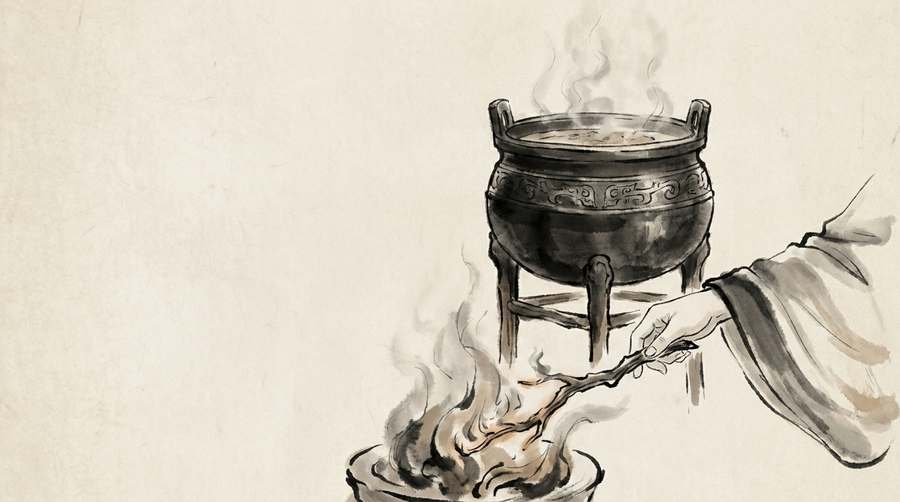
Don't fight the boiling water — pull out the fire beneath it. Instead of matching an enemy's visible strength, cut off the source that fuels it: their supply, their money, their morale, their base.
The principle
Visible power is an effect; something feeds it. Meeting a boiling enemy head-on spends your strength against their strength; removing the fuel makes the boiling stop by itself. The target is the base condition without which the enemy's force cannot be sustained — the supply line, the funding, the alliance, the belief that keeps their people fighting. It is patient and indirect: no dramatic clash, just the quiet removal of what everything else depends on. The art is identifying the true fuel, which is often unglamorous and lightly guarded precisely because no one thinks of it as the battle.
Historical origin
The image appears in Han-era writing — 'to stop the boiling, pull out the firewood.' The decisive military example is the Battle of Guandu (200 CE). Vastly outnumbered by Yuan Shao, Cao Cao learned the location of Yuan's grain depot at Wuchao and led a raid that burned it. With his supplies gone, Yuan Shao's far larger army — its 'fire' pulled out from under it — collapsed within days. Recorded in the Records of the Three Kingdoms.
Applied today
Don't out-market a stronger rival ad-for-ad. Cut off what feeds them — lock up a key supplier, win the channel they depend on, or undercut the single revenue line that funds everything else they do.
To end a recurring problem, treat its source, not its symptoms. Firefighting the same flare-up forever is exhausting; find the underlying condition feeding it and remove that instead.
In practice
Invented scenarios showing this stratagem at work — illustrations, not reports of real events.
The bill was a loop
Costs had quadrupled in five weeks and every proposal on the table was a discount: reserved capacity, a cheaper tier, a renegotiation. One engineer instrumented the calls instead. A retry wrapper written during a transient outage was reattempting every failure three times, and a nightly job re-embedded the entire corpus whether or not anything had changed. Neither had ever reached an agenda.
Use it Instrument call volume before you negotiate unit price — most cost blowouts turn out to be a loop, not a rate.
Discounting the wrong problem
Churn was answered for two quarters with retention discounts, which worked briefly and lowered the average price permanently. A support review then showed most cancellations came from accounts that had never finished the data import. Two engineers spent five weeks rewriting the importer. Cancellations fell further than the discounts had ever moved them, and the discounts were withdrawn.
Use it Find what keeps producing the problem before buying your way out of it — a discount treats the symptom every month.
Stop feeding the fire
Analysts spent a week blocking addresses as fast as the attacker rotated them. Nothing improved. The change came when they stopped chasing sessions and invalidated every token issued before the breach window, forcing a clean re-authentication. The attempts continued for days afterwards and all of them failed, because the fuel underneath had been removed rather than the flames fought.
Use it Remove what sustains the attack — rotate the secrets — instead of blocking each symptom as it appears.
The argument about the sink
Four months of reminders, one laminated rota and a genuinely unpleasant Sunday produced no lasting change in the state of the kitchen sink. What ended it was a second drying rack and halving the number of plates in the cupboard. The washing-up had never been a discipline problem. It had been a capacity problem wearing a discipline costume.
Use it Before enforcing a rule harder, remove whatever keeps producing the problem — most household friction is logistics, not character.
The wallet that kept refilling
For three months they cut individual purchases, argued about coffee, and ended each month roughly where they had started. The pattern broke when they found an automatic top-up quietly refilling a spending wallet whenever it ran low. Nothing had been overspent so much as continuously refuelled. Cancelling one standing instruction did more than the previous ninety days of restraint.
Use it Find the standing instruction behind the pattern — an automatic outflow beats willpower, and only one of the two can be switched off.
In the treatise
The two works are separate books, roughly a thousand years apart. A chapter link is a reading aid grounded on the line quoted beneath it — not a derivation.