偷梁换柱
Leave the outward structure standing while you quietly replace what actually holds it up. Swap out the core — the load-bearing people, terms, or premises — so a thing that looks unchanged now serves you, or falls when you choose.
The principle
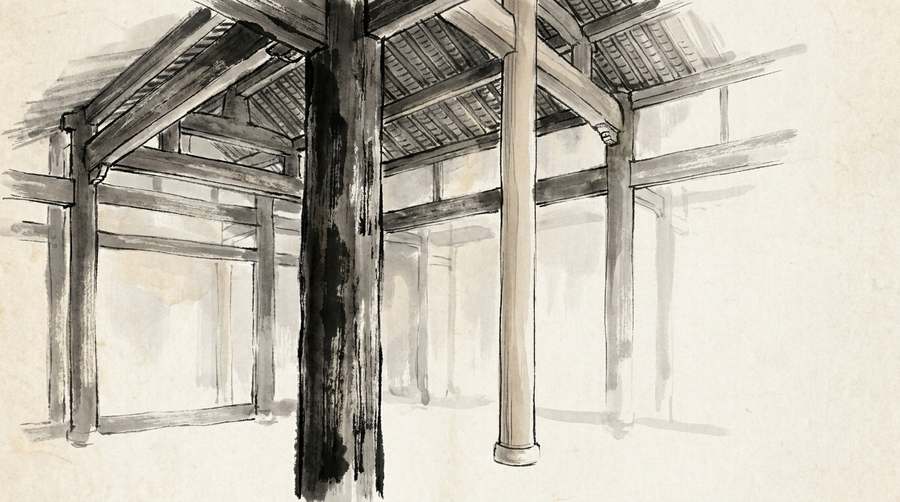
Every structure — an army, an alliance, a contract, an argument — rests on a few load-bearing elements: its 'beams and pillars.' You don't attack the visible façade; you quietly substitute those hidden supports. Replace the key people in an allied force with your own, and you command it without a battle. Alter the pivotal clause while the document reads the same, and the deal now tilts your way. Swap the unstated premise under an argument, and its conclusion changes while its words don't. Because the exterior is untouched, no one raises the alarm until the substitution is already load-bearing. The counter-discipline is to audit what's actually holding your structures up, not just that they still look intact.
Historical origin
A stark historical instance is the Shaqiu coup of 210 BCE. When the First Emperor of Qin died on tour, the chief eunuch Zhao Gao and the chancellor Li Si concealed the death and secretly replaced his final edict — which had named the elder son Fusu heir — with a forgery installing the pliable younger son Huhai and ordering Fusu's suicide. The imperial form was untouched; only the load-bearing content was swapped. The forged succession helped bring the Qin dynasty down within years. Recorded in the Records of the Grand Historian.
Applied today
Control something without a visible takeover by placing your people and terms into its load-bearing roles — the key hire, the pivotal clause, the default setting — while its brand and structure look untouched.
Protect yourself by auditing what actually holds your commitments up, not just that they look intact: reread the clause that changed, check who really owns the critical step, question the premise everyone assumes.
In practice
Invented scenarios showing this stratagem at work — illustrations, not reports of real events.
Same endpoint, different engine
Output quality drifted over a fortnight with no change on the team's side. The interface, the documentation and the version string were identical; the model behind them had been substituted for a cheaper one. Nothing was hidden and nothing was announced. The structure stood exactly as before while the beams inside it had been exchanged.
Use it Pin versions and keep a fixed evaluation set you re-run — an unchanged interface does not mean unchanged behaviour.
Same part number
The part number, the packaging and the datasheet were unchanged for four years. Field failures rose slowly enough to be blamed first on humidity, then on handling. A teardown eventually found a different alloy behind the same label. Nothing in the paperwork was false: the supplier had exercised a substitution clause nobody had read since the day it was signed.
Use it Test incoming goods against your own specification rather than the label — an unchanged part number is not an unchanged part.
The team that pitched
Three named specialists presented, answered the hard questions, and were the reason the contract was awarded. They appeared at the kickoff and then at nothing else. Delivery ran for eleven months on staff hired a fortnight before it started. From outside the structure looked identical — same firm, same plan, same invoices — while the load-bearing parts had been exchanged.
Use it Name the individuals in the statement of work and control substitutions there — a pitch team is not a delivery team.
The phone that lost signal on Friday
Her handset dropped to no service at four on a Friday afternoon, which read as a network fault worth ignoring until Monday. The number had been ported to another carrier. Nothing on the device was touched and no password was broken. The pillar holding up every one-time code had been replaced with one belonging to somebody else, behind an unchanged screen.
Use it Move high-value accounts off text-message codes, and treat an unexplained loss of mobile service as a security incident.
In the treatise
The two works are separate books, roughly a thousand years apart. A chapter link is a reading aid grounded on the line quoted beneath it — not a derivation.