李代桃僵
Trade a smaller loss for a larger win. Deliberately give up a lesser piece — a market, a battle, a round — where you were going to lose anyway, to secure the greater prize elsewhere.
The principle
Not all positions are worth defending equally. When some loss is unavoidable, the mistake is to spend your strength minimising it everywhere; the stratagem is to choose where to lose. Concede the point that costs least and matters least, and pour what you saved into the position that decides the whole. It requires seeing the board as a whole rather than clinging to each piece — and the courage to accept a visible, deliberate loss now for an invisible, larger gain later. Clinging to everything is how you lose the thing that counts.
Historical origin
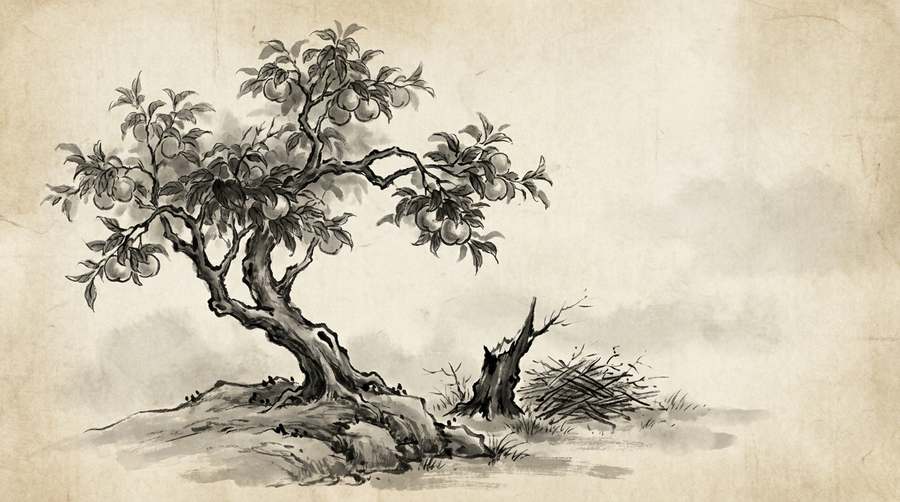
The name comes from an ancient folk poem in which a plum tree, attacked by insects at its roots, withers in place of the peach tree beside it. The classic strategic illustration is Tian Ji's horse race, advised by Sun Bin (4th c. BCE): racing three grades of horse against the king's, Sun Bin told Tian Ji to run his worst horse against the king's best — a certain, cheap loss — then win the next two matchups with his better horses against the king's lesser ones, taking the series two to one. Recorded in the Records of the Grand Historian.
Applied today
Exit a costly market you can't win to concentrate cash on the segment you can dominate. A deliberate, orderly retreat from the weak position funds victory in the strong one.
Drop the low-value tasks you're judged least on, even if it means visibly doing them worse, to free time for the one or two deliverables your reputation actually rests on.
In practice
Invented scenarios showing this stratagem at work — illustrations, not reports of real events.
They kept the dull one
Both projects were behind schedule: an autonomous purchasing agent and a dull classifier that sorted incoming email. Funding stretched to one. The team stopped the agent, which had by far the better story, and moved everyone onto the classifier, which already worked at ninety-four percent. A year later the classifier handled most of the queue. The agent was still the thing visitors asked about.
Use it When capacity is short, fund the boring thing that works over the ambitious thing that demonstrates — and record which you chose.
The line they let go
Two product lines were both losing money and the company could fund the recovery of one. Rather than starve both evenly, it closed the older line outright, moved its best people onto the other, and told customers plainly. The closed line was viable in principle. It was given up so that something else would survive intact.
Use it When resources cannot cover everything, choose deliberately what to lose — spreading them evenly loses both.
The service they switched off
With an intruder inside and the scope still unclear, the choice was to keep trading while investigating or to take the storefront down and protect the customer database. The storefront went dark for two days and the quarter suffered for it. The decision itself took eleven minutes, because it had been made a year earlier, on paper, by people under no pressure.
Use it Decide in advance which systems you will sacrifice to protect which data — that choice is unaffordable mid-incident.
The one they cancelled
Five obligations and enough energy for four had meant, in previous years, attending all five badly and arguing on the drive home from each. That December they cancelled the largest one outright, early, with a real apology and no invented excuse. The remaining four were the first in years that anybody in the house actually enjoyed.
Use it Decline one thing properly and early rather than half-attending everything — thin commitment costs more than a clean refusal.
In the treatise
The two works are separate books, roughly a thousand years apart. A chapter link is a reading aid grounded on the line quoted beneath it — not a derivation.