树上开花
Make a small force look formidable by dressing it in borrowed splendour. Display flags, dust, allies, momentum — signals of strength you don't truly possess — so the enemy overestimates you and dares not test what's really there.
The principle
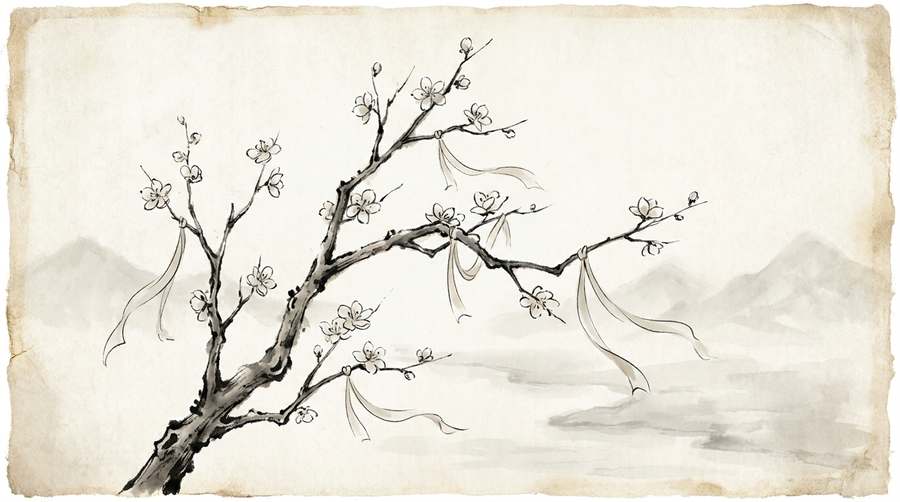
A bare tree can be made to look like it's in full bloom by tying on false blossoms; a weak position can be made to look strong by borrowing the trappings of power. You array more banners than you have troops, raise dust to suggest a great host, associate yourself with impressive allies or numbers, and project unstoppable momentum. The enemy, unable to cheaply verify what's real, prices in the appearance and treats you as far stronger than you are — deterring an attack, winning a concession, or buying time. It works precisely because testing the bluff looks risky. Its limit is exposure: a display that invites close inspection, or is called, collapses fast — so the false blossoms must deter engagement, not provoke it.
Historical origin
The vivid example is Zhang Fei at the Changban bridge (208 CE). Covering Liu Bei's retreat with only a couple dozen horsemen, Zhang Fei had them tie branches to their horses' tails and gallop through the woods behind him, raising a great cloud of dust to suggest a large hidden force. He then stood alone at the bridge and roared his challenge. Cao Cao's advancing army, reading the dust as an ambush by a much larger force, hesitated and pulled back — the bare tree had been made to bloom. Recorded in the Records of the Three Kingdoms.
Applied today
A small startup can borrow credibility to punch above its weight: marquee logos, a notable advisor, a polished launch, visible traction. The signals price you as bigger — just be ready before the display invites a close look.
Project alternatives you may not fully have — other bidders, other options, a walk-away — to shift the other side's estimate of your leverage. The appearance of strength changes their offer before anyone tests it.
In practice
Invented scenarios showing this stratagem at work — illustrations, not reports of real events.
The demo that scaled beautifully
The demonstration was flawless: instant responses, clean answers, an impressive dashboard. It ran on eleven curated examples. In the buyer's own pilot, with real and messy inputs, latency tripled and a third of the answers needed correction. Nothing shown had been false. The display had simply been dressed to look like the whole tree.
Use it Insist on a pilot with your own data — evaluate what the thing does unrehearsed, not what it displays.
The wall of logos
The office was impressive, the logo wall was long, and the proposal described a support organisation spanning three time zones. A reference call established that the three time zones were three individuals, and that most of the logos were pilots which had quietly ended. Nothing stated had been untrue. The blossoms had been tied onto the branches for the visit.
Use it Ask how many people will actually staff your account, and call two references you sourced yourself rather than theirs.
Everything about it was real except the domain
The page carried a valid certificate, the correct logo, a genuine office address, the names of three real staff lifted from a conference programme, and a working privacy-policy link pointing at the company's own site. Every signal a careful person checks was authentic, because each had been borrowed from somewhere authentic. Only the domain, one character adrift, belonged to someone else.
Use it Legitimacy signals are cheap to borrow — check the domain itself, because the padlock, logo and staff names prove nothing.
The number on the first slide
The headline figure was accurate: it described a real result over a real period. That period had been chosen afterwards, began at a low point, ended at a high one, and excluded charges. Every slide that followed inherited its optimism from the first. Nothing shown was false anywhere. The tree had simply been arranged to be in flower on the night.
Use it Ask what period a figure covers, who chose that period, and what it excludes, before letting it anchor everything after.
In the treatise
The two works are separate books, roughly a thousand years apart. A chapter link is a reading aid grounded on the line quoted beneath it — not a derivation.