空城计
When you are too weak to defend and cannot flee, show no fear at all. Open the gates, project perfect calm — and let the enemy's own caution fill the silence with the trap they assume you've laid.
The principle
This is a bluff of last resort, used when you are genuinely weak and normal defence or escape is impossible. Instead of showing the panic that would confirm your weakness, you display the opposite: calm, openness, apparent invitation. A cautious enemy cannot believe you would leave yourself exposed unless you held a hidden advantage, so your very defencelessness reads as confidence, and confidence reads as a trap. Their own imagination does the defending. The stratagem is pure psychology and works only against a thoughtful, risk-averse opponent who has time to second-guess — a reckless or overwhelming foe simply walks in. It is a desperate gamble, not a reliable defence: if the bluff is called, there is nothing behind it.
Historical origin
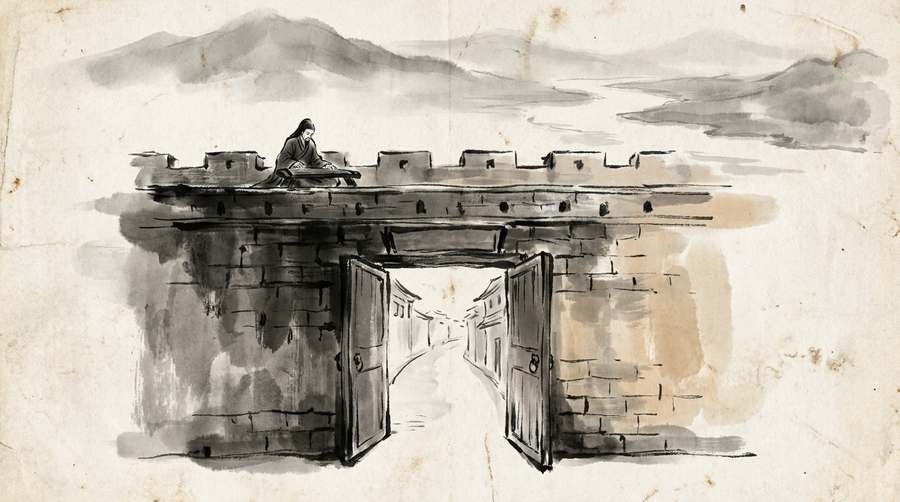
Three accounts stand behind this stratagem, and the famous one is the least defensible. Zhuge Liang alone on the wall at Xicheng, incense lit and qin in hand, playing on until a suspicious Sima Yi turns his army around, is a scene from the fourteenth-century novel Romance of the Three Kingdoms, chapter 95. Neither the zither nor Xicheng appears in any earlier source — and the novel never calls the trick an empty fort at all. That name arrives centuries later, with the stratagem compilation.
What does survive from the fourth century is Guo Chong's account, and it survives only because Pei Songzhi quoted it in his commentary of 429 in order to demolish it. The place is Yangping, not Xicheng, and there is no music. Zhuge Liang, left holding the town with ten thousand men against a reported two hundred thousand, orders the banners laid flat and the drums silenced and no man to step outside the tents — then has all four gates thrown open and the ground swept and sprinkled. Sima Yi, who had always taken him for a cautious commander, reads the exposure as a concealed ambush and withdraws north into the hills.
Pei Songzhi rejects it on four grounds. Yangping is in Hanzhong, and at that time Sima Yi was military governor at Wancheng — the two men never faced each other there at all. A general who suspects an ambush entrenches and holds; he does not simply run. Wei Yan's own biography records that Zhuge Liang refused him even ten thousand men for an independent march, so he would hardly have handed him the main army and kept himself lightly defended. And Guo Chong supposedly told the story to the Prince of Fufeng — disparaging Sima Yi to the face of his own descendant, which propriety would not permit. "Hence we know," Pei concludes, "that everything this book cites is false."
The same device, told of a different man, has the better claim. The Biography of Zhao Yun — which Pei Songzhi quotes without objecting to it — has Zhao Yun pursued back to his camp on the Han River. The garrison commander Zhang Yi wants the gates barred; Zhao Yun throws them wide open instead, lowers the banners and silences the drums. Cao Cao's men suspect an ambush and pull back, at which point Zhao Yun has the drums thundered and crossbows loosed into their backs. They trampled one another, and many drowned in the river. Liu Bei, walking the ground the next morning: "Zilong is all courage, head to foot."
Earliest and soberest is Li Guang, in the Records of the Grand Historian. Caught far from support with a hundred horsemen by a large Xiongnu force, he rode toward them, halted some two li short, and ordered every man to dismount and unsaddle. His riders protested that the enemy was close and numerous. "They expect us to run," he said. "Unsaddling shows we will not — and that hardens what they already believe." The Xiongnu did not attack.
Sources
Primary texts, linked to the Chinese originals. The provenance of the Thirty-Six itself is a separate question — see the collection page.
- Records of the Three Kingdoms 《三國志》 35 (Shu 5, Zhuge Liang), Pei Songzhi's commentary of 429, quoting Guo Chong's Three Matters together with Pei's own rebuttal The Yangping account, and the four grounds on which it is rejected.
- Records of the Three Kingdoms 《三國志》 36 (Shu 6, Zhao Yun), Pei Songzhi's commentary quoting the Biography of Zhao Yun 《雲別傳》 The open gates at the Han River — quoted by Pei Songzhi without objection, unlike the Yangping story.
- Records of the Grand Historian 《史記》 109, Biography of General Li (Li Guang) Dismounting and unsaddling before the Xiongnu — the earliest and least contested instance.
- Romance of the Three Kingdoms 《三國演義》, chapter 95, 「Ma Su rejects counsel and loses Jieting; the Marquis of Wu plays the qin and repels Zhongda」 The scene everyone knows — Xicheng, the incense, the zither. The novel is the source of all three, and never calls it an empty fort.
Applied today
When you actually hold a weak hand, visible panic confirms it. Composed transparency — calmly opening your books, inviting scrutiny — can make the other side suspect you have strength in reserve and hesitate to push.
Use it only as a last resort, and know the risk: the empty-fort bluff wins solely against a cautious mind that stops to think. Against someone who simply acts, there is nothing behind the open gate.
In practice
Invented scenarios showing this stratagem at work — illustrations, not reports of real events.
Ask for the dated report
The assurance page listed a safety policy, an evaluation framework, a red-team cadence and three committee names. It was detailed enough that most buyers read it and stopped there. One buyer asked for the dated report from the most recent red-team round. This vendor produced it within a day and it was thorough. Two others on the shortlist did not reply.
Use it Ask any confident assurance page for its most recent dated artefact — the request costs nothing and separates posture from practice.
The gate left open
A small security team could not afford round-the-clock monitoring, so they published their patching cadence, their disclosure address and a monthly advisory. Opportunists scanning for soft targets read the confidence and moved on to quieter doors. The team was thinly staffed the whole time. What deterred the casual attacker was not depth of defence but the visible appearance of attention.
Use it Visible diligence deters opportunists — but never mistake looking defended for being defended.
Nobody home, apparently
Before the trip they asked a neighbour to move the bins each week, put two lamps on a timer, and left a coat hanging where it could be seen from the front door. The house was empty the entire time and looked continuously inhabited. What turns away a casual opportunist is rarely the lock; it is the impression of somebody about to walk in.
Use it Deter casual opportunism with visible signs of occupancy — but never let the appearance stand in for the actual lock.
Comfortable either way
Asked to improve its price, the supplier said calmly that it was comfortable either way and had capacity committed elsewhere. The buyer conceded within the week. Two months later the same supplier was quoting hard for work of exactly that shape. The composure had been genuine; the alternatives had not. Nobody had asked which customer, what volume, or by when.
Use it Test a claimed alternative with specifics — a counterparty who cannot name their other option probably does not have one.
In the treatise
The two works are separate books, roughly a thousand years apart. A chapter link is a reading aid grounded on the line quoted beneath it — not a derivation.