苦肉计
People trust suffering. By visibly harming yourself or your own side — taking a real loss, a demotion, a punishment — you make a deception credible, because no one suspects the person who has evidently been hurt by their own camp.
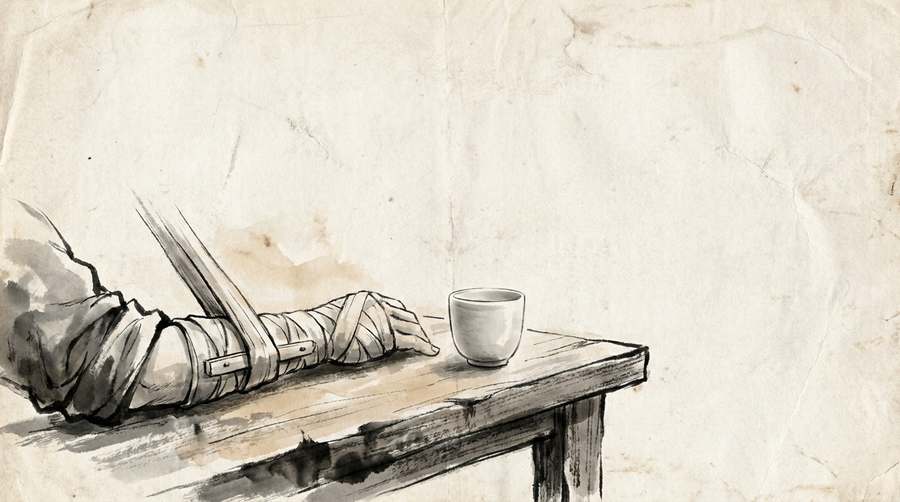
The principle
Deceptions usually fail on the question 'why would he be on our side?' The self-injury ploy answers it in advance: the deceiver arrives visibly wronged by his own people — beaten, demoted, disgraced — so his defection or grievance looks entirely genuine, and the target lowers his guard. The cost is real pain, real loss, willingly borne, which is exactly what makes it convincing; a wound one would never inflict on oneself carries the ring of truth. It demands nerve and complete commitment, because a half-hearted or obviously staged sacrifice is worse than none — it confirms the plot. The same reasoning is a warning: the defector who conveniently shows up freshly injured by the very side he's leaving deserves the most suspicion, not the least.
Historical origin
The classic association is Huang Gai at the Battle of Red Cliffs (208 CE). The historical record is clear that Huang Gai proposed the fire attack on Cao Cao's chained fleet and sent a letter feigning surrender to get his fire-ships close — that feigned defection is genuine history. The vivid detail of Zhou Yu first having Huang Gai flogged before the army, so that his 'defection' would look like the act of a bitterly punished man, is the memorable elaboration of the Romance of the Three Kingdoms. Either way it captures the principle: a visible wound makes the deception believable. The core event is recorded in the Records of the Three Kingdoms.
Applied today
A visible, costly concession early builds the trust that carries the rest of a deal. Taking a real, evident loss up front signals sincerity in a way words cannot — the other side stops looking for the catch.
Read the reverse with suspicion: the vendor, partner, or hire who arrives conspicuously wronged by your own rival — full of grievance and inside information — may be the most calculated approach of all, not the most trustworthy.
In practice
Invented scenarios showing this stratagem at work — illustrations, not reports of real events.
The candid disclosure
The post-mortem was unusually candid: a precise timeline, an apology without qualifiers, and one small flaw described in careful detail. It was widely praised and circulated for a week. Published in the same fortnight, and much shorter, was a notice that prompt logs had been retained well beyond the stated period. Reviewers read the candid document twice and the retention notice not at all.
Use it Read what a vendor published alongside its praised disclosure — candour about a small failure moves attention off a larger one.
The very public apology
He opened the review by taking full responsibility, in detail, at considerable length. The room softened, the harder questions stopped, and the two process failures that had actually caused the outage were never examined. The contrition was sincere enough. It had also, without anybody intending it, absorbed the entire hour that was supposed to produce fixes.
Use it Separate accountability from analysis — accept the fault, then insist the review carries on to the causes anyway.
The caller who blamed himself
He opened by admitting he had already sent the file to the wrong address, sounded genuinely frightened of losing his job, and asked only for help correcting his own mistake. Almost nobody suspects a person confessing a failure. The agent, wanting to help, confirmed which internal address the file should have gone to, and then that it had arrived.
Use it An admission of fault is a persuasion technique too — sympathy does not replace verification, and shame plus urgency is a pattern.
What it cost them to agree
The account manager left the room to call his director, returned looking harassed, and said he had been authorised to hold the price but had taken it personally. The buyer, moved, dropped two remaining requests. The price hold had been budgeted three weeks earlier and appeared in the supplier's own forecast. The discomfort was the only part that had been improvised.
Use it Value a concession by what it costs the other side, not by how reluctantly it arrives — reluctance is free to perform.
In the treatise
The two works are separate books, roughly a thousand years apart. A chapter link is a reading aid grounded on the line quoted beneath it — not a derivation.