

Ask our working-days calculator how many working days Singapore has in 2026 and, until this week, it told you 252. It’s 251.
It also had Hari Raya Puasa on Friday 20 March. The Ministry of Manpower has it on Saturday 21 March. And while it knew that National Day falling on a Sunday earns the following Monday, it had missed that Vesak Day and Deepavali do the same — so two days off were being counted as working days.
Those are small errors with a common cause. Scheduling anything across this region means running three calendars at once, and only one of them stays where you left it.
Three calendars, one working week
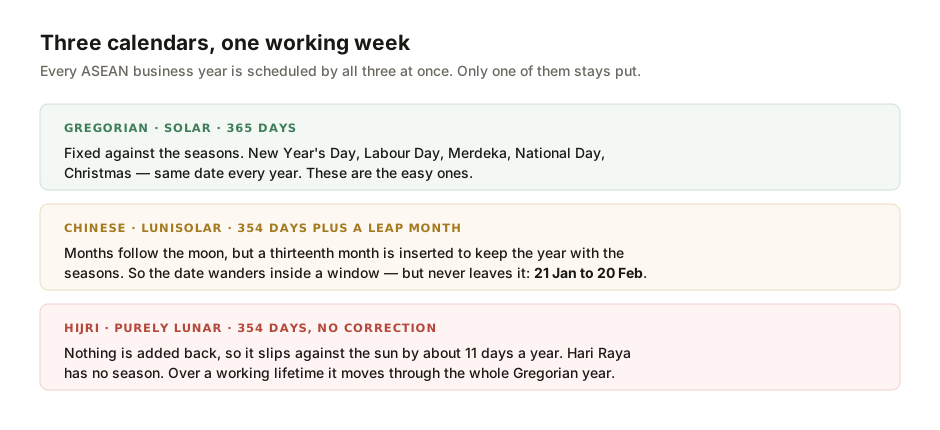
The Gregorian calendar is solar. Its year tracks the Earth's orbit, so Merdeka Day is always 31 August and Christmas is always 25 December. These are the holidays nobody has to think about.
The Chinese calendar is lunisolar, which is the more interesting engineering problem. Its months follow the moon — each begins at a new moon — but twelve lunar months come to about 354 days, eleven short of a solar year. Left alone, the new year would march backwards through the seasons. So a thirteenth month is inserted in some years to pull it back into step.
This system produces a date that wanders but never escapes. Chinese New Year is the second new moon after the winter solstice, confining it to the window 21 January to 20 February. In 2026 it lands on 17 February — late in the range, which is why the year feels as though it starts twice. Our lunar/solar date converter will show you the same date in both systems, which is the quickest way to see the drift for yourself.
The Hijri calendar is purely lunar, and this is the part that catches people out. It has the same twelve lunar months and adds nothing back. So it slips against the sun by roughly eleven days every year, permanently. Hari Raya has no season. Over a working life it travels through the entire Gregorian year and returns.
This is why "when is Hari Raya?" has no rule of thumb, while "roughly when is Chinese New Year?" does.
And a fourth thing: moon-sighting
Even the Hijri arithmetic does not settle the date. Islamic months begin when the new crescent is sighted, and jurisdictions differ on whether sighting is by observation or calculation, and on whose sighting counts.
Which is why the same festival can fall on different days on either side of a border, and why every published Malaysian calendar carries a caveat that Islamic dates are subject to confirmation. If you are scheduling around Hari Raya more than a few months out, treat the date as provisional. It usually holds. It does not always.
The day off you get, and the one you do not
Now the part that decides your actual working year, and the part our calculator was getting wrong.
When a public holiday falls at a weekend, some of them come back as a weekday and some do not, and the rule differs by country. Singapore compensates Sunday holidays with the following Monday, and Saturday holidays not at all. Malaysia grants replacement days more broadly, but which states observe them varies.
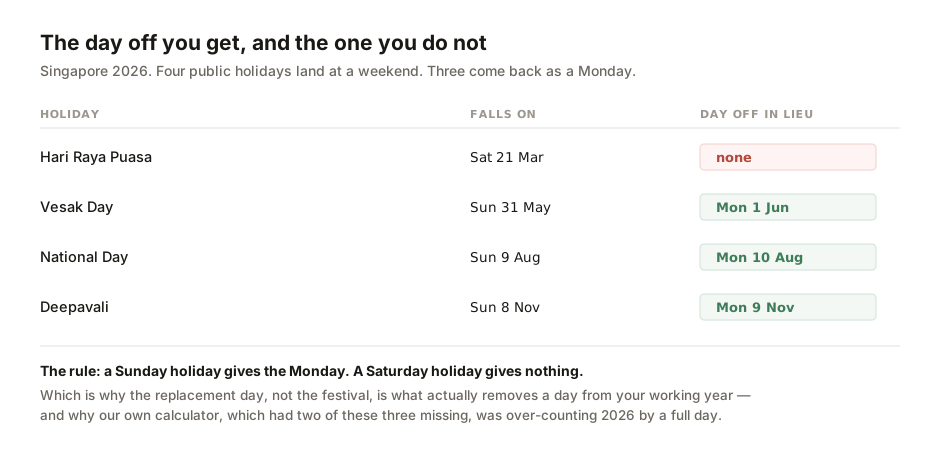
Four of Singapore's eleven public holidays fall at a weekend in 2026. Three return as Mondays. One — Hari Raya Puasa, on a Saturday — simply vanishes.
The replacement day, not the festival itself, is what removes a day from the working year. That was the distinction our tool was missing. A calendar of festivals isn’t a calendar of days your counterparty is unreachable.
Malaysia is harder still, because holidays there are federal plus state. Deepavali 2026 falls on Sunday 8 November; most states grant the Monday, but Kedah, Kelantan, Sarawak and Terengganu do not. There is no single national answer, and any tool that gives you one — ours included — is offering an approximation.
The holiday is two days. The disruption is two months.
This is where the calendar becomes a plan.
Chinese New Year closes factories for something like two to four weeks. But the closure is the middle of the story, not the whole of it. Output tapers for two or three weeks beforehand as workers begin travelling, and capacity returns unevenly over two or three weeks afterwards as they come back — some of them to different employers.
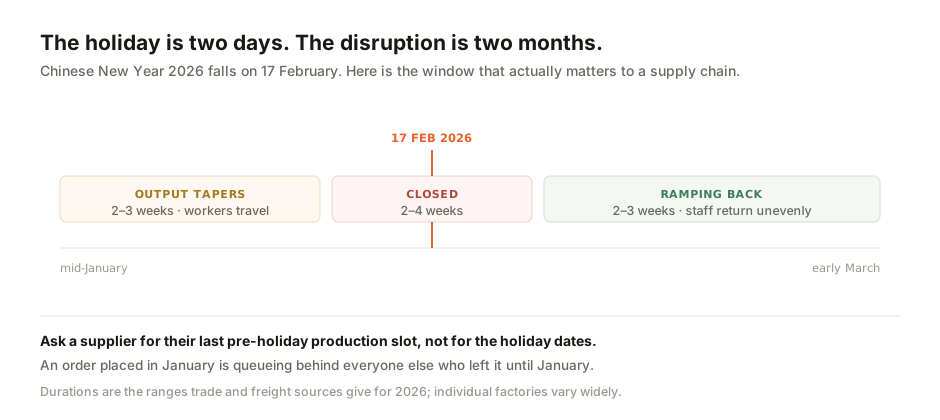
Trade and freight sources put the practical window at six to eight weeks around the holiday — for 2026, roughly mid-January to early March. The useful question for a supplier isn’t "when are you closed?" but "when is your last production slot before the break, and will my order ship before it or wait for the ramp?"
An order placed in January is queueing behind everyone else who also left it until January.
What this does to a business year
Stack the calendars and some practical consequences fall out that no single country's holiday list would show you.
- February 2026 is short twice over. Chinese New Year on 17–18 February takes two weekdays out of an already short month, on top of the pre-holiday taper. Anything with a month-end deadline in February is being asked to happen in about three usable weeks.
- Late March is thin across the region. Hari Raya Aidilfitri falls on 21–22 March 2026, with additional and replacement days in Malaysia and Indonesia. Approvals, customs clearance and anything requiring a signature slow down on both sides of the Causeway at once.
- Payment cycles stall, they do not disappear. Invoices dated into a long break are not paid late so much as paid on the far side of it. If your terms are 30 days and the 30th day lands inside a shutdown, you are financing the gap.
- The overlap is the risk. A supplier in one market, a bank in another and a customer in a third can each be closed on different days for different calendars. The question isn’t who has a holiday, but which days all three are simultaneously available.
Holiday data goes stale, and quietly
One more thing the audit turned up, and it generalises well beyond our own tool.
Our working-days calculator carries holiday tables for 2025 and 2026. Ask it about a range in 2027 and, until this week, it answered with confidence: 261 working days for Malaysia, with zero holidays deducted — roughly twelve too many. Nothing in the result said so. The only mention of the limit was a static note that appeared identically whether or not it applied to your dates, which is a footnote rather than a warning.
It is July 2026. Anyone setting next year's contract dates, notice periods or delivery schedules is asking exactly that question. The tool now says plainly when your range runs past its data, and the number it gives you is an over-estimate.
A holiday calendar is a perishable good. Gazettes are published a year or so ahead, Islamic dates are confirmed later still, and any table more than about eighteen months old is a guess wearing a suit. Check the date the source was published, not just the dates in it.
What to actually do
- Plan around windows, not days. For Chinese New Year, block out mid-January to early March. For Hari Raya, allow the week either side. The festival dates are the least useful part of the calendar — our festival countdown gives the dates, but the window around them is what you schedule against.
- Count working days per market, then intersect. Our working-days calculator takes a country and a range. Run it for each party to a deadline and use the worst answer, not the average.
- Treat Islamic dates as provisional beyond a few months. They are confirmed by sighting. Published calendars say so; contracts often do not.
- Check the replacement day, not the festival. A holiday on a Saturday may cost you nothing in Singapore and a Monday in Malaysia. The in-lieu rule is where the working days actually go.
- Verify the gazette for anything contractual. State holidays, in-lieu days and late declarations move. For a penalty clause or a statutory deadline, no third-party calendar is good enough — including ours.
Three calendars run at once here. The Gregorian is fixed to the sun. The Chinese is lunisolar, with lunar months corrected by an occasional thirteenth; this lets Chinese New Year wander inside the 21 January–20 February window (it’s on 17 February in 2026). The Hijri is purely lunar, so it slips about eleven days earlier each year and Hari Raya has no season. Hijri dates are also settled by moon-sighting, which is why they can differ across a border and are provisional until confirmed.
What decides your working year, though, isn’t the calendar maths. It’s the in-lieu rule. Singapore returns a Sunday holiday as the following Monday and gives nothing back for a Saturday one; Malaysia grants replacements more widely but state by state. Four of Singapore's eleven 2026 holidays fall at a weekend and three come back — which is exactly what our own calculator was getting wrong, along with the date of Hari Raya Puasa. And for anything with a supply chain attached, remember the ratio: a two-day holiday produces a six-to-eight-week disruption window. Plan the window.
The demand side of the same year is covered in house calculations for a tropical climate, which deals with the electricity your building uses while everyone is away — and, in Malaysia, the monthly threshold that makes the last kilowatt-hour of a billing period cost seventy times the first.
- Ministry of Manpower — Public Holidays for 2026, via data.gov.sg (dataset updated 3 July 2026). Source for every Singapore date used here, including Hari Raya Puasa on Saturday 21 March and the in-lieu Mondays of 1 June, 10 August and 9 November. Accessed 29 July 2026.
- Malaysian public-holiday listings for 2026, cross-checked across publicholidays.com.my and malaysiapublicholiday.com, for the Aidilfitri and Deepavali dates and the states that do and do not observe the replacement days. The two disagree on whether the additional Aidilfitri day falls on 20 or 23 March, which is recorded here rather than resolved. Accessed 29 July 2026.
- The lunisolar rule — Chinese New Year as the second new moon after the winter solstice, confining it to 21 January–20 February — from standard references on the structure of the Chinese calendar. Accessed 29 July 2026.
- Chinese New Year 2026 production timings: trade and freight sources converging on a 2–4 week closure inside a 6–8 week disruption window from mid-January to early March. Individual factories vary widely; the figure is a planning range, not a schedule. Accessed 29 July 2026.
- Our own audit of the working-days calculator, 29 July 2026, which found the wrong Hari Raya date, two missing in-lieu Mondays and the silent out-of-range behaviour described above. All three are fixed; the corrected 2026 count for both Singapore and Malaysia is 251 working days.
Public holidays are gazetted per country and, in Malaysia, per state; Islamic dates are subject to confirmation. Everything here is July 2026. For anything contractual, check the gazette.