Ask someone in Singapore or Kuala Lumpur what animal they are and you will usually get an instant answer — Rabbit, Dragon, Horse — followed, if you press, by a small hesitation about the year. "I was born in January, so I might be the animal before." That hesitation points to the calendar mechanics this guide explains. The 生肖 shēngxiào, the twelve-animal Chinese zodiac, is one of the most widely recognised cultural systems on earth, and also one of the most widely half-understood. This guide explains how the system is built—the twelve animals, the calendar grid they sit on, the five elements, and the traditional rules of compatibility. It describes the structure of a cultural practice, without claiming that any of the readings come true.
The zodiac's personality and compatibility readings are cultural tradition and folklore, not science. There is no evidence that a birth year shapes character or decides who suits whom, and nothing in this article predicts anyone's life. Where we describe what the tradition takes an animal or a pairing to mean, that meaning belongs to the tradition and its practitioners. What is checkable is the machinery: a calendar older than most nations, a tidy piece of arithmetic recycling every sixty years, and a boundary line that trips up most explainers.
The twelve animals, and the hours they divide
The everyday name for the zodiac is 生肖 shēngxiào, roughly "birth likeness"; you will also hear 属相 shǔxiàng. The twelve run in a fixed order — Rat, Ox, Tiger, Rabbit, Dragon, Snake, Horse, Goat, Monkey, Rooster, Dog, Pig — and that order is load-bearing, because each animal is bolted to an Earthly Branch 地支 dìzhī, and the branches are much older than the animals riding on them.
The twelve branches are an ancient time-and-space grid: twelve double-hours of the day, twelve months, twelve compass directions, and the roughly twelve-year loop of Jupiter across the sky. Each branch governs a two-hour window called a 時辰 shíchén, and the first of them, the Hour of the Rat, opens at 23:00. The branch characters turn up on Shang-dynasty oracle bones — over three thousand years ago — for counting days, which makes this one of the oldest timekeeping systems still in use. The animals were mapped onto that pre-existing grid later; the famous "Great Race" story, in which the Rat rides across the river on the Ox and jumps ahead at the finish, is folklore invented to explain an order that already existed, not the reason for it.
| # | Animal | Simp. | Trad. | Pinyin | Branch 地支 | Double-hour 時辰 |
|---|---|---|---|---|---|---|
| 1 | Rat | 鼠 | 鼠 | shǔ | 子 zǐ | 23:00–00:59 |
| 2 | Ox | 牛 | 牛 | niú | 丑 chǒu | 01:00–02:59 |
| 3 | Tiger | 虎 | 虎 | hǔ | 寅 yín | 03:00–04:59 |
| 4 | Rabbit | 兔 | 兔 | tù | 卯 mǎo | 05:00–06:59 |
| 5 | Dragon | 龙 | 龍 | lóng | 辰 chén | 07:00–08:59 |
| 6 | Snake | 蛇 | 蛇 | shé | 巳 sì | 09:00–10:59 |
| 7 | Horse | 马 | 馬 | mǎ | 午 wǔ | 11:00–12:59 |
| 8 | Goat | 羊 | 羊 | yáng | 未 wèi | 13:00–14:59 |
| 9 | Monkey | 猴 | 猴 | hóu | 申 shēn | 15:00–16:59 |
| 10 | Rooster | 鸡 | 雞 | jī | 酉 yǒu | 17:00–18:59 |
| 11 | Dog | 狗 | 狗 | gǒu | 戌 xū | 19:00–20:59 |
| 12 | Pig | 猪 | 豬 | zhū | 亥 hài | 21:00–22:59 |
Two footnotes on the names. Only four animals change between simplified and traditional script — Dragon 龙/龍, Horse 马/馬, Rooster 鸡/雞, and Pig 猪/豬 — while the other eight are written the same way in both, as are all twelve branch characters. And several English names are unsettled: the eighth sign 羊 yáng is rendered as Goat, Sheep, or Ram depending on who is translating, the tenth is Rooster or Chicken, and the twelfth is Pig or Boar. None of that is a mistake; the Chinese character is the fixed point, and English just has more words for the same barnyard. If you only want to know which animal rules a given year, our Chinese Zodiac Year Lookup maps years to animals directly.
Two year-boundaries, and why they differ
The calendar mechanics are the technical heart of the guide. The most common error is thinking the zodiac animal changes on 1 January. It doesn't. The usual correction—that it changes at Chinese New Year—stops a step too early, because two different year boundaries are in play.
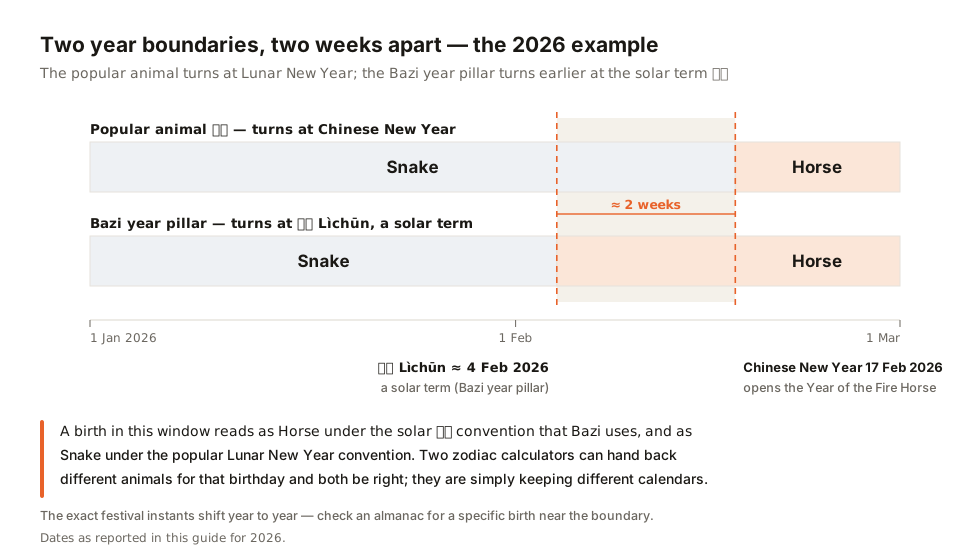
The popular animal — the "what animal am I" question, the 生肖 — rolls over at Chinese New Year (Lunar New Year), a lunar date that drifts between late January and mid-February. A separate system, 八字 bāzì (the Four Pillars used in Chinese astrology), turns its year pillar at 立春 Lìchūn, the "Start of Spring," which is the first of the twenty-four solar terms and falls around 3–5 February every year. Lìchūn is fixed by the sun's position, not the moon's, so the two boundaries can sit almost two weeks apart. As Wikipedia puts it, "for the starting date of a zodiac year, there are two schools of thought in Chinese astrology: Chinese New Year or the start of spring."
Take 2026 to see why this matters. Lìchūn falls around 4 February 2026, while Chinese New Year falls on 17 February 2026, opening the Year of the Fire Horse. Someone born between roughly 4 and 16 February 2026 lands in the gap. Under the solar 立春 convention that Bazi uses, the year has already turned, so that birth counts as a Horse. Under the popular Lunar New Year convention, the lunar year has not turned yet, so the same birth is still a Snake. Two zodiac calculators can hand back different animals for that birthday and both be right; they are simply keeping different calendars. (The exact festival instants shift year to year — treat the February dates here as the standard reported figures and check an almanac for a specific birth near the boundary.)
Our Chinese Zodiac Calculator makes a disclosed simplification. It reads the animal from the calendar year and its own notes tell you so — the zodiac year really begins at Chinese New Year, late January to mid-February, so anyone born in those early weeks may fall under the previous animal, and the tool flags exactly that. It uses the calendar year as a disclosed shortcut rather than pretending to resolve the lunar boundary for you. If you want the solar-term machinery in full — how 立春 defines the Bazi year and why it reshuffles late-winter birthdays — our companion piece, What Bazi Actually Is, walks through it, and Bazi Compatibility Match works from that fuller eight-character chart rather than the year animal alone.
Five elements, sixty years: how an animal gets its flavour
A birth year carries more than an animal; in the full tradition, it also has one of the Five Elements (五行 wǔxíng): Wood 木, Fire 火, Earth 土, Metal 金, or Water 水. That is why you hear compound names like Wood Dragon or Metal Rat. The element does not come from the animal. It comes from a second wheel turning alongside the branches: the ten Heavenly Stems 天干 tiāngān, each of which carries one element and a polarity, yang or yin.
| Stem 天干 | Pinyin | Element 五行 | Polarity |
|---|---|---|---|
| 甲 | jiǎ | Wood 木 | Yang |
| 乙 | yǐ | Wood 木 | Yin |
| 丙 | bǐng | Fire 火 | Yang |
| 丁 | dīng | Fire 火 | Yin |
| 戊 | wù | Earth 土 | Yang |
| 己 | jǐ | Earth 土 | Yin |
| 庚 | gēng | Metal 金 | Yang |
| 辛 | xīn | Metal 金 | Yin |
| 壬 | rén | Water 水 | Yang |
| 癸 | guǐ | Water 水 | Yin |
Pair the ten stems with the twelve branches, stepping both forward one notch at a time, and you get the sexagenary cycle 干支 gānzhī — described in the encyclopedic account as "a cycle of sixty terms." You might expect ten times twelve to give 120 combinations. It gives sixty, because a yang stem only ever meets a yang branch and a yin stem a yin branch; the mismatched halves never occur, an omission "traditionally explained by reference to pairing the stems and branches according to their yin and yang properties." Sixty is the least common multiple of ten and twelve, and after sixty terms the whole thing returns to its start.
The practical upshot is neat. The animal (the branch) repeats every twelve years, the element (from the stem) on a ten-year rhythm, and the two only line up again after sixty. So each animal cycles through all five elements once per sixty years — Wood Horse, Fire Horse, Earth Horse, Metal Horse, Water Horse — before returning to where it began. Living to see your birth stem-branch come round again is the sixtieth-year 花甲 huājiǎ milestone, historically a major birthday.
Working out the element for most years takes only the last digit of the Gregorian year, because that digit tracks the Heavenly Stem: years ending 4 or 5 are Wood, 6 or 7 Fire, 8 or 9 Earth, 0 or 1 Metal, 2 or 3 Water. So 1984 was a Wood Rat, 2020 a Metal Rat, 2024 a Wood Dragon, and 2026 a Fire Horse — the 6 giving Fire. The one caveat is the boundary from the section above: the digit trick keys off the solar-term year, so for a birth in the late-January or early-February window you have to compute the actual stem-branch rather than trust the shortcut. Our Chinese Zodiac Calculator returns the animal, its fixed element, the yin-yang polarity, and the full stem-branch pair for a given year, which saves the arithmetic.
How compatibility is traditionally reckoned
The tradition also sorts the animals into friendly and clashing groups. What follows describes how the tradition sorts the animals into friendly and clashing groups. It is a scheme drawn on a wheel, not advice about any real relationship, and the "meaning" attached to each grouping is folklore rather than fact. Read every row below as "in the tradition, these are considered compatible" — never as a verdict about two actual people. Our Chinese Zodiac Compatibility tool lays out exactly these relationships in the tradition's own terms.
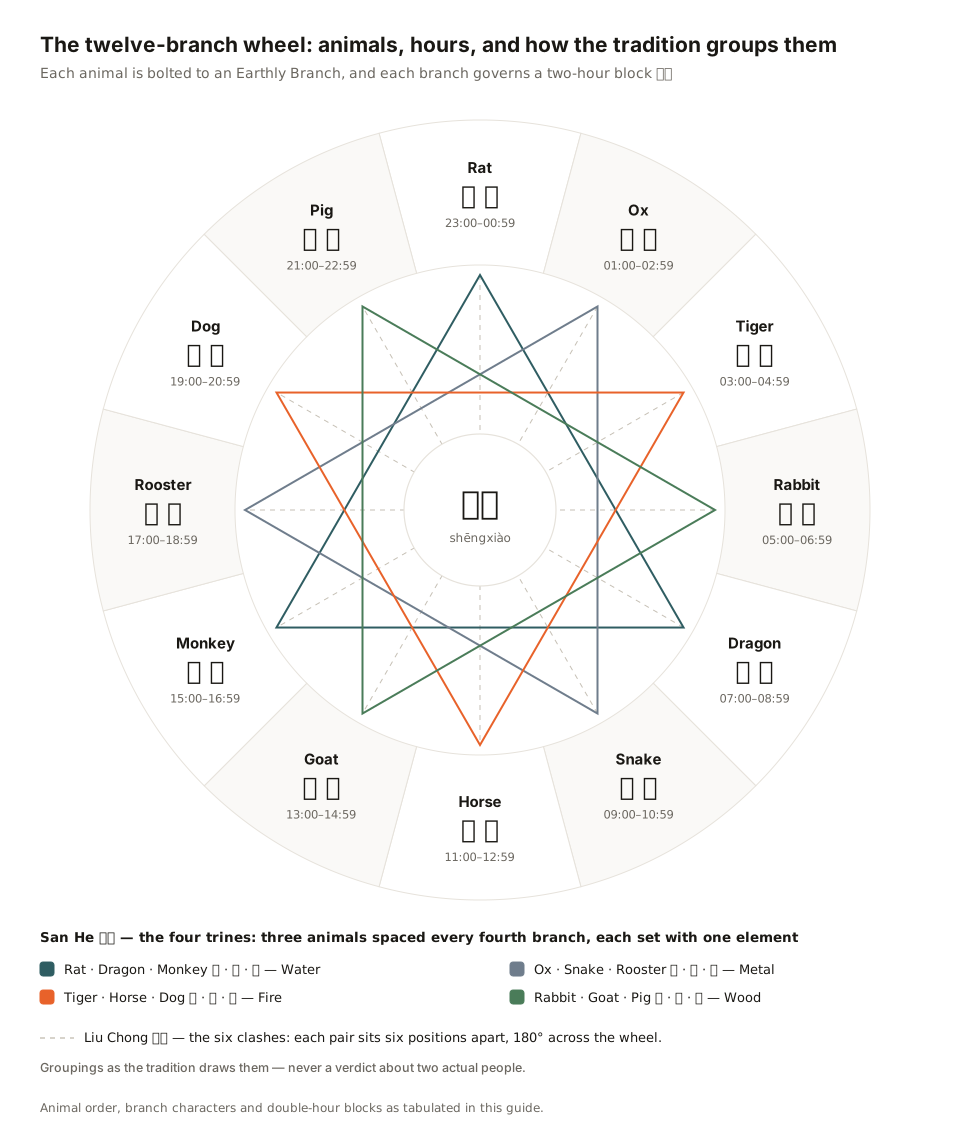
The tradition's headline grouping is San He 三合, the "three harmonies" or trines: four sets of three animals spaced evenly around the twelve-branch wheel, every fourth branch, each set associated with one element.
| Trine (三合) | Branches | Trine element |
|---|---|---|
| Rat · Dragon · Monkey | 子 · 辰 · 申 | Water |
| Ox · Snake · Rooster | 丑 · 巳 · 酉 | Metal |
| Tiger · Horse · Dog | 寅 · 午 · 戌 | Fire |
| Rabbit · Goat · Pig | 卯 · 未 · 亥 | Wood |
One trap worth flagging: the trine's element is a property of the group, and it is not the same thing as the year-stem element from the section above. A Fire Horse happens to sit in the Fire trine, so the two coincide and the naming looks tidy. A Metal Horse still sits in the Fire trine — its stem element is Metal, its trine element is Fire, and they are simply different layers of the system. Keep them apart and the scheme stays coherent.
Alongside the trines run the Liu He 六合, six one-to-one "harmonies" the tradition calls secret friends, and their mirror image, the Liu Chong 六冲, six "clashes" between animals sitting directly opposite each other on the wheel.
| Liu He 六合 — harmonies | Liu Chong 六冲 — clashes |
|---|---|
| Rat · Ox (子 丑) | Rat ✗ Horse (子 午) |
| Tiger · Pig (寅 亥) | Ox ✗ Goat (丑 未) |
| Rabbit · Dog (卯 戌) | Tiger ✗ Monkey (寅 申) |
| Dragon · Rooster (辰 酉) | Rabbit ✗ Rooster (卯 酉) |
| Snake · Monkey (巳 申) | Dragon ✗ Dog (辰 戌) |
| Horse · Goat (午 未) | Snake ✗ Pig (巳 亥) |
The clashes have an elegant geometric logic: each pair consists of two animals sitting 180° opposite each other on the wheel. Rat opposite Horse, Ox opposite Goat, and so on down the wheel. That geometric fact is objective. The reading layered on top of it — that a clash pair should think twice about marrying, or that the harmonies make natural allies — is the tradition's interpretation, and it is the layer to hold at arm's length. Grandparents citing a "clash" across a wedding table are quoting folklore, gently and often affectionately, not reporting a result. For a family-oriented version of the same scheme, our Baby-Parent Zodiac Compatibility arranges parent and child animals the same traditional way. Full practice adds finer relationships still — 六害 harm, 相刑 punishments — but San He, Liu He and Liu Chong carry most of what a general reader meets.
The same twelve, reshaped across a region
The zodiac is a shared inheritance across East and Southeast Asia, but it diverges in interesting ways. As it travelled the Sinosphere, cultures swapped animals in and out, which is the clearest sign that this is tradition rather than physics — physics does not have regional editions.
Vietnam is the famous case. The fourth sign there is the Cat 猫 mèo, not the Rabbit, and the second is the Water Buffalo rather than the Ox. Wikipedia states it flatly: "the Vietnamese zodiac varies from the Chinese zodiac with the second animal being the Water Buffalo instead of the Ox, and the fourth animal being the Cat instead of the Rabbit." The most commonly cited explanation is linguistic — the Sino-Vietnamese reading of the fourth branch 卯 (Middle Chinese mǎo) sounds like Vietnamese mèo, "cat" — though folk stories about cats guarding the grain stores circulate too, and the linguistic account is the leading theory rather than a settled fact. Elsewhere the swaps are smaller: Japan's cycle (十二支 jūnishi) uses Sheep for the eighth sign and Wild Boar for the twelfth, and Korea likewise reads the eighth as Sheep. The twelve-animal frame reached mainland Southeast Asia through the Buddhist calendar as well, though the specific substitutions there vary and are best checked country by country.
A living calendar across ASEAN
None of this is archival. Across Singapore, Malaysia, Vietnam, Indonesia, the Philippines and Thailand, the animal of the year is a mass-market motif every Lunar New Year — on hongbao packets, shop windows, greetings and a wave of zodiac-of-the-year merchandise. The Vietnamese Cat year sitting a shelf away from the Chinese Rabbit year, in the same shopping mall in the same fortnight, is about the most concrete illustration you could ask for of the pattern above: one calendar, many local editions, all lived at once.
In Chinese-heritage communities region-wide, a person's birth animal is common conversational shorthand and still surfaces in match-making talk, which is where the compatibility scheme leaves the page and enters real kitchens. The zodiac is worth understanding on its own terms as a centuries-old system with a beautiful internal symmetry. As a forecast, it has no supporting evidence. There is no contradiction in holding both views.
FAQ
When does the zodiac animal actually change — 1 January?
No. The popular animal (生肖) changes at Chinese New Year, a lunar date falling between late January and mid-February, never on 1 January. To complicate it slightly, the Bazi system used in Chinese astrology turns its year at the solar term 立春 Lìchūn, around 3–5 February, which can be up to two weeks before the lunar festival. A birth in that gap can read as one animal under the solar convention and the previous animal under the lunar one.
Why might two zodiac calculators give me different animals?
Almost always because they use different year boundaries for a birthday near the turn of the year. A calculator following Lunar New Year and one following 立春 will disagree for anyone born in the early-February window. Our Chinese Zodiac Calculator discloses that it reads the animal from the calendar year as a simplification and tells you to check the festival date if you were born in those early weeks.
How does an animal get an element like "Fire Horse"?
The element comes from the year's Heavenly Stem, not the animal. For most years you can read it off the last digit of the Gregorian year: 4–5 Wood, 6–7 Fire, 8–9 Earth, 0–1 Metal, 2–3 Water. So 2026, ending in 6, is a Fire Horse. Each animal cycles through all five elements once every sixty years.
Are the compatibility trines and clashes real?
They are a real part of the tradition — the San He trines, Liu He harmonies and Liu Chong clashes are well-defined groupings on the twelve-branch wheel, and the clashes are simply the animals sitting opposite each other. What the tradition reads into those groupings, about who suits whom, is folklore, not evidence. This guide and our tools present the scheme as the tradition's own, not as advice about any relationship.
Is the Chinese zodiac scientific?
No, and this guide does not claim otherwise. The zodiac's personality and compatibility readings are cultural tradition and folklore. There is no evidence that a birth year determines character or relationship outcomes. Its value is in understanding an elegant, centuries-old system of ideas and its regional life, not in forecasting anyone's future.
- "Chinese zodiac" — Wikipedia (animal order, branch and double-hour table, the two-schools year-start rule, 60-year cycle, Vietnam/Japan/Korea variants) (accessed 25 Jul 2026)
- "Sexagenary cycle" — Wikipedia (gānzhī definition, ten Heavenly Stems with element and polarity, the yin-yang pairing rule, Shang oracle-bone attestation) (accessed 25 Jul 2026)
- "Earthly Branches" — Wikipedia (twelve branches as double-hours, months and directions; the animal mapping) (accessed 25 Jul 2026)
- "Wuxing (Chinese philosophy)" — Wikipedia (the Five Elements: Wood, Fire, Earth, Metal, Water) (accessed 25 Jul 2026)

View author profile → · Editorial policy