Around Chinese New Year, ask an older relative in Singapore or Kuala Lumpur when you were "really" born and the answer can be oddly specific: not the date on your passport but the hour, and sometimes a quiet correction to the year itself. That correction is the doorway into 八字 bāzì, the "eight characters" — a centuries-old Chinese system that turns a birth moment into a chart of eight Chinese characters. This guide is a beginner's look at how a Bazi chart is put together—the calendar mechanics and the rules for deriving the eight characters. It describes the structure of a cultural practice, the way one might explain how a tarot spread is laid out or how astrology computes a natal chart, without claiming any of the readings come true.
So, plainly, before anything else. 八字 is a traditional Chinese metaphysical and divinatory practice, not a scientific method. Nothing in this article predicts anyone's life, and nothing here is financial, medical, relationship, or life advice. Where we describe what a chart is taken to mean, that meaning belongs to the tradition and its practitioners, and interpretations vary between schools. This guide focuses on the machinery underneath, which most short explainers get wrong: a solar calendar, two sets of Chinese characters, and a fixed set of rules for combining them.
What the Four Pillars actually is
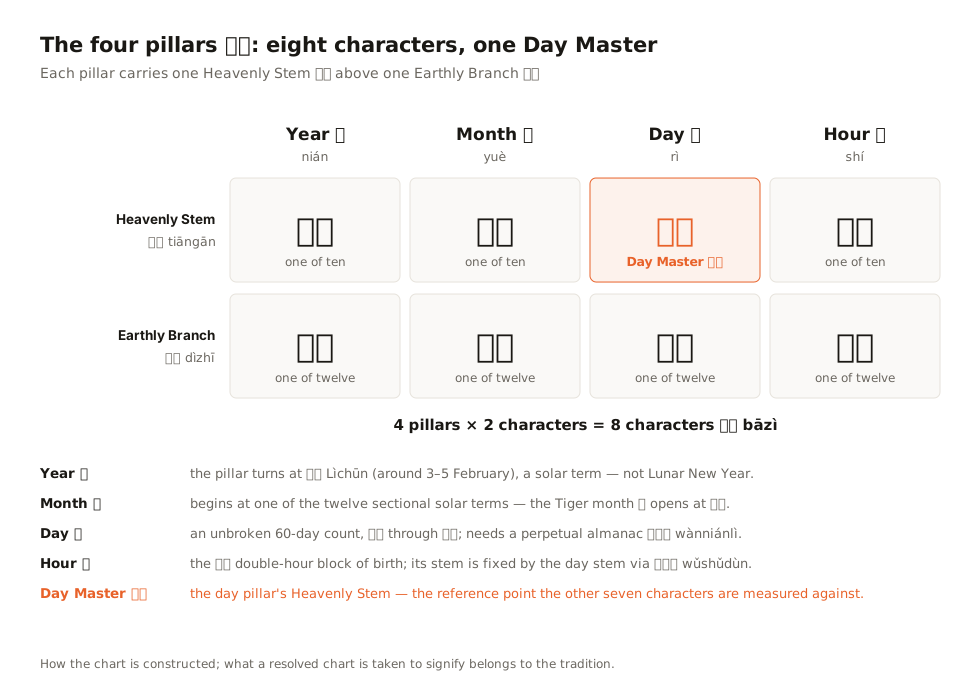
The formal name is 四柱 sìzhù, the "Four Pillars," and the four pillars are simply four units of time: the year 年 nián, month 月 yuè, day 日 rì, and hour 時 shí (時 in traditional script, 时 simplified). Each pillar is written with two Chinese characters stacked together — one Heavenly Stem 天干 tiāngān on top and one Earthly Branch 地支 dìzhī below. Four pillars, two characters each, gives eight characters, which is where the everyday name comes from. As the encyclopedic description puts it, the system "is a Chinese astrological and calendrical system used to analyse an individual's destiny or life path based on the person's date and time of birth."
This is a coordinate system, not a prediction. A birth moment gets four labels, each drawn from the same cycle of paired characters, and the whole practice of reading a chart is the practice of describing how those eight characters relate to one another. Our Bazi Chart Calculator handles the mechanical work. Give it a Gregorian birth date and time, and it returns the four pillars and other structural pieces this guide walks through. It makes no claims about anyone's fate; it draws the chart.
The day-master-centred method used today is traditionally attributed to 徐子平 Xú Zǐpíng of the Song dynasty, which is why the tradition is often called 子平八字 Zǐpíng Bāzì, and the system as a whole is commonly said to date back much further, to the Han dynasty. Treat those as traditional attributions rather than settled history — the exact authorship and dating of the method are a soft spot even in careful accounts.
The two alphabets: stems and branches
Every chart is spelled from two short lists. The first is the ten Heavenly Stems 天干. Each stem carries one of the Five Elements and a polarity — yang 陽 (阳 simplified) or yin 陰 (阴). The system's rule is tidy. The stems run in element pairs; within each pair, the odd-numbered stem is yang and the even-numbered one is yin.
| # | Stem 天干 | Pinyin | Element 五行 | Polarity |
|---|---|---|---|---|
| 1 | 甲 | jiǎ | Wood 木 | Yang |
| 2 | 乙 | yǐ | Wood 木 | Yin |
| 3 | 丙 | bǐng | Fire 火 | Yang |
| 4 | 丁 | dīng | Fire 火 | Yin |
| 5 | 戊 | wù | Earth 土 | Yang |
| 6 | 己 | jǐ | Earth 土 | Yin |
| 7 | 庚 | gēng | Metal 金 | Yang |
| 8 | 辛 | xīn | Metal 金 | Yin |
| 9 | 壬 | rén | Water 水 | Yang |
| 10 | 癸 | guǐ | Water 水 | Yin |
The second list is the twelve Earthly Branches 地支. These are the characters most people already half-know, because each branch maps to one animal of the Chinese zodiac and to a two-hour block of the day called a 時辰 shíchén. The branch that opens the day, 子 zǐ, runs from 23:00, which is why a birth just before midnight and one just after can land on different day pillars.
| # | Branch 地支 | Pinyin | Zodiac 生肖 | Element | Polarity | Double-hour 時辰 |
|---|---|---|---|---|---|---|
| 1 | 子 | zǐ | Rat 鼠 | Water 水 | Yang | 23:00–01:00 |
| 2 | 丑 | chǒu | Ox 牛 | Earth 土 | Yin | 01:00–03:00 |
| 3 | 寅 | yín | Tiger 虎 | Wood 木 | Yang | 03:00–05:00 |
| 4 | 卯 | mǎo | Rabbit 兔 | Wood 木 | Yin | 05:00–07:00 |
| 5 | 辰 | chén | Dragon 龍 | Earth 土 | Yang | 07:00–09:00 |
| 6 | 巳 | sì | Snake 蛇 | Fire 火 | Yin | 09:00–11:00 |
| 7 | 午 | wǔ | Horse 馬 | Fire 火 | Yang | 11:00–13:00 |
| 8 | 未 | wèi | Goat 羊 | Earth 土 | Yin | 13:00–15:00 |
| 9 | 申 | shēn | Monkey 猴 | Metal 金 | Yang | 15:00–17:00 |
| 10 | 酉 | yǒu | Rooster 雞 | Metal 金 | Yin | 17:00–19:00 |
| 11 | 戌 | xū | Dog 狗 | Earth 土 | Yang | 19:00–21:00 |
| 12 | 亥 | hài | Pig 豬 | Water 水 | Yin | 21:00–23:00 |
The polarity column above is the branch's positional one, and it is the standard textbook labelling. Advanced practice complicates it: each branch is held to conceal one or more "hidden stems" (藏干 cánggān) inside it, and two branches in particular, 子 and 午, carry a well-known polarity subtlety that different schools resolve differently. None of that is needed to understand how a chart is built, so we note it exists and leave the argument to the specialists.
Why there are sixty combinations, not a hundred and twenty
Pairing ten stems with twelve branches should yield 120 combinations, but the system's pairing rule produces only 60. Stems and branches advance together, one step at a time, so a yang stem only ever meets a yang branch and a yin stem only a yin branch. Half the pairings never occur, and the sequence returns to its start after sixty steps — the least common multiple of ten and twelve. This is the sexagenary cycle 干支 gānzhī (also called the 甲子 jiǎzǐ cycle after its first term). In the encyclopedic description, "each term in the sexagenary cycle consists of two Chinese characters, the first being one of the ten Heavenly Stems… and the second being one of the twelve Earthly Branches," and "the first term jiǎzǐ (甲子) combines the first heavenly stem with the first earthly branch."
This matters for Bazi because the same 60-term cycle is used to label years, months, days, and hours. Because one repeating alphabet labels four different time units, a single birth moment generates four distinct stem-and-branch pairs.
The Five Elements and their two cycles
Underneath the characters sit the Five Elements 五行 wǔxíng — Wood 木, Fire 火, Earth 土, Metal 金, Water 水 — and the whole interpretive layer of Bazi runs on two relationships between them. The tradition describes a generating cycle (相生 xiāngshēng) and a controlling cycle (相剋 xiāngkè, 相克 in simplified script).
The generating cycle runs Wood → Fire → Earth → Metal → Water → Wood, and the classic imagery is concrete: "Wood feeds Fire / Fire produces Earth (ash, lava) / Earth bears Metal (geological processes produce minerals) / Metal collects, filters and purifies Water / Water nourishes Wood." The controlling cycle runs the other way around the star — Wood → Earth → Water → Fire → Metal → Wood — with imagery to match: "Wood grasps Earth / Earth contains Water / Water dampens Fire / Fire melts Metal / Metal chops Wood." Hold on to those two loops; the Ten Gods below are nothing more than these cycles applied to a single reference character. Our Five Elements Personality tool works from this same five-way framework, sorting a chart by its dominant elements according to the tradition's associations.
How the four pillars are derived — and the thing everyone gets wrong
Most popular explanations get the calendar wrong. The Bazi calendar is solar, not lunar, even though it borrows characters that also decorate the lunar festival calendar. Each pillar is read off a different clock.
- The year pillar turns at 立春 Lìchūn, not Lunar New Year. 立春 ("Beginning of Spring," around 3–5 February, the moment the sun reaches 315° of ecliptic longitude) is a solar term, and it — not the lunar festival that the fireworks celebrate — is where the Bazi year rolls over. Someone born after Lunar New Year but before Lìchūn still belongs to the previous year pillar. As one practitioner reference states it, many "Four Pillars systems switch the Year Pillar at Li Chun, Start of Spring, while public zodiac and festival calendars usually follow Chinese New Year." Getting the calendar right is the most critical correction.
- The month pillar follows the solar terms, not the lunar month. The year is carved into twelve Bazi "months," each beginning at one of the twelve sectional solar terms — the Tiger month 寅, for instance, opens at Lìchūn. In the encyclopedic phrasing, "the month is determined by the solar terms (二十四節氣, èrshísì jiéqì) rather than the lunar month, making the Four Pillars system a solar-based calculation."
- The day pillar is a continuous count. Days have been numbered 甲子 through 癸亥 in an unbroken 60-day loop for millennia. There is no shortcut from a Gregorian date; you need a perpetual almanac (a 萬年曆 wànniánlì) or an algorithm to find the right pair.
- The hour pillar is a double-hour, and its stem is not free. The branch comes straight from the 時辰 block of birth, but the hour stem is fixed by the day stem through a five-day rotation known as the 五鼠遁 wǔshǔdùn, or "Five Rat" rule.
The day and hour stems require real calendar computation, which is where a tool is most useful. The Bazi Chart Calculator computes the pillars from the solar calendar using a vendored almanac library that is solar-term aware, accepts any Gregorian date from 1900 to 2100, and converts internally, so the 立春 boundary and the double-hour blocks are handled for you rather than by hand. To be clear, this means the tool resolves the calendar correctly. What a resolved chart signifies is a matter of tradition and interpretation.
The Day Master: the chart's reference point
Of the eight characters, one is singled out as the anchor: the Heavenly Stem of the day pillar, called the Day Master 日主 rìzhǔ (also 日元 rìyuán or 日干 rìgān). In the tradition it represents the person themselves. As the encyclopedic account puts it, this stem "is considered the most important element, as it represents the person themselves… and serves as the reference point."
Mechanically, the Day Master's job is to be the origin against which everything else is measured. If the day stem is 甲, practitioners describe the Day Master as "Yang Wood," and the remaining seven characters are then read in terms of how their elements and polarities stand relative to Yang Wood. This is a structural point about the chart's bookkeeping, not a claim about a person. The Day Master simply gives the other seven characters a fixed point to be measured against.
The Ten Gods: relationships, not labels
The Ten Gods 十神 shíshén are where the generating and controlling cycles come back. They are not ten fixed traits pinned to fixed characters; the tradition computes them from how each other character's element and polarity relate to the Day Master. In the encyclopedic phrasing, the Ten Gods "describe the relationship between the Day Master and each of the other elements." There are five relationships, each splitting into two by polarity, which is where the count of ten comes from.
The rule the system uses is compact. Take how the other element stands to the Day Master — same element, or generated by it, or controlled by it, or controlling it, or generating it — then split by polarity. Broadly, an opposite polarity gives the "Direct" (正 zhèng) form and the same polarity gives the "Indirect" (偏 piān) form or a special name. This is a bookkeeping classification internal to the system, so read the table as "the tradition sorts the other characters this way," never as an outcome about a life.
| Relationship to Day Master | Category | One polarity form | Other polarity form |
|---|---|---|---|
| Same element as the Day Master | Companion 比劫 | 比肩 bǐjiān — "Companion / Peer" | 劫財 jiécái (劫财) — "Rob Wealth" |
| The Day Master generates it (output) | Output 食傷 | 食神 shíshén — "Eating God" | 傷官 shāngguān (伤官) — "Hurting Officer" |
| The Day Master controls it (wealth) | Wealth 財 | 正財 zhèngcái (正财) — "Direct Wealth" | 偏財 piāncái (偏财) — "Indirect Wealth" |
| It controls the Day Master (authority) | Officer 官殺 | 正官 zhèngguān — "Direct Officer" | 七殺 qīshā (七杀 / 偏官) — "Seven Killings" |
| It generates the Day Master (resource) | Resource 印 | 正印 zhèngyìn — "Direct Resource / Seal" | 偏印 piānyìn (梟神) — "Indirect Resource" |
The English names are the tradition's own colourful labels — "Rob Wealth," "Seven Killings," "Eating God" — and it is tempting to read them as verdicts. They are not, at least not here. In the system they are category names for a relationship between two characters, in the same way "dominant seventh" names a relationship between musical notes without predicting how a song will end. Our Bazi Ten Gods Analyzer applies exactly this derivation, tagging each character in a chart with its Ten Gods relationship to the Day Master. It reports the classification the rules produce; what any given god is said to signify is left to the tradition and to whoever is reading the chart.
The useful element: a method of analysis, described as such
One more concept rounds out a beginner's map, and it is the one to handle most carefully. The useful or favourable element 用神 yòngshén (the searchable compound is 喜用神 xǐyòngshén) is, in the tradition, the one or two of the Five Elements a chart is judged to most need for balance. The method behind it goes like this: practitioners first assess whether the Day Master is "strong" or "weak" — drawing partly on the season the birth month sits in — and then reason that a weak Day Master calls for an element that supports it, while a strong one calls for an element that drains or controls the excess.
We describe 用神 as a method of analysis because that's what it is: a way practitioners approach a chart. Even practitioner sources concede it is the hardest and most disputed step, with different schools reaching different answers from the same eight characters. Our Bazi Favorable Element Finder surfaces the balance analysis the tradition uses; it is a window onto the method, not a directive, and it does not tell anyone what to do. Treat its output the way you would treat a summary of how a school of astrology reads a chart — an account of the interpretation, not a fact about your life.
Where this is a living practice
Bazi is not a museum piece, and its living home today is largely Chinese Southeast Asia. The Four Pillars system "remains widely practised in mainland China, Taiwan, Hong Kong, Singapore, Malaysia, and among Chinese diaspora communities," and Singapore and Malaysia in particular support a visible professional consulting market around it. Interest runs on a seasonal cycle: around Chinese New Year, annual outlook readings (流年, the "year's fortune") draw a wave of attention across the region — a genuine cultural rhythm, which we mention as an observation rather than an offer of any reading.
This guide exists to fill a practical gap. Most authoritative material on Bazi is in Chinese; most English writing on it is a sales funnel for paid consultations, not a clear account of the mechanics. A plain English explanation of how the chart is constructed, rather than what it supposedly foretells, is hard to find. The same framing extends to comparison charts: our Bazi Compatibility Match tool arranges two charts side by side according to the tradition's matching rules, which is a reading in the tradition's own terms and nothing more. Notice, too, that the twelve-branch zodiac most people know is only the outermost layer of this system; a full chart is eight characters, not one animal.
What our Bazi tools do, and don't
Every tool referenced here is a structural calculator. The Bazi Chart Calculator derives and displays the four pillars, the five-element distribution, the hidden stems, the Day Master with its element and polarity, the Ten Gods, and the zodiac, in simplified Chinese, traditional Chinese, or English. The Ten Gods Analyzer, Favorable Element Finder, Compatibility Match, and Five Elements Personality each take one further slice of the same chart and lay it out according to the tradition's rules. None of them forecasts events, and none of them offers advice. They compute the chart and show you how it was built; the meaning has always lived with the tradition, not with a calculator.
FAQ
Is Bazi the same as the Chinese zodiac?
No — the zodiac is one layer of it. Your zodiac animal comes from a single Earthly Branch (usually the year branch), whereas a full Bazi chart is all eight characters: four Heavenly Stems and four Earthly Branches across the year, month, day, and hour pillars. The animal is the outermost decoration; the chart is the whole structure.
Why does Bazi use 立春 instead of Chinese New Year for the year?
Because the Bazi calendar is solar, not lunar. The year pillar turns at 立春 Lìchūn, the "Beginning of Spring" solar term around 3–5 February, defined by the sun's position rather than the moon. Lunar New Year is a festival on the lunisolar calendar and usually falls on a different date, so a birth after Lunar New Year but before Lìchūn belongs to the previous year pillar. It is the most common mistake in casual explanations.
What is the Day Master?
The Day Master 日主 is the Heavenly Stem of your day pillar, and in the tradition it stands for the person themselves. It is the reference point: every other character in the chart is read relative to the Day Master's element and polarity. That is a structural role, not a personality verdict — it is what the other seven characters are measured against.
Do I need my exact birth time?
For the full chart, yes. The hour pillar is set by the two-hour 時辰 block you were born in, and its stem is derived from the day stem, so without a birth time the hour pillar cannot be fixed. The other three pillars — year, month, day — only need the date. Our Bazi Chart Calculator will build whatever the inputs allow.
Does a Bazi chart predict my future?
This guide makes no such claim, and neither do our tools. Bazi is a traditional Chinese cultural and divinatory practice; what we have described is how a chart is constructed and what practitioners do with the rules. Any interpretation belongs to the tradition and its practitioners, and it varies between schools. Nothing here is a prediction, and nothing here is financial, medical, relationship, or life advice.
- "Four Pillars of Destiny" — Wikipedia (name, eight characters, Day Master, Ten Gods, solar-term month rule) (accessed 24 Jul 2026)
- "Sexagenary cycle" — Wikipedia (ten stems, sixty combinations, jiǎzǐ, day and hour counting) (accessed 24 Jul 2026)
- "Earthly Branches" — Wikipedia (twelve branches, zodiac animals, elements, double-hour blocks) (accessed 24 Jul 2026)
- "Solar term" — Wikipedia (24 solar terms; the year starts at Lìchūn) (accessed 24 Jul 2026)
- "Wuxing (Chinese philosophy)" — Wikipedia (Five Elements generating and controlling cycles, verbatim imagery) (accessed 24 Jul 2026)
- cosmictao.com — Bazi reference (Year-Pillar switch at Li Chun vs. festival calendars; Six Relationships / Ten Gods framing) (accessed 24 Jul 2026)

View author profile → · Editorial policy