Ask a property agent in Petaling Jaya or Toa Payoh why two identically laid-out units in the same stack draw different levels of interest, and the view is not always the reason. Orientation and door position sit high on buyer shortlists in Malaysia and Singapore, and behind them, often enough, is 八宅 bāzhái — "Eight Mansions" — a method that turns a birth year into a single number, and that number into a fixed set of compass sectors. This guide takes apart the arithmetic, the trigram geometry, and the rule that generates the system's charts.
Plainly, before anything else. Feng shui is a traditional practice with a long documented history and no scientific validation. Nothing here predicts anything about anyone's home, money, health or relationships. Where we describe what a sector is taken to mean, that meaning belongs to the tradition and its practitioners, and it varies between lineages. The system's own rules, however, can be stated flatly. These are claims about which trigram sits at which compass point, how the arithmetic works, and which line of a trigram flips to produce which star. Those are claims about a chart, not about a reader.
Wind, water, and two ways of reading a site
The term is 风水 / 風水 fēng shuǐ, literally "wind-water," described in encyclopedic accounts as a traditional form of geomancy that originated in ancient China and is organised around 气 / 氣 qì and its management through the arrangement of a site. Two streams run through it. The Form School 形势派 / 形勢派 xíngshì pài reads landform, the shape of the land and the flow of wind and water. The Compass School 理气派 / 理氣派 lǐqì pài reads direction and formula, working from the eight directions, the trigrams, the nine palaces and the five elements, with the ringed 罗盘 / 羅盤 luópán as its instrument. Chinese sources place both emergences in the Song period, contemporaneous rather than sequential — though English-language sources call the Form School the older branch — and Bourassa and Peng note that "two different approaches are regarded as 'traditional' in practising feng shui, the Form School and the Compass School."
Eight Mansions belongs to the compass stream and says nothing whatever about landform. Where it sits inside that stream is unsettled — English Wikipedia files 八宅 under the San He 三合 techniques, while most practitioner literature treats it as a school of its own — and its age is similarly soft. The tradition traces it to the Tang dynasty and the monk-astronomer 一行 Yīxíng, a traditional attribution rather than verified authorship; the method as practised now comes down mainly through later texts, above all the 八宅明镜 / 八宅明鏡 Bāzhái Míngjìng, the "Eight Mansions Bright Mirror." Our companion guide to the bagua map and the luopan covers the instrument; this one stays with the personal-direction formula.
The board the system plays on
Everything here is laid over one diagram: the 后天八卦 / 後天八卦 hòutiān bāguà, the Later Heaven or King Wen arrangement. A symmetrical Earlier Heaven arrangement 先天八卦 also exists, but Later Heaven is what the luopan is built around.
| Trigram | Simp. | Trad. | Pinyin | Direction | Element 五行 | No. |
|---|---|---|---|---|---|---|
| ☵ | 坎 | 坎 | Kǎn | North | Water 水 | 1 |
| ☷ | 坤 | 坤 | Kūn | Southwest | Earth 土 | 2 |
| ☳ | 震 | 震 | Zhèn | East | Wood 木 | 3 |
| ☴ | 巽 | 巽 | Xùn | Southeast | Wood 木 | 4 |
| ☰ | 乾 | 乾 | Qián | Northwest | Metal 金 | 6 |
| ☱ | 兑 | 兌 | Duì | West | Metal 金 | 7 |
| ☶ | 艮 | 艮 | Gèn | Northeast | Earth 土 | 8 |
| ☲ | 离 | 離 | Lí | South | Fire 火 | 9 |
The numbers come from the 洛书 / 洛書 Luòshū, the Lo Shu magic square, in which "the sums in each of the three rows, in each of the three columns, and in both diagonals, are all 15." Written as Chinese charts write it, south at the top, the grid reads 4 9 2 / 3 5 7 / 8 1 6 — which puts 5 in the centre, the 中宫 zhōnggōng or central palace. A centre is not a bearing, so the number 5 has no trigram, leaving a hole in the scheme that has to be patched by hand.
The Kua number 命卦
The Chinese term is 命卦 mìng guà, "life trigram" — 卦 as in trigram, not the homophone. English sources say Kua number, Gua number, Life Kua or Ming Gua interchangeably. It comes from a birth year plus a gender and resolves to one of eight values: 1, 2, 3, 4, 6, 7, 8, 9. The formula is binary by construction, written in a context that assumed two categories, and every calculator implementing it inherits that.
Practitioner sites publish it two ways. One splits by century and uses only the last two digits. Let s be those two digits added and reduced to a single digit: for a twentieth-century birth, male is 10 − s and female 5 + s; for the twenty-first, male is 9 − s and female 6 + s. The other ignores centuries. Let b be all four digits added and reduced; male is 11 − b, female 4 + b. Two-digit results reduce again, and a male result of 0 reads as 9. Take 2018: the century-split form gives 1 + 8 = 9, then 9 − 9 = 0 → 9; the four-digit form gives 2 + 0 + 1 + 8 = 11 → 2, then 11 − 2 = 9. Not a coincidence.
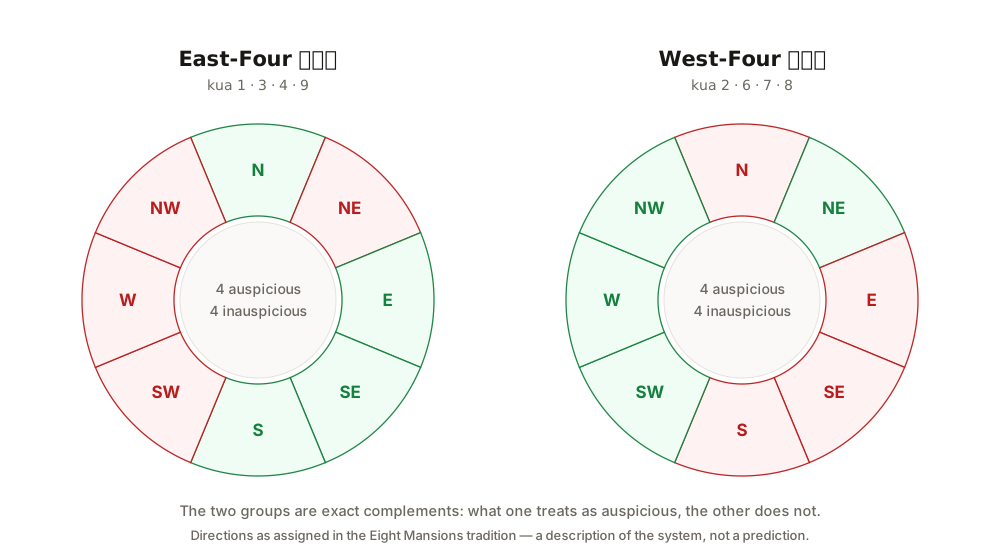
The eight trigrams then split into two families, and that split is the heart of the method.
| Group | Life 命 / House 宅 | Kua | Trigrams | Directions | Elements |
|---|---|---|---|---|---|
| East group | 东四命 dōngsì mìng / 东四宅 dōngsì zhái | 1, 3, 4, 9 | 坎 震 巽 离 | N, E, SE, S | Water, Wood, Wood, Fire |
| West group | 西四命 xīsì mìng / 西四宅 xīsì zhái | 2, 6, 7, 8 | 坤 乾 兑 艮 | SW, NW, W, NE | Earth, Metal, Metal, Earth |
Read the element columns and the split stops looking arbitrary. East runs Water, Wood, Fire, a continuous stretch of the five-element generating cycle; West runs Earth and Metal, another generating pair. Each family is internally compatible under the tradition's own element logic — a fact about how the scheme was assembled, not a sign that it does anything. Our Kua Number Calculator runs the arithmetic for any year from 1900 to 2099, in simplified Chinese, traditional Chinese or English.
The two formulas are one formula
Practitioner sites present those calculations as alternatives, and at least one warns that the methods "may produce different results" without saying which to trust. In practice, they never do. We checked every year from 1900 to 2099 against both genders, 400 combinations, and found zero disagreements.
The century digits behave predictably under modulo 9 arithmetic. For a 19xx year the four-digit sum is 1 + 9 + (the last two digits), and 9 vanishes mod 9, so the total is congruent to 1 + s — making 11 − (1 + s) = 10 − s, the twentieth-century male rule exactly. For a 20xx year the sum is congruent to 2 + s, and 11 − (2 + s) = 9 − s. The female forms fall out the same way. The century digits shift the total by precisely the amount the century-split rule adjusts for, so the four-digit version absorbs the split rather than contradicting it. One method, written down twice, in a literature that, so far as we can find, never noticed. Our calculator uses the four-digit form.
A result of exactly 5 has nowhere to go, creating a hole in the middle that the standard modern rule patches by substitution: 5 becomes 2 for men and 8 for women. Both targets are Earth trigrams — 坤 Kūn at Southwest, 艮 Gèn at Northeast — matching the central palace's own element, with the male-to-yin and female-to-yang assignment a deliberate polarity inversion, and both land in the West group. This is what calculators implement, ours included, and it is also disputed: some practitioners reject the substitution and hold that a Ming Gua 5 takes a central, supervising role rather than being converted. Adjudicating a folklore dispute is not our job. Flagging it is.
Three neighbouring systems, three New Years
The formula needs a birth year, but cannot answer for itself which calendar's year to use. Practitioner sources are consistent about the answer: the Kua year turns at 立春 Lìchūn, "Start of Spring," first of the twenty-four solar terms, falling around 3 to 5 February and fixed astronomically rather than by the moon. One Bazhai reference states it outright — "Ba Zhai uses the solar term Li Chun (Start of Spring). If you were born before Li Chun (≈ Feb 3–5), use the previous year." Others agree, calling 4 February a safe cut-off and deriving the personal gua from the Chinese solar calendar rather than the lunar month.
Be precise about the status of that. Practitioner sources consistently specify Lìchūn, and it is coherent with Eight Mansions sitting in a compass stream that works from solar-term astronomy throughout. What we could not find is an academic or primary-textual citation establishing the rule for Bazhai specifically. It is well attested in modern practitioner literature; it is not, on the evidence available here, established from the classics.
Two people born ten days apart in early February can get different Kua numbers, hence different trigrams and a completely disjoint set of sectors. Nothing about either person changed. Only the calendar convention did.
The calendar problem is significant because three neighbouring systems in the same tradition draw the year's boundary in three different places. Bazi's year pillar turns at 立春, as our guide to the Four Pillars sets out. The popular zodiac animal turns at Lunar New Year, a lunisolar date drifting between late January and mid-February, covered in our Chinese zodiac guide. Kua calculators are split three ways, many taking the plain 1 January Gregorian year — a simplification rather than a traditional rule. Ours is in that camp and says so: the Kua Number Calculator takes the Gregorian year, and the widget discloses that practitioners place the boundary at 立春 around 3 to 5 February, and that an earlier birth should be adjusted back a year by hand.
The eight stars
Each Kua trigram assigns one of eight 游年星 yóuniánxīng, "wandering-year stars," to each compass sector — four treated as auspicious, four as inauspicious. The glosses below describe the tradition's meanings for these stars, not outcomes for any house.
| Star | Trad. | Pinyin | Literal | In the tradition |
|---|---|---|---|---|
| 生气 | 生氣 | shēng qì | "generating qi" | Most auspicious; activated for vitality, career, wealth |
| 天医 | 天醫 | tiān yī | "heavenly physician" | Health, and 贵人 helpful people |
| 延年 | 延年 | yán nián | "extending years" | Relationships, stability, longevity |
| 伏位 | 伏位 | fú wèi | "resting position" | Mildly auspicious; the person's own trigram — calm, contentment |
| 祸害 | 禍害 | huò hài | "calamity and harm" | Mildly inauspicious; mishaps, obstacles, scattering |
| 六煞 | 六煞 | liù shà | "six killings" | Inauspicious; disputes, entanglements, overindulgence |
| 五鬼 | 五鬼 | wǔ guǐ | "five ghosts" | Inauspicious; gossip, betrayal, quarrels, loss |
| 绝命 | 絕命 | jué mìng | "severing life" | Treated as the most inauspicious of the eight |
六煞 is the standard classical form, though practitioner sites also print 六殺 and 六杀, liù shā. The four-good, four-bad split is settled across sources; the ranking inside each half is not. In the full assignment below, every row draws its four auspicious sectors from its own group's directions. That regularity is the East Four / West Four rule — the group split is not doctrine layered on top, it is what the table does.
| Kua | Trigram | Group | 生气 | 天医 | 延年 | 伏位 | 祸害 | 五鬼 | 六煞 | 绝命 |
|---|---|---|---|---|---|---|---|---|---|---|
| 1 | 坎 Kǎn | East | SE | E | S | N | W | NE | NW | SW |
| 3 | 震 Zhèn | East | S | N | SE | E | SW | NW | NE | W |
| 4 | 巽 Xùn | East | N | S | E | SE | NW | SW | W | NE |
| 9 | 离 Lí | East | E | SE | N | S | NE | W | SW | NW |
| 2 | 坤 Kūn | West | NE | W | NW | SW | E | SE | S | N |
| 6 | 乾 Qián | West | W | NE | SW | NW | SE | E | N | S |
| 7 | 兑 Duì | West | NW | SW | NE | W | N | S | SE | E |
| 8 | 艮 Gèn | West | SW | NW | W | NE | S | N | E | SE |
Where that table comes from, and how to catch a bad copy
Sixty-four cells is a lot to memorise and an easy thing to garble in transcription. The tradition does not memorise them. It generates them, with a line-change rule called 爻变 yáo biàn. A trigram has three lines, each either flipped or left alone, giving exactly 2³ = 8 patterns; there are exactly 8 stars, and the mapping is one-to-one. Flip nothing for 伏位, the trigram itself; the top line alone for 生气, the bottom alone for 祸害, the middle alone for 绝命; bottom and middle for 天医, middle and top for 五鬼, bottom and top for 六煞; all three for 延年.
Two properties follow, both checkable by inspection rather than belief. First, every relation is mutual, because flipping a fixed set of lines is its own inverse. Read it off the table: Kua 1 (坎, North) has 绝命 at Southwest, which is 坤, Kua 2 — and Kua 2 has 绝命 at North. That holds for all eight stars across all eight rows. Second, 延年, the all-three-lines flip, always pairs a trigram with its exact complement: 乾↔坤, 坎↔离, 震↔兑, 艮↔巽. The star the tradition reads for relationships and longevity is, structurally, the maximal-opposite pairing.
The rule travelled as a mnemonic verse, the 大游年歌 dà yóu nián gē or "Great Wandering-Year Song." Two of its lines are attested verbatim in sources we could reach — 乾六天五祸绝延生 and 坎五天生延绝祸六 — and regenerating all eight from the line-change rule reproduces both character for character.
Mutuality also catches errors, which matters because published per-Kua tables are not all identical. One widely circulated chart gives Kua 7 (兑) with 六煞 at East and 绝命 at Southeast; the rule gives the reverse, and mutuality confirms it, since that same chart puts Kua 3 (震) at 绝命 = West, so Kua 7's 绝命 must point back at East. Two cells swapped. We ran the involution check across all eight rows of the table our Kua Number Calculator ships, Kua 7 included, and every relation is mutual. The rule, not the chart, is the arbiter.
Putting it on a house
All of that is about a person. Applying it to a building takes a second step, and the vocabulary is 坐山朝向 zuò shān cháo xiàng: 坐山 zuò shān, the "sitting mountain," is what the building has behind it, and 朝向 cháo xiàng is the front it presents. The two are always 180° apart, and the house takes the trigram of its sitting direction — sitting South and facing North makes a 离 Lí house, sitting North and facing South a 坎 Kǎn house. Sectors run in 45° slices with boundaries at 22.5°, which is why bearings matter and eyeballing does not.
The house then carries the same eight-star table a person of that Kua would, laid over its own floor plan, and the classical placements the tradition concerns itself with are the main door 门, the stove 灶 and the bed 床. The pairing practitioners look for is same-group to same-group; Baidu Baike states the governing rule in translation as "Those with an East Four Life reside in East Four Mansions; those with a West Four Life reside in West Four Mansions."
Two of our tools take these two steps. House Direction Analyzer works from a sitting-and-facing orientation plus an occupant's details, reporting the house's group, the occupant's life trigram, the compatibility verdict the tradition would assign, and classical sunlight and ventilation notes per orientation. Bagua House Analysis runs the other way, mapping an existing house from its door-facing octant into the full eight-sector layout with the tradition's own description of each sector attached. One part of that classical advice has an ordinary rationale: orientation really does govern how much sun a room takes and how air crosses a building. The auspicious and inauspicious verdicts are a different kind of claim, and the first does nothing to support the second.
The cousin from the other side of the family
One tool in this cluster looks like an Eight Mansions tool and is not. Personal Lucky Color & Direction is built on 用神 yòngshén, the "useful element" method from Bazi: it tallies the five elements across a full eight-character chart, identifies the Day Master's element, judges whether that Day Master is strong or weak, and reports the colours, directions and industries the tradition associates with the resulting element. Different inputs, different machinery, different tradition — Bazi works from a full birth moment on a solar-term calendar, Eight Mansions from a year, a gender and a compass. The two can return different favourable directions for the same person, and neither corrects the other. Our Four Pillars guide covers the 用神 step and why practitioners themselves call it the most disputed part of chart reading.
The honest limits
The first problem is internal: the tradition disagrees with itself. Eight Mansions is one compass method among several — Flying Star 玄空飞星, San He 三合, San Yuan 三元 — and they return different answers for the same building. The Kua-5 substitution is rejected by some practitioners. The sharpest documentation comes from inside the field: the practitioner Michael Oon records that a property can have a West-group sitting direction and an East-group-favourable main door at once, so an occupant's requirements cannot all be met, and notes that "consultants and experts based in Hong Kong view this formula as fake" while Taiwanese consultants read the method differently again.
The second problem is evidential. Feng shui is described in encyclopedic accounts as "generally regarded as non-scientific," with some going further and calling it a paradigmatic example of pseudoscience. The more careful academic statement of why comes from Michael Matthews, writing in Cultures of Science in 2023, whose abstract notes that chi claims "have rarely been scientifically appraised. This is, in part, because they are stated so vaguely and mysteriously that no definite test is possible."
One randomised controlled trial exists in the area, and it needs care. Zijlstra and colleagues, in PLOS ONE in 2024, ran an online multi-arm trial with 558 participants in a digital twin of a Dutch hospital room, comparing a control against rooms designed on Golden Ratio, feng shui and evidence-based design principles. The feng shui arm showed no direct effect on anxiety against control (p = 0.142), but significant gains in rated room pleasantness (+1.07, p < 0.001) and perceived social support (+1.29, p = 0.002), with a significant indirect anxiety reduction running through those. That trial tested Form School room design — positioning, qi-flow moderation, avoiding 煞气 shà qì — in an online simulation. It did not test Eight Mansions, and it did not test Kua directions. It says nothing for or against anything in this guide.
The trial illustrates a useful distinction. The parts of feng shui that overlap with ordinary good building — light, outlook, ventilation, a bed that is not in a doorway — have an independent, non-mystical rationale, and a pleasanter room reducing anxiety through pleasantness is what that rationale would predict. The specific machinery has no such support — the claims that a birth year fixes a personal compass, or that Southwest is calamitous for one person and generative for another. That is a cultural scheme, coherent and worth understanding as a system without being true about anyone. The anthropologist Ole Bruun frames it as an alternative tradition of cosmological knowledge used to explain everyday misfortune — explanatory work, rather than a failed physics.
A live part of the property market
None of which has stopped feng shui being transacted, and there is peer-reviewed evidence from ASEAN itself about how it operates. Yap and Lum, in Property Management in 2020, surveyed prospective homebuyers in the Klang Valley across 26 feng shui elements and found the five most influential to be orientation, main entrance, street location, house number and living room. Kruskal–Wallis and Spearman tests found no significant difference between Malay, Chinese and Indian respondents in how they prioritised those criteria, and the same three ranked highest across income levels. The one that came top, orientation, is precisely the variable Eight Mansions is a theory about.
Singapore treats consultation as a priced, ordinary service, with consumer and property media reporting fixed residential fees roughly in the S$288 to S$888 band by home size — media listings rather than an industry survey, so read them as order of magnitude. Consultants are engaged before commitment, to screen units out. What this research measures is what buyers do, not whether the tradition works.
FAQ
Why do online Kua calculators disagree?
Disagreements are almost never about the formula itself. The century-split method and the four-digit-sum method are arithmetically identical for every year from 1900 to 2099 and both genders. Disagreements come from the year boundary — Gregorian, Lunar New Year, or 立春 — and occasionally from the Kua-5 substitution or a transcription error in whichever direction chart the tool was built from.
Does Eight Mansions work?
This guide makes no such claim, and neither do our tools. Feng shui is a cultural tradition with a long documented history and no scientific validation, and the one randomised trial in the area tested Form School room design in an online simulation, not Kua directions. The tradition also disagrees with itself: methods conflict, charts differ, and practitioners have published on the contradictions inside Eight Mansions specifically. What we have described is how the system is constructed and what practitioners do with its rules. Nothing here is a prediction, and nothing here is property, financial, medical or life advice.
- "Feng shui" — Wikipedia (etymology, qi, Form and Compass definitions, scientific status) (accessed 25 Jul 2026)
- "Bagua" — Wikipedia (Earlier and Later Heaven arrangements; the trigram table) (accessed 25 Jul 2026)
- "Lo Shu Square" — Wikipedia (the grid, the magic constant 15, 5 at the centre) (accessed 25 Jul 2026)
- 維基百科, 風水 (形勢派 and 理氣派 definitions; Song-era emergence) (accessed 25 Jul 2026)
- Baidu Baike (English), "Eight Mansions" (East Four / West Four rule, sitting and facing, classical texts) (accessed 25 Jul 2026)
- Matthews, M. R. (2023). "Feng shui and the scientific testing of chi claims." Cultures of Science 6(3): 278–291 (accessed 25 Jul 2026)
- Zijlstra, E. et al. (2024). "A randomized controlled trial of Golden Ratio, Feng Shui, and evidence based design in healthcare." PLOS ONE 19(6): e0303032 (accessed 25 Jul 2026)
- Yap, J. B. H. & Lum, K. C. (2020). "Feng Shui principles and the Malaysian housing market." Property Management 38(5): 643–664 (accessed 25 Jul 2026)
- Bourassa, S. C. & Peng, V. S. (1999). "Hedonic Prices and House Numbers: The Influence of Feng Shui." International Real Estate Review 2(1): 79–93 (accessed 25 Jul 2026)
- Bruun, O. (2003). Fengshui in China. University of Hawai'i Press, ISBN 9780824826727 (accessed 25 Jul 2026)
- theqiflow.com — Li Chun boundary statement; fengshuinexus.com — Kua calculation methods; michaeloon.com — "8 Controversies Of The Eight Mansions Feng Shui" (practitioner references, accessed 25 Jul 2026)
- RECATOOLS own computation (25 Jul 2026): the two Kua formulas compared across all 400 year × gender combinations 1900–2099 (0 mismatches); the 8 × 8 star table derived from the 爻变 line-change masks, reproducing both attested 大游年歌 lines; involution check across all eight rows of the shipped direction table

View author profile → · Editorial policy