In the older shophouse rows of Singapore, Kuala Lumpur and Hong Kong there is usually one shop selling a heavy lacquered disc with a needle floating at its centre and a thicket of Chinese characters printed in rings around it. That object is a 罗盘 luópán (羅盤 in traditional script), the Chinese geomantic compass. This guide covers the instrument itself—its parts, the construction of the main ring, its origins, and what a magnetic needle can and cannot reveal.
Feng shui is a cultural tradition with a long history, and it is not an evidence-based system: in encyclopedic terms, it "has been identified as non-scientific by both scientists and philosophers, while some have gone further to describe it as a paradigmatic example of pseudoscience." Nothing here predicts anything about anyone's home, money, health or relationships. Where we describe what a bearing is taken to mean, that meaning belongs to the tradition and its practitioners. The other half of the honest account gets less airtime: the compass is one of the significant technologies in human history, it was Chinese, and the earliest securely dated written description of magnetic declination anywhere appears in a Chinese geomantic context centuries before Europe noticed the effect. Both statements hold at once.
What a luopan is, part by part
The encyclopedic description is blunt: a luopan is "a Chinese magnetic compass, also known as a feng shui compass," used "to determine the precise direction of a structure, place or item." Structurally it is a magnetic compass with a reference library printed around it. The needle does one job, finding the magnetic meridian; everything else on the face is a lookup table engraved in concentric circles, converting a bearing into the tradition's vocabulary without arithmetic in the field.
| Part | Pinyin | What it is |
|---|---|---|
| 天池 (also 海底) | tiānchí / hǎidǐ | The "heaven pool" — the needle housing at the centre of the rotating plate: a pivot pin 顶针, the magnetic needle 磁针, the sea-bottom line 海底线, a case and a glass cover |
| 内盘 (內盤) | nèipán | The inner plate, which rotates and carries the concentric rings. Each ring is called a 层 céng, a layer |
| 外盘 (外盤) | wàipán | The outer plate: a square wooden base cradling the inner plate, holed at the midpoint of each side |
| 天心十道 | tiānxīn shídào | Two red threads strung through those holes, crossing at 90°. Whatever ring value falls under the thread is the value recorded |
Drag the ring, use the slider, or focus it and press the arrow keys (hold shift to jump a whole sector). The dial starts at 352.0° — inside 壬 by half a degree. Nudge it up and it crosses into 子; that is how narrow the boundary is, and why a 3.3° correction is not a rounding error.
The 海底线 is the whole method of use in one line: a mark printed on the floor of the needle housing, and using a luopan means rotating the entire plate until the needle sits exactly over it. That zeroing step is mechanical, done by hand and watched as it happens. Two other notes on the object. The needle points south by convention, which is why the Chinese for a compass is 指南针 (指南針) zhǐnánzhēn, "south-pointing needle" — the same device as a European compass with the other end of the arrow labelled. And sources disagree on ring counts, from twenty-one on an eight-inch face to forty or fifty-two on elaborate instruments, so "dozens" is the safe word.
Written down for siting, before sailing
The luopan's ancestor is not a compass at all. It is the 式盘 (式盤) shìpán, the Han-era diviner's board — a round rotating "heaven plate" on a square "earth plate," marked with directions and calendrical signs, the oldest known examples coming from tombs dated between 278 BCE and 209 BCE. The directional lookup table came first and the magnet was dropped into the middle of it later, which is also why every luopan still carries the 天圆地方 "round heaven, square earth" silhouette: design lineage, not a functional requirement.
A popular claim holds that the compass was invented for feng shui centuries before anyone sailed with it. That overshoots the sources. The defensible version is a matter of dated documents.
| Date | Text | What it records |
|---|---|---|
| c. 70–80 CE | 王充, 论衡 | "But when the south-pointing spoon is thrown upon the ground, it comes to rest pointing at the south" — interpretation contested |
| conventionally 880 CE | 管氏地理指蒙 | Described as "the first clear account of magnetic declination" — and it appears in a geomancy manual. A traditional dating |
| 1040–44 | 武经总要 | A magnetised "south-pointing fish" floated in a bowl, for direction-finding on land |
| 1088 | 沈括, 梦溪笔谈 | "The first incontestable reference to a 'magnetized needle' in Chinese literature appears in 1088." Shen Kuo describes geomancers magnetising needles, and records that they are "always displaced slightly east rather than pointing due south" |
| c. 1111–17 | 朱彧, 萍洲可谈 | "In dark weather they look at the south-pointing needle" — the earliest record of a compass used at sea |
| 1187 | Alexander Neckam | The first European description, ninety-nine years after Shen Kuo |
Read that as a paper trail rather than a chronology of invention. The record begins in site selection: the first unambiguous description of a magnetised needle is about geomancers, and it predates the first recorded use of that needle at sea by roughly thirty years. The gap is the famous 司南 sīnán, the lodestone spoon on a bronze plate from every museum gift shop — a disputed reconstruction that replications using natural lodestone alone have not managed to make work.
The 24 Mountains 二十四山: the ring that matters
One ring on the luopan carries the reading that compass-school methods are quoted in: "the most important ring on the Luopan is the 24 Mountain ring. On the 24 Mountain ring, each direction is subdivided into three sectors."
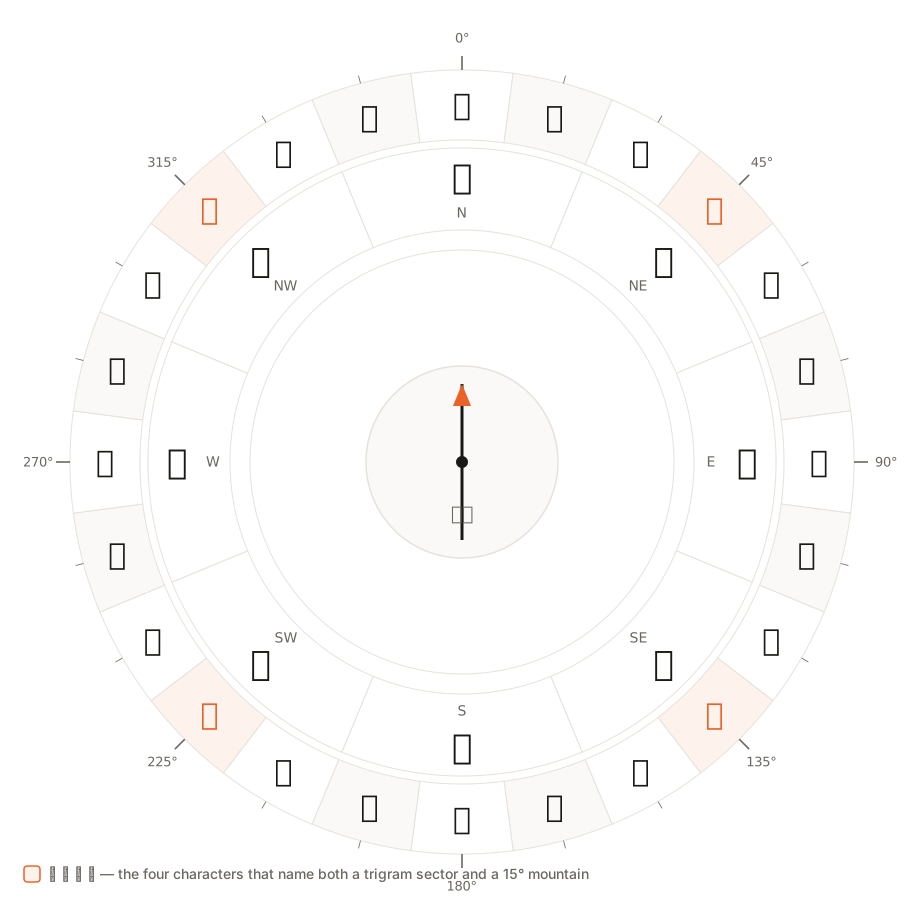
The rule is arithmetic, and the reference literature states it plainly: the 360° of the circle is divided into twenty-four equal parts, each occupying fifteen degrees, and each is called one 山 shān, a "mountain." What makes the ring worth explaining is not the arithmetic but the naming. The twenty-four labels weren't invented for the luopan; they were borrowed from three existing sets.
- Twelve Earthly Branches 地支 — 子 丑 寅 卯 辰 巳 午 未 申 酉 戌 亥, the same twelve that carry the zodiac animals, whose popular layer is the subject of our guide to the Chinese zodiac beyond horoscopes.
- Eight of the ten Heavenly Stems 天干 — 甲 乙 丙 丁 庚 辛 壬 癸. Stems and branches together form the sexagenary alphabet a Bazi chart is spelled from, covered in what Bazi actually is.
- Four "corner" trigrams 四维卦 — 乾 Qián, 坤 Kūn, 艮 Gèn, 巽 Xùn.
Why 戊 and 己 are not on the ring
Twelve plus eight plus four is twenty-four, and the classical mnemonic is 八干四维十二支: eight stems, four corners, twelve branches. The missing pair of stems is the most elegant thing about the construction. Baidu Baike's entry on 二十四山法 states the exclusion directly: the eight used are 甲乙丙丁庚辛壬癸, with a parenthesis noting that 戊 wù and 己 jǐ "belong to the central Earth position and are generally omitted."
The reason, under the Five Phases logic, is structural rather than mystical. Wood is East, Fire is South, Metal is West, Water is North — and Earth is the centre. 戊 and 己 are the Earth stems. Since a ring divides the rim of a circle and the centre has no bearing, they have nowhere to sit. The same logic surfaces in the layout, where stems arrive in yang/yin pairs flanking each cardinal branch: 壬 and 癸 (Water) flank 子 at north, 甲 and 乙 (Wood) flank 卯 at east, 丙 and 丁 (Fire) flank 午 at south, and 庚 and 辛 (Metal) flank 酉 at west.
The full ring, in compass order
All twenty-four characters are identical in simplified and traditional script. The arcs follow the exact fifteen-degree arithmetic with 子 centred on 0°; instruments and software differ over which side of a boundary a value falling precisely on the line belongs to, so treat the endpoints as convention rather than canon.
| # | Mountain | Pinyin | Type | Sector | Degrees |
|---|---|---|---|---|---|
| 1 | 壬 | rén | Stem (Yang Water) | N1 | 337.5° – 352.5° |
| 2 | 子 | zǐ | Branch (Rat) | N2 — due north | 352.5° – 7.5° |
| 3 | 癸 | guǐ | Stem (Yin Water) | N3 | 7.5° – 22.5° |
| 4 | 丑 | chǒu | Branch (Ox) | NE1 | 22.5° – 37.5° |
| 5 | 艮 | gèn | Trigram (Mountain) | NE2 — due NE | 37.5° – 52.5° |
| 6 | 寅 | yín | Branch (Tiger) | NE3 | 52.5° – 67.5° |
| 7 | 甲 | jiǎ | Stem (Yang Wood) | E1 | 67.5° – 82.5° |
| 8 | 卯 | mǎo | Branch (Rabbit) | E2 — due east | 82.5° – 97.5° |
| 9 | 乙 | yǐ | Stem (Yin Wood) | E3 | 97.5° – 112.5° |
| 10 | 辰 | chén | Branch (Dragon) | SE1 | 112.5° – 127.5° |
| 11 | 巽 | xùn | Trigram (Wind) | SE2 — due SE | 127.5° – 142.5° |
| 12 | 巳 | sì | Branch (Snake) | SE3 | 142.5° – 157.5° |
| 13 | 丙 | bǐng | Stem (Yang Fire) | S1 | 157.5° – 172.5° |
| 14 | 午 | wǔ | Branch (Horse) | S2 — due south | 172.5° – 187.5° |
| 15 | 丁 | dīng | Stem (Yin Fire) | S3 | 187.5° – 202.5° |
| 16 | 未 | wèi | Branch (Goat) | SW1 | 202.5° – 217.5° |
| 17 | 坤 | kūn | Trigram (Earth) | SW2 — due SW | 217.5° – 232.5° |
| 18 | 申 | shēn | Branch (Monkey) | SW3 | 232.5° – 247.5° |
| 19 | 庚 | gēng | Stem (Yang Metal) | W1 | 247.5° – 262.5° |
| 20 | 酉 | yǒu | Branch (Rooster) | W2 — due west | 262.5° – 277.5° |
| 21 | 辛 | xīn | Stem (Yin Metal) | W3 | 277.5° – 292.5° |
| 22 | 戌 | xū | Branch (Dog) | NW1 | 292.5° – 307.5° |
| 23 | 乾 | qián | Trigram (Heaven) | NW2 — due NW | 307.5° – 322.5° |
| 24 | 亥 | hài | Branch (Pig) | NW3 | 322.5° – 337.5° |
Three checks fall straight out of that table. Every cardinal point is a branch — 子 north, 卯 east, 午 south, 酉 west — and every intercardinal point is a trigram: 艮 northeast, 巽 southeast, 坤 southwest, 乾 northwest. Each forty-five-degree trigram sector contains exactly three mountains. And the 子–午 axis, Rat to Horse, is the north–south line, which is why the ordinary Chinese word for a meridian is 子午线 zǐwǔxiàn.
Our Feng Shui Luopan Reader draws this ring sector by sector. It reads the device magnetometer, or takes a bearing set by hand on a 0–359° slider in half-degree steps, and shows where that bearing lands on the 二十四山 ring and on the eight trigram bearings. It just maps an angle onto a coordinate system. The table does the same: the mountains name directions, they do not imply what a direction does.
The eight trigram bearings 八卦方位
Alongside the mountain ring sit the eight trigrams of the 后天八卦 (後天八卦) hòutiān bāguà, the Later Heaven or King Wen arrangement — summarised as "Water is placed downwards and Fire at the top; Thunder is in the East, while Lake is in the West."
| Trigram | Simp / Trad | Pinyin | Image | Bearing (45° sector) |
|---|---|---|---|---|
| ☵ Kan | 坎 | kǎn | Water 水 | N — 337.5°–22.5° |
| ☶ Gen | 艮 | gèn | Mountain 山 | NE — 22.5°–67.5° |
| ☳ Zhen | 震 | zhèn | Thunder 雷 | E — 67.5°–112.5° |
| ☴ Xun | 巽 | xùn | Wind 风 / 風 | SE — 112.5°–157.5° |
| ☲ Li | 离 / 離 | lí | Fire 火 | S — 157.5°–202.5° |
| ☷ Kun | 坤 | kūn | Earth 地 | SW — 202.5°–247.5° |
| ☱ Dui | 兑 / 兌 | duì | Lake 泽 / 澤 | W — 247.5°–292.5° |
| ☰ Qian | 乾 | qián | Heaven 天 | NW — 292.5°–337.5° |
The two rings nest exactly: each trigram's forty-five degrees is three mountains wide, so north 坎 is 壬 子 癸 and northeast 艮 is 丑 艮 寅. Four characters — 艮 巽 坤 乾 — do double duty as trigram and mountain, and 乾 is always read qián here, never gān. Only 离/離 and 兑/兌 differ between simplified and traditional script.
A second arrangement exists, and confusing the two is the commonest error in English-language material on the subject. The 先天八卦 xiāntiān bāguà, Earlier Heaven or Fuxi arrangement, places Qián south, Kūn north, Lí east and Kǎn west, organised by symmetry rather than seasonal flow. The encyclopedic account: "the bagua used in feng shui can appear in two different versions: the Earlier Heaven bagua, used for burial sites, and the Later Heaven bagua, used for residences," and it is Later Heaven that "is the sequence used by the Luo Pan compass." The "bagua map" of Western décor writing, a grid laid over a floor plan by where the front door is, is a twentieth-century adaptation involving no compass at all.
Our Bagua House Analysis tool works in the octant register: it takes a door-facing direction with a birth year and gender and lays out the tradition's eight-zone map of an existing home by the Eight Mansions 八宅 method. The zone labels it prints — four the tradition calls auspicious, four inauspicious — are the tradition's own vocabulary, and the sibling guide to feng shui Kua numbers covers how those personal trigrams are derived.
Two schools, and where the luopan belongs
Chinese Wikipedia records both streams as current in southern China by the Song dynasty: 「宋代南方地區流行起看形勢的巒頭派和看方位的理氣派」 — the landform-reading school and the direction-reading school became popular together.
| Form / Landform School | Compass / Principle School | |
|---|---|---|
| Names | 形势派 / 形勢派 · 峦头派 / 巒頭派 · 江西派 | 理气派 / 理氣派 · 理法派 |
| Pinyin | xíngshì pài / luántóu pài | lǐqì pài / lǐfǎ pài |
| Reads | The shape of the environment — mountains, rivers, buildings, surroundings | The bearing, expressed as a number |
| Uses a luopan? | Not essentially | Yes — this is the luopan's stream |
The one-line version: the Form school looks at the hill, the Compass school looks at the number, and the luopan exists to produce the number. Encyclopedic sources describe the Compass branch as "a collection of more recent feng shui techniques based on the Eight Directions, each of which is said to have unique qi," including "techniques such as Flying Star and Eight Mansions."
Of those, 玄空飞星 (玄空飛星) xuánkōng fēixīng — Flying Star — leans hardest on the twenty-four-mountain ring, and it is worth describing at the level of shape rather than recipe. The method cuts time into twenty-year blocks: "Time is divided into 20-Year cycles. Each cycle of 20 years is a Period or 'Yun'. A grand cycle comprises 9 Periods in total, which covers a span of 180 years." Within the 三元九运 frame the current grand cycle runs 1864–2043, and in this system the current period runs 2024 to 2043. A building has a sitting 坐 and a facing 向 direction, and "the Sitting Palace is always opposite of the Facing Palace." A chart is a three-by-three grid of "palaces" carrying numbers descended from the Lo Shu square 洛书 (洛書) — a genuine order-three magic square, every row, column and diagonal summing to fifteen. How the individual stars are then derived is documented mainly in practitioner manuals rather than encyclopedic or academic sources, so this guide stops there.
The sitting-and-facing pair is where our House Direction Analyzer operates. It takes a property's 坐山向 with the owner's details and reports the tradition's classifications: the owner's life trigram and East/West group, the house's group, the compatibility verdict the system produces, and classical sunlight and ventilation notes for that orientation. The verdicts belong to the tradition. The sunlight and ventilation observations are the one part of classical siting advice with an ordinary physical rationale, since which way a window faces does determine how much sun and cross-breeze a tropical room gets.
Magnetic north is not true north
The rest of this technical section is physics and government geomagnetic data, needing no attribution to any tradition.
A compass needle does not point at the geographic North Pole. It aligns with the horizontal component of the Earth's magnetic field where it happens to be standing — as the US National Centers for Environmental Information puts it, a compass "points in the directions of the horizontal component of the magnetic field where the compass is located, and not to any single point." The angle between that direction and true north is magnetic declination, counted positive east and negative west, and the correction is one addition: true bearing = magnetic bearing + declination, signed.
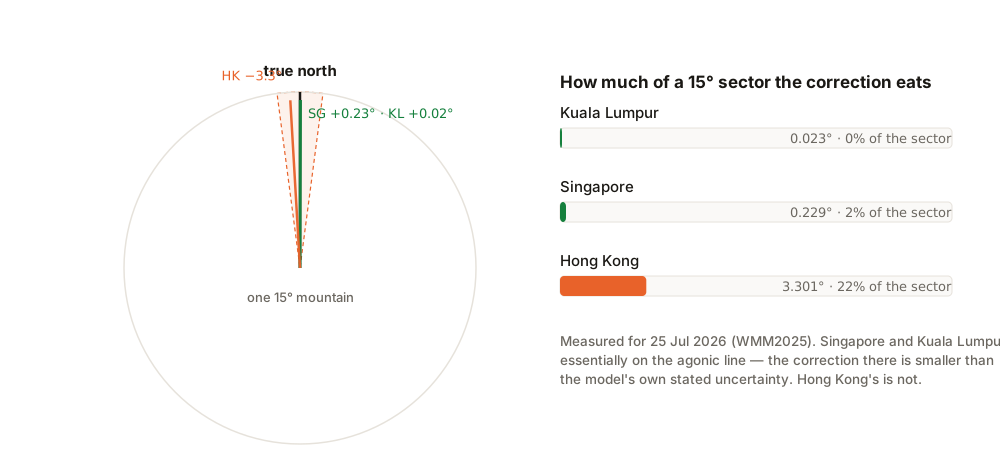
Declination varies by place and drifts with time, because the field moves; the north magnetic pole travelled roughly 1,100 km during the twentieth century, and its rate has accelerated from about 9 to about 52 km a year since 1970. Predicting it is the job of the World Magnetic Model, "the standard model for navigation, attitude, and heading referencing systems that use the geomagnetic field," produced jointly by NOAA NCEI and the British Geological Survey and updated every five years. The values below come from the BGS WMM2025 service, computed for 25 July 2026 at sea level; the right-hand column expresses each as a fraction of one fifteen-degree mountain.
| City | Declination, 25 Jul 2026 | Annual change | Share of a 15° mountain |
|---|---|---|---|
| Kuala Lumpur | +0.023° East (essentially zero) | +2.2′/yr E | 0.15% |
| Singapore | +0.229° East | +1.9′/yr E | 1.5% |
| Jakarta | +0.645° East | +1.4′/yr E | 4.3% |
| Bangkok | −0.665° (0.67° West) | +1.8′/yr E | 4.4% |
| Manila | −2.736° (2.74° West) | −2.3′/yr | 18% |
| Hong Kong | −3.301° (3.30° West) | −0.9′/yr | 22% |
| London | +1.173° East | +10.2′/yr E | 7.8% |
| Seattle | +14.897° East | −7.4′/yr | 99% — almost a whole mountain |
The Hong Kong figure has an independent check on it, which is why it is the one to quote. The Lands Department publishes an official value: "The Magnetic Declination in 2026 at Lion Rock is 3°17' west of True North changing by approximately 1' westward annually." That is 3.283°; the BGS model, computed separately, gives 3.301°. The two agree to within two hundredths of a degree, and on the direction of drift.
Singapore and Kuala Lumpur, meanwhile, sit almost exactly on the agonic line, the contour along which declination is zero. In Singapore the correction is about a quarter of a degree; in Kuala Lumpur, under a fortieth — smaller in both cases than the model's own stated uncertainty, which NOAA gives as mostly under 0.3°. In Hong Kong the correction is fourteen times larger.
What that does to a fifteen-degree sector is easy to show, because the boundaries sit 7.5° either side of a sector's centre. Take a luopan in Hong Kong reading a magnetic bearing of 355°. That falls inside 子 zǐ, 352.5° to 7.5°. Apply the local declination — 355 minus 3.30 — and the true bearing is 351.7°, inside 壬 rén, 337.5° to 352.5°. Same building, same instrument, same afternoon, different mountain, purely on whether the correction was made. The identical arithmetic in Singapore shifts the reading by 0.229°, so a flip needs a bearing already within a quarter-degree of a boundary. Whether practitioners should apply the correction is a question inside the tradition, conventions differ, and this guide does not adjudicate it. The measurement point holds either way. A system whose smallest unit is fifteen degrees is only as good as the angle fed into it.
Interference: the error that is not on any map
Declination is the error that can be looked up. The one that cannot is deviation — the error induced by nearby metal, or in the classic formulation, a compass "influenced by the magnetism of the iron used in the construction of the vehicle." Two mechanisms are involved, and popular writing muddles them. Hard-iron effects come from a permanently magnetised object nearby, such as a speaker magnet or a magnetic case clasp, adding a constant field and producing a fixed bias. Soft-iron effects come from un-magnetised ferromagnetic mass such as steel rebar or a car body, which generates no field of its own but distorts the Earth's field lines around it, so the error changes as the instrument turns.
Reinforced concrete is steel-reinforced by definition and rebar concentrates magnetic flux, so a modern apartment, office floor or MRT station is a soft-iron environment by construction — exactly the environment a luopan gets used in. NOAA lists magnetised crustal rocks and buried iron pipes among the major error sources, and notes that structures like power lines are "too small to be seen with our models, which have resolutions of at least 30 km." Nobody has published an authoritative measured figure for how far a compass swings inside a typical concrete building, so this guide will not invent one: the mechanism is established, the magnitude is not. Taking readings outside, away from vehicles and metal, is sound instrumental practice on physics grounds alone, and our Luopan Reader carries the same warning in its own interface — keep away from metal, electronics and magnets, and prefer an outdoor spot or an open room.
The proportion problem: the phone is the dominant error
A smartphone compass is a three-axis magnetometer, a chip a few millimetres across, fused with the accelerometer so software can resolve a heading at arbitrary tilt. It measures the total local field — Earth's field plus every stray field inside the handset, from battery currents to speaker and vibration-motor magnets to a charging coil or the case. That is what the figure-of-eight dance solves for. Google's Maps documentation is direct about it: "make a figure 8 until the beam becomes narrow and points in the right direction." The width of that beam is the app displaying its own uncertainty about the heading.
The peer-reviewed evidence is not flattering. Novakova and Pavlis (2017), in the Journal of Structural Geology, benchmarked two Android devices, and seven compass apps installed on one of them, against an analogue Freiberg geological compass across twenty-five fractures, collecting over 14,000 sensor readings. Their abstract reports "a high level of disagreement was observed with discrepancies as high as 80° with azimuthal errors dominant," and that "the magnetic sensor in the tablet was unacceptably unstable." Azimuth — the exact quantity a luopan measures — was the weaker of the two axes tested. Asked whether a user watching the device could spot the drift as it happened, the authors answer: "We believe the answer is probably no." Other studies are kinder, and the same paper cites them: Lee et al. (2013) calculated a variance of 1.7° for dip and 2.63° for dip direction across forty fractures. The honest range runs from two or three degrees in good conditions to a documented eighty-degree failure nobody in the field could detect.
Putting the two error terms side by side shows why proportion matters. Singapore's declination correction is 0.229°. Published smartphone azimuth error reaches 80° in the worst documented case — roughly three hundred and fifty times larger than the correction people argue about, against a sector only fifteen degrees wide. Of the two, the instrument is what deserves the worry, not the map datum.
A physical luopan has an engineering advantage here. A pivoted needle has no software between the field and the reading; its magnet is large and low-friction and averages over a far bigger volume than a millimetre-scale chip; it holds no battery, speaker or charging coil; and its zeroing is mechanical and visible, the needle going onto the 海底线 where anyone can see whether it did. None of that makes the interpretive rings more valid — it makes the angle more trustworthy, which is a different claim. The cleanest line between this guide's two registers is a physical one. A magnetometer measures the geomagnetic field in nanotesla, and that is all it measures. It does not detect qi. Our Luopan Reader says as much in its own disclaimer — a cultural-entertainment reference, professional work a matter for a licensed practitioner, and a phone magnetometer of limited accuracy that does not replace a real luopan.
What can and cannot be said
Two things are true at once, and an honest account needs both. The first is that the interpretive layer is not evidence-based, and the careful encyclopedic phrasing is worth reproducing rather than flattening: "In Western philosophy of science, feng shui is generally regarded as non-scientific, while some scientific skeptics have more narrowly classified it as a pseudoscience." Non-scientific is the broad position; pseudoscience is a stronger claim held by some. The more useful observation is internal—the schools disagree with each other about the same building. Form and Compass read entirely different things; Earlier and Later Heaven assign the same trigram to different bearings; Flying Star readings change with the twenty-year period; and there is no settled convention on declination. A system in which competing lineages produce different answers from identical measurements is a tradition of interpretation rather than a measurement science — our reading of the structure above, not a citation.
The second truth is that the object underneath it is genuine. The compass sits in the standard list of the Four Great Inventions of imperial China, beside gunpowder, papermaking and printing. Shen Kuo's 1088 note on the eastward displacement of the needle is the earliest securely dated written description of magnetic declination anywhere, and Europeans remained unaware of the effect for roughly another four hundred years. There is even an argument that it left a fingerprint in the ground plan: a preprint by A. C. Sparavigna of the Politecnico di Torino measures the Forbidden City's axis from satellite imagery at about two degrees off true north, reading that as evidence Ming surveyors used magnetic compasses where their Yuan predecessors used astronomical methods. One researcher's analysis, not peer-reviewed and not consensus — but if it holds, declination is legible in the floor plan of the largest palace complex on earth.
The practice across the region
The declination table above is what makes this subject regionally specific, not who believes what.
On the cultural side, the strongest evidence about how these beliefs behave in a real market comes from Singapore. He, Liu, Sing, Song and Wong, publishing in Management Science in 2019, examined Singapore housing transactions and found a price discount of about 1.3% for addresses considered very unlucky and a premium of about 1.9% for very lucky ones, with related estimates of −1.1% for numbers ending in 4 and +0.9% for numbers ending in 8. What makes the study the right citation for a guide like this one is the control: residents of lucky-numbered homes were no less likely to have car accidents than residents of unlucky-numbered ones. The beliefs moved the prices. They did not move the outcomes.
Institutional traces exist too. Singapore's National Heritage Board writes on its Roots portal that "the Merlion statue faced east, an auspicious feng shui (Chinese geomancy) orientation that is believed to bring prosperity," while attributing the statue's 2002 relocation to the Esplanade Bridge blocking views and to seawater corrosion rather than to geomancy. Many other famous "feng shui building" stories about landmarks in Singapore and Hong Kong trace only to practitioner blogs and tourism pages, sometimes contradicting one another, and this guide does not repeat them. The tradition also has more than one measuring instrument: VnExpress International reported in June 2025 that in Vietnam, where the practice is called phong thủy, "many still rely on the lu ban ruler to size stairs and doorways" — the thước Lỗ Ban, a measuring rule with auspicious and inauspicious bands marked along its length.
Regulation is thin everywhere in the region, and no licensing regime for feng shui practitioners exists in Singapore, Malaysia or Hong Kong. Singapore has an industry self-regulatory body, the International Feng Shui Association, founded in 2004 and accrediting members under the post-nominal AFSM, whose accreditation carries no legal force. When Hong Kong's government engaged with the subject at all — a 2009 Legislative Council reply about the common practice of skipping floors numbered 4, 13, 14, 24, 34 and 44 — it recorded that the Building Authority had no statutory power to refuse a building plan over floor numbering, and proposed a voluntary code of good practice instead. On the size of the consulting industry there is no credible published figure at all: every number in circulation traces to practitioner self-report or to a source selling courses, so the honest move is to state the absence rather than repeat one.
In November 2023, Hong Kong police reported that 185 victims lost roughly HK$100 million in about a week to fraudsters impersonating feng shui masters, who offered "exclusive stock tips based on feng shui" over WhatsApp and funnelled victims into fake trading platforms. The harm in this space comes from predictive claims dressed as expertise. Explaining the instrument and declining the predictions is not squeamishness — it is the only version of this subject that does a reader any good.
What our compass tools do, and don't
All three are structural: the Feng Shui Luopan Reader, Bagua House Analysis and the House Direction Analyzer each turn a direction into the tradition's own vocabulary and stop there. None forecasts events, none speaks in our voice rather than the tradition's, and none is a reason to sign or not sign anything.
FAQ
What are the 24 Mountains, in one sentence?
Twenty-four named sectors of fifteen degrees each, covering the full 360° of the compass, labelled with twelve Earthly Branches, eight Heavenly Stems and four trigrams.
Why are 戊 and 己 missing from the ring?
They are the two Earth stems. In the Five-Phase system, Earth is the centre, not a direction. Since a ring has no centre, the Earth stems have no place, leaving the eight that make up the twenty-four mountains.
Does magnetic declination change a luopan reading?
It can, where declination is large relative to a fifteen-degree sector. In Hong Kong the correction is 3°17′ west, so a magnetic bearing of 355° falls in 子 while the corresponding true bearing of 351.7° falls in 壬. In Singapore the correction is about 0.23° and in Kuala Lumpur about 0.02°, so a sector change requires a reading already within a fraction of a degree of a boundary. Whether to apply the correction is a convention question inside the tradition, and practitioners differ.
How accurate is a phone compass compared with a real luopan?
Not very, on the peer-reviewed evidence. A 2017 study in the Journal of Structural Geology collected over 14,000 readings from Android devices and reported discrepancies against an analogue compass "as high as 80°," with azimuth the weaker axis and the drift undetectable in the field; other studies report two to three degrees in good conditions. A physical luopan has a large pivoted needle, no software in the path, no internal magnets or battery currents, and a mechanical zeroing step visible as it happens — which makes the angle more trustworthy, though it says nothing about the interpretation layered on top.
Was the compass really invented for feng shui?
That claim goes further than the sources support, but the documentary trail is striking. The first incontestable written description of a magnetised needle, in Shen Kuo's Dream Pool Essays of 1088, describes geomancers magnetising needles, and predates the first recorded maritime use by roughly thirty years. An account of magnetic declination appears earlier still, in a geomancy manual conventionally dated to 880 CE. The instrument's paper trail begins in site selection rather than seafaring.
- "Luopan" — Wikipedia (definition, heaven-centre cross line, shipan precursors, 24 directions at 15°, south-pointing convention) (accessed 25 Jul 2026)
- 罗盘 — Baidu Baike (天池/海底 components, 内盘 layers, 外盘 and 天心十道) — user-edited encyclopedia (accessed 25 Jul 2026)
- 二十四山法 — Baidu Baike (360° into 24 parts of 15°; the eight stems and the omission of 戊/己) — user-edited encyclopedia (accessed 25 Jul 2026)
- 堪輿羅盤 — Chinese Wikipedia (the ordered 24-mountain sequence; Wan'an craft tradition and ring counts) (accessed 25 Jul 2026)
- "Bagua" — Wikipedia (Later Heaven assignments; Earlier vs Later Heaven use; the Luo Pan sequence) (accessed 25 Jul 2026)
- "Feng shui" — Wikipedia (Form and Compass branches; Flying Star and Eight Mansions; the non-scientific / pseudoscience wording) (accessed 25 Jul 2026)
- 風水 — Chinese Wikipedia (巒頭派 and 理氣派 both current in southern China by the Song dynasty) (accessed 25 Jul 2026)
- "History of the compass" — Wikipedia (Lunheng, the 880 CE declination account, Wujing Zongyao, Shen Kuo 1088, Zhu Yu, Neckam 1187) (accessed 25 Jul 2026)
- "Shen Kuo" — Wikipedia (the 1088 declination observation; Europe unaware for another four hundred years) (accessed 25 Jul 2026)
- "Flying Star Feng Shui" — Wikipedia (20-year periods; sitting and facing palaces; the 24 Mountain ring as the key ring) — stale on the current period (accessed 25 Jul 2026)
- British Geological Survey — World Magnetic Model (WMM2025) web service; declination and secular variation computed for eight cities at 25 Jul 2026 (accessed 25 Jul 2026)
- NOAA NCEI — Geomagnetism FAQ (what a compass points at; model accuracy; local anomalies; 30 km model resolution) (accessed 25 Jul 2026)
- NOAA NCEI — World Magnetic Model (joint NOAA/BGS production; five-year update cycle) (accessed 25 Jul 2026)
- Hong Kong Lands Department — official 2026 magnetic declination at Lion Rock (3°17′ west, drifting ~1′/yr westward) (accessed 25 Jul 2026)
- Natural Resources Canada — compass bearings and magnetic declination (deviation vs declination) (accessed 25 Jul 2026)
- Novakova, L. & Pavlis, T. L. (2017), "Assessment of the precision of smart phones and tablets for measurement of planar orientations: A case study," Journal of Structural Geology 97: 93–103 (14,000+ readings; discrepancies to 80°; azimuth the weaker axis) (accessed 25 Jul 2026)
- Google Maps Help — compass calibration and beam width as displayed heading uncertainty (accessed 25 Jul 2026)
- Sparavigna, A. C., "Magnetic Compasses and Chinese Architectures," arXiv:1709.07056 — preprint, not peer-reviewed (Forbidden City axis measured from satellite imagery) (accessed 25 Jul 2026)
- He, Liu, Sing, Song & Wong (2019), "Superstition, Conspicuous Spending, and Housing Market: Evidence from Singapore," Management Science 66(2): 783–804 (price discount and premium; no difference in car accidents) (accessed 25 Jul 2026)
- Hong Kong SAR Government — LegCo written reply, 4 November 2009 (floor-numbering practice; no statutory power; voluntary code of good practice) (accessed 25 Jul 2026)
- Singapore National Heritage Board, Roots portal — the Merlion's east-facing orientation, and the 2002 relocation attributed to bridge views and corrosion (accessed 25 Jul 2026)
- International Feng Shui Association (Singapore) — self-regulatory body, founded 2004, AFSM accreditation (no legal force) (accessed 25 Jul 2026)
- South China Morning Post — 16 November 2023, Hong Kong feng-shui stock-tip fraud (185 victims, roughly HK$100 million in about a week; "exclusive stock tips based on feng shui" over WhatsApp) (accessed 25 Jul 2026)
- VnExpress International — 9 June 2025, phong thủy in Vietnam and the thước Lỗ Ban / lu ban ruler ("Many still rely on the lu ban ruler to size stairs and doorways") (accessed 25 Jul 2026)
- "Four Great Inventions" — Wikipedia (the compass among the four) (accessed 25 Jul 2026)

View author profile → · Editorial policy