
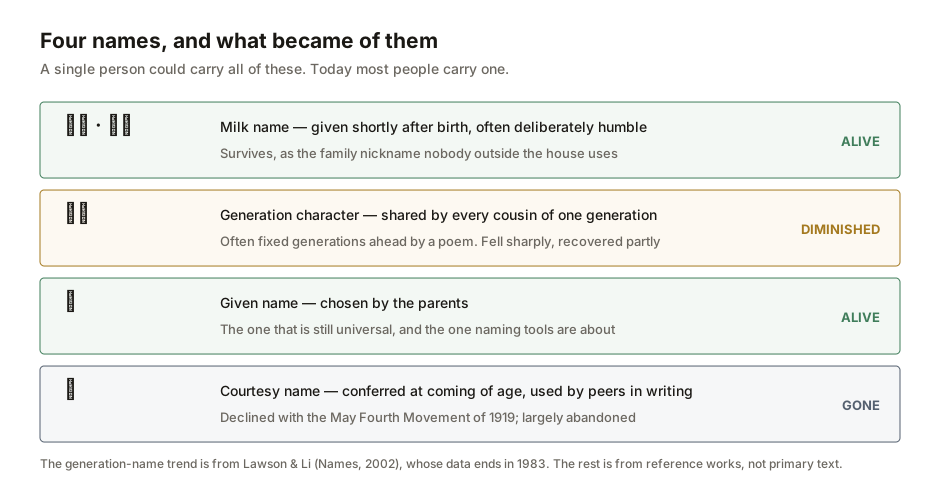
A Chinese name has two parts, and almost everyone knows the first one: the surname comes first. The part after the surname, however, was never a single thing. A person could carry a name for the family to use, a name shared with every cousin born in the same decade, a name their parents chose, and a name conferred on them at twenty that only their peers would use in writing.
Three of those four are gone or going. Which they are, and why, is most of what there is to say about how Chinese given names actually work.
The generation character, and what happened to it
The idea is elegant. Siblings and paternal cousins of the same generation share a character in their given name, stating its owner's place in the family before anyone has to ask. In many lineages the sequence was not improvised but fixed generations in advance, in a poem written by an ancestor, each character in turn allocated to a generation still unborn.
It is the sort of thing that invites romanticising, so here is the measured version. A study in Names: A Journal of Onomastics tracked the incidence of generation names across four periods between 1940 and 1983 and found:
"The major finding is that generation names decreased significantly until the 1960s; since 1976 their use has increased, but not to pre-1950 levels."
Two things follow, and the second is the one usually skipped. The practice really did collapse in mainland China through the middle of the century, under urbanisation, the loosening of ties to an ancestral place, and a political period in which a marker of lineage was a liability. And the recovery is partial — the tradition did not come back to where it was.
That study's data stops in 1983, which means it tells us nothing about what parents are doing now. Anyone who tells you generation names are enjoying a revival today is not citing this, because this does not reach that far.
The name that was conferred, not chosen
The 字 was a different thing altogether: not a name you were given as a baby but one conferred at a coming-of-age ceremony, conventionally around twenty. Its function was social distance. Your given name belonged to your elders; your 字 was what equals called you, and what appeared in formal writing. Addressing someone by their given name when you should have used their 字 was a small act of rudeness with a name of its own.
The practice declined with the May Fourth Movement of 1919 and is now essentially gone, simplifying the modern naming question to a single choice.
The milk name survived, though nobody calls it that. A 乳名 or 小名 was given shortly after birth, often something humble or unflattering on the theory that it would not attract unwanted attention to the child. The practice survives today as the nickname that never leaves the house.
Chosen freely, and identically
Which leaves the given name, and a paradox worth sitting with. It is the freest naming decision in the world — any character, any meaning, no list to pick from — and it produces some of the most uniform results anywhere.
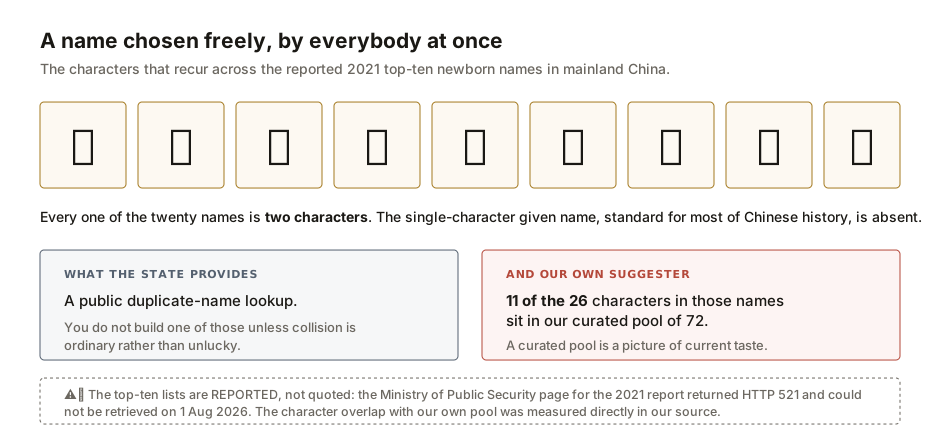
Look at what the reported top-ten lists of 2021 newborn names have in common. Every one of the twenty is two characters. The single-character given name, standard for most of Chinese history, has vanished from the top ranks because such names collide too often in a population this large.
And a small set of characters does most of the work: 沐, 宸, 辰, 泽, 宇, 涵, 诺, 汐, 语. These are not traditional in any deep sense. They are fashionable, in the way that names are fashionable everywhere, and they will date their bearers as precisely as a birth certificate.
The strongest evidence that this is a mass phenomenon is not a statistic at all. China's Ministry of Public Security operates a public duplicate-name lookup. States do not build those for rare problems.
What this means if you are choosing a name
Mostly it means the meaning of a character is doing less work than the fashion of it. A parent choosing 泽 for its sense of moistening and nourishing is doing so alongside tens of thousands of others moved by the same idea. That is not a reason to avoid it. It is a reason to know what you are doing.
If you want the classical layer rather than the fashionable one, our surname origin lookup gives the clan story behind the family name, which is the part of a Chinese name that genuinely is old. And if you have arrived here from the numerology side, the five-grid stroke system is a separate subject with its own arithmetic and its own problems — we have written it up in the company-naming guide, including the stroke-counting error we found in our own tools.
Names on identity documents
One practical point for readers in this region, since it causes real confusion: an English name is not automatically an official name.
In Hong Kong the identity card carries both — the Immigration Department describes the card as showing a "Name in English and Name in Chinese", and both are registered particulars. Amending either is a formal process requiring supporting documents, an interview, and in some cases a statutory declaration.
In Singapore, changing a registered name requires a deed poll, a legal document executed by an advocate or solicitor, with parental execution for anyone under 21. An English name used since primary school is either on the document or it is not; simply using it does not make it official.
Mainland China maintains a standard character set — the 通用规范汉字表, promulgated in June 2013, with 8,105 characters in three tiers, the third of which is explicitly for characters used in names and terminology. That is a strong hint about why rare characters cause trouble at registration desks and in databases. It is not, and we could not find, a rule that a name must be drawn from it.
What this audit found in our own tools
We read the source of the tools a guide will link to before writing it, and this time the finding was in the stroke counts.
Our baby name suggester keeps two character pools, one simplified and one traditional. The traditional pool converts each character to 繁體, and its own comment said the stroke counts were "kept as-is". That was an accurate description of a bug. Twelve of seventy-two traditional characters displayed their simplified twin's stroke count, printed beside the character with a 筆 suffix. 麗 was shown as 7 strokes, which is 丽's count; it has 19. 澤 was shown as 8, which is 泽's; it has 16.
Stroke count is the one number this tradition runs on, so the filter was wrong for precisely the readers most likely to use it.
Rather than correct the ones we had noticed, we checked all 144 entries against hanzi-writer-data, the source our stroke library already uses. That found one more, in the simplified pool: 钰 listed as 13 when it is 10. That error had been cancelling a second one — the traditional pool inherited 13, which happens to be correct for 鈺. Fixing only what was visible would have left one wrong and made the other wrong.
All thirteen counts are now taken from the data rather than typed by hand, and both pools verify against it. We also added a clarification to the code that these are modern stroke counts for browsing and filtering. The five-grid system is defined on 康熙 counts, which are different numbers, and conflating the two is how the earlier bug in our sancai tools happened.
One thing we are recording rather than fixing. Of the 26 distinct characters in those reported top-ten names, 11 are in our 72-character pool. A "curated" naming pool is largely a snapshot of current taste, with no single correct alternative. A reader should know, however, that a suggester shows the fashion, not an escape from it.
Ask the oldest relative whether your lineage has a generation poem before assuming it does not — that question expires with the person who can answer it. Treat character meaning and character fashion as two separate things, because the beautiful sense you have found in 泽 is the same sense that put it in the top ten. Check what a rare character will do at a registration desk, since the state maintains a standard set and systems outside it behave badly. Put the name you actually use on the document, in whichever script, rather than discovering the gap at a bank. And be sceptical of any tool that scores a name, including ours — a curated pool is taste, and a five-grid reading is a tradition, and neither is a measurement.
- The generation-name finding is quoted verbatim from Li Zhonghua and Edwin D. Lawson, "Generation Names in China: Past, Present, and Future", Names: A Journal of Onomastics, vol. 50 no. 3 (2002), abstract read 1 August 2026. The study measured four periods between 1940 and 1983. ⚠️ Its data ends in 1983 and it is a mainland-China study, so it supports no claim about naming today, nor about Taiwan, Hong Kong or the diaspora — and the body says so.
- ⚠️ The mechanism of the generation poem (派詩/字輩詩), the courtesy name and its association with the May Fourth Movement of 1919, and the milk-name tradition are from reference works and general scholarship rather than primary text. They are described as what the tradition holds.
- ⚠️ The 2021 newborn name lists are REPORTED, not quoted. China's Ministry of Public Security publishes an annual 全国姓名报告, but its page for the 2021 report returned HTTP 521 on 1 August 2026 and could not be retrieved, and the People's Daily write-up did not yield the figures either. The structural observations — that all twenty names are two characters, and that a small set of characters recurs — are visible in the names themselves.
- Hong Kong: the Immigration Department states the identity card shows a "Name in English and Name in Chinese", with amendment requiring form ROP 73, supporting documents and an interview (immd.gov.hk, read 1 August 2026). Singapore: ICA requires a deed poll executed by an advocate or solicitor to change a registered name, executed by parents for a registrant under 21 (ica.gov.sg, read 1 August 2026). ⚠️ Malaysian practice was not sourced and is not described.
- The 通用规范汉字表 was promulgated on 5 June 2013 with 8,105 characters in three tiers, the third covering characters used in names and terminology. ⚠️ No rule restricting personal names to the table was found, and none is claimed.
- The figures for our own tool — 12 of 72 traditional characters carrying simplified stroke counts, one further error in the simplified pool, 13 corrections in total, and 11 of 26 top-ten characters present in our curated pool — were measured in our own source on 1 August 2026 against hanzi-writer-data. Full audit detail in docs/guide14-chinese-given-names-sources.md.
General information about naming practice and about what identity documents record, not legal advice. Naming customs vary between families, lineages and jurisdictions far more than any general account can capture, and a description of what a tradition holds is not a claim that it predicts anything. Where this guide states a limit on its own sources it means it: the generation-name study stops in 1983, the newborn-name figures are reported rather than quoted, and Malaysian identity-document practice is absent because we did not verify it.