

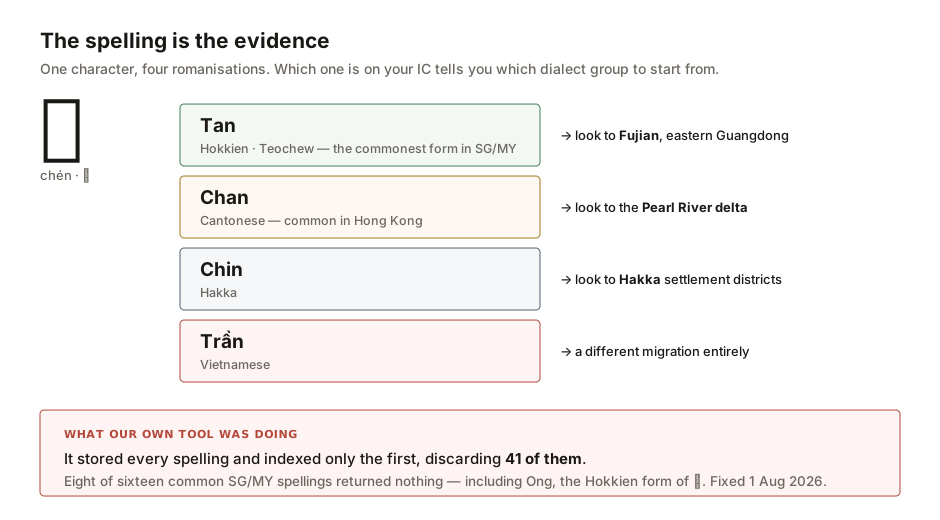
If your identity card says Tan, someone in your family once spoke Hokkien or Teochew. If it says Chan, the household language was Cantonese. If it says Chin, Hakka. All three are the same character, 陳, and the difference between them is not a spelling preference. It is a record of which dialect group your ancestors belonged to, written down by a colonial clerk who asked a name and wrote what he heard.
For anyone starting to trace Chinese ancestry in Southeast Asia, that is the most useful fact there is. The dialect group narrows everything that follows.
Why the dialect group is the key that fits
The Chinese who came south in the nineteenth and early twentieth centuries did not arrive as a single population. They came in dialect-group streams, each drawn from particular counties, each landing in particular trades and particular towns.
Knowing the dialect group points you to a region of origin, not just a country: Hokkien speakers came largely from southern Fujian, Teochew from the Chaoshan districts of eastern Guangdong, Cantonese from the Pearl River delta, Hakka from the inland hill districts, Hainanese from the island. It identifies the clan and district associations your family might have joined, since they organised by surname and home district together. And it suggests the language of the records.
Our Chinese surname origin lookup takes a romanised spelling and returns the character, the dialect the spelling comes from, and the classical origin of the clan. That is step one. The tool is a pointer, not a family tree.
Indonesia is where the trail most often breaks
For families with Indonesian ancestry there is a discontinuity in the record that has nothing to do with archives being lost.
In December 1966 the Indonesian cabinet issued Keputusan Presidium Kabinet No. 127/U/Kep/12/1966. Its official title, in the archive catalogue of the Yogyakarta provincial government, is "peraturan ganti nama bagi Warga Negara Indonesia yang memakai nama Cina" — regulations on name-changing for Indonesian citizens who use Chinese names.
The form and the effect were different things. On its face, the decision established a procedure: rules for those changing their names. It arrived inside the New Order's assimilation programme, alongside the closure of Chinese-language schools and restrictions on Chinese publications, and in practice it was experienced as compulsory. Both halves of that sentence matter, and they come from different places: the title is from the archive, the account of how it operated is from historians.
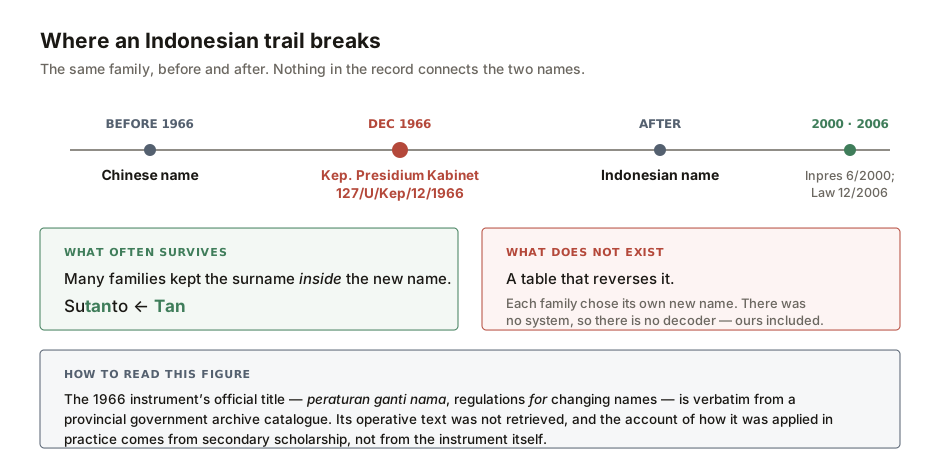
The effect on research is blunt: a family's documents may carry one name before roughly 1967 and a completely different one after, with no link between them.
One useful technique remains. Many families kept the surname inside the new name: Tan, for instance, survives inside Sutanto. So an Indonesian name that looks entirely Indonesian may carry a Hokkien syllable in the middle of it, and it is worth reading the names in your own family aloud with that possibility in mind.
But this was a choice each family made for itself, not a scheme anybody administered. There is no table that reverses it — not ours, not anyone's — and any tool claiming to convert Indonesian names back to Chinese ones is guessing.
Two later instruments matter mostly for dating documents. Presidential Instruction 6/2000, issued in January 2000, revoked the 1967 ban on Chinese religious and cultural expression. Law No. 12 of 2006 on citizenship replaced the 1958 law and removed the legal basis for the SBKRI, the citizenship certificate that had been demanded specifically of ethnic Chinese for passports, marriage registration and university entry. That certificate was a burden at the time. It is now sometimes the only document that links a family's two names.
What the records actually are, and what they are not
Most guides skip what comes next.
There is no searchable pan-ASEAN Chinese genealogical index. Nothing you can type a surname into that returns your ancestors. What exists is a scatter of holdings, most of them offline:
Clan and district associations kept membership rolls, burial records and mutual-aid ledgers, and many still hold them. Access is generally in person, generally in Chinese, and entirely at the association's discretion — these are private bodies, not public archives.
族谱 (zupu), the clan genealogies, are held by lineage and usually kept in the ancestral village rather than in the country your family migrated to. They are not systematically digitised, and a family that left in 1890 may appear in one as a single line of departure, or not at all.
Civil and colonial records — birth, death, marriage, immigration, cemetery registers — are the most searchable layer, and the place where romanisation matters most, because the same ancestor may be spelled three ways across four documents.
It helps to grasp the scale of the search. The number of direct ancestors doubles every generation; five generations back is thirty-two people, and ten is over a thousand — our ancestor count calculator does that arithmetic, and it is a useful corrective to the idea that a family tree is a line rather than a rapidly widening fan. If a DNA test is what brought you here, the shared DNA calculator shows what percentage each relationship is expected to share, which is the difference between a match that means something and one that does not.
A dialect group narrows a search, but it does not resolve one. Many of these searches end without an answer — a normal outcome, not a sign of failure.
What this audit found in our own tools
We audit our own tools for these guides, and this time we found ourselves making the exact mistake we warn against.
Our surname lookup stored every dialect spelling and could only find the first one. The tool builds its search index from each surname's list of diaspora forms, but kept only the first token of each entry. An entry reading 'Heng / Ong (Hokkien)' indexed Heng and threw away Ong — the Hokkien form of 王, the commonest surname in China. Across the dataset, 90 romanised forms were indexed and 41 were discarded, every one of them an alternative sitting after a slash.
Tested with sixteen spellings someone in Singapore or Malaysia would actually type, eight returned nothing: Ong, Goh, Yeo, Sim, Neo, Toh, Quek and Chin. The tool's own documentation promised users could find their family name "regardless of which dialect their forebears used". It now indexes every alternative, and twenty-three of twenty-seven test spellings resolve.
It also told users, in three languages, that it covers "the top 50 most-common surnames". It holds 35. Corrected everywhere it appeared. And two dialect forms were missing outright — Yeo, the Hokkien and Teochew form of 杨, and Chin, the Hakka form of 陳 — so a Hakka Chin could not find themselves in a tool built to find them. Both added.
Three spellings still fail, and for now they will continue to. Sim, Neo and Toh point at 沈, 梁 and 卓/杜, and of those only 梁 is in the dataset at all. Adding a surname properly means sourcing its census rank, its share of the population and its classical origin in three languages. Inventing any of that to close a gap would be worse than the gap. It is queued as its own job.
One more thing we are recording rather than building: the dataset is ranked by the 2020 PRC census, which is the wrong prior for this audience. Southeast Asia's Chinese population came overwhelmingly from two provinces, so a mainland ranking systematically under-weights exactly the surnames our readers have.
Write down every spelling of the family name you can find, across every document, and treat the variations as evidence rather than errors — they are the dialect record. Establish the dialect group before you look for anything else, because it determines which province, which associations and which language you are searching. Talk to the oldest living relative first, since an ancestral village name remembered out loud is worth more than any online index, and that source expires. For Indonesian ancestry, read the modern names aloud listening for a buried surname, and expect the trail to stop at 1966 regardless. And expect not to finish. This research is manual, partial and often inconclusive, and anyone promising otherwise is selling something.
- The official title of Keputusan Presidium Kabinet No. 127/U/Kep/12/1966 — "peraturan ganti nama bagi Warga Negara Indonesia yang memakai nama Cina" — is verbatim from the catalogue of the Dinas Perpustakaan dan Arsip Daerah DIY, the Yogyakarta provincial government archive, read 1 August 2026. ⚠️ That is a CATALOGUE entry: it confirms the instrument's title, number and year. Its operative text was not retrieved.
- ⚠️ The account of how the decision operated in practice — that it arrived within the New Order assimilation programme alongside school closures and publication restrictions, and was experienced as compulsory — is from secondary scholarship and reference works, not from the instrument. It is characterisation, and is flagged as such in the body.
- ⚠️ Presidential Instruction 6/2000 (January 2000, revoking the 1967 ban on Chinese religious and cultural expression) and Law No. 12 of 2006 on citizenship (replacing the 1958 law and removing the basis for the SBKRI) are from secondary sources; neither instrument's text was retrieved.
- ⚠️ The Tan → Sutanto example of a surname surviving inside a new name is widely reported and is used here as an illustration of a pattern, not as a documented rule. Public-figure examples of the same pattern exist but are likewise reported rather than documented, and none is presented here as a mapping.
- The dialect romanisations (Tan and Yeo as Hokkien/Teochew forms, Chan as Cantonese, Chin as Hakka, Trần as Vietnamese) were checked against surname reference works on 1 August 2026 before being added to our tool.
- The figures for our own tool — 90 romanised forms indexed, 41 discarded, eight of sixteen test spellings failing before the fix and twenty-three of twenty-seven resolving after it — were measured in the tool's source and in the browser on 1 August 2026. Full audit detail in docs/guide18-chinese-ancestry-sources.md.
General information about genealogical research, not a research service and not legal or immigration advice. The Indonesian material describes a discriminatory policy and its consequences for records; it is included because it determines what a researcher will and will not find, and every claim about it carries its provenance above. Records held by clan and district associations belong to those associations, and nothing here should be read as a suggestion that you are entitled to access them. Every figure carries the date it was read.