Measure a bedroom in Petaling Jaya — say 3.5 by 4 metres, which is an ordinary master bedroom — and ask this site how much air-conditioning it needs. Until this week you got two answers.
Our BTU calculator said 5,000 BTU per hour. Our air-conditioner sizing calculator said 9,000 — a 1 horsepower unit. Walk into any dealer in Selangor with those dimensions and they will quote you a 1.5 hp.
One of those tools was wrong, and it was ours in the sense that both are. This guide explains what we found when we settled the argument. The answer is less about air-conditioners than about what happens when a rule of thumb crosses a latitude.
Two calculators, one bedroom, two answers
The gap was not a rounding quirk. Run both algorithms across every room size and they disagree by exactly the same factor — 2.23 — from a box room to an open-plan living-dining.
| Room | Old BTU calculator | Sizing calculator |
|---|---|---|
| Small bedroom, 9 m² | 5,000 BTU | 9,000 BTU · 1 hp |
| Master bedroom, 14 m² | 5,000 BTU | 9,000 BTU · 1 hp |
| Large bedroom, 18 m² | 5,000 BTU | 12,500 BTU · 1.5 hp |
| HDB living room, 25 m² | 8,000 BTU | 18,000 BTU · 2 hp |
| Living-dining, 35 m² | 10,000 BTU | 24,000 BTU · 2.5 hp |
The embarrassing part is that the BTU calculator's own page already contained the correct answer. Scroll past the widget and its educational section said, in as many words, that 1 HP is about 9,000 BTU and suits a 10 to 14 square metre bedroom. The prose knew. The arithmetic above it did not.
The rule that does not travel
The low number came from somewhere respectable. "About 20 BTU per square foot" is the rule of thumb everyone quotes, and it traces back to the US Environmental Protection Agency's ENERGY STAR guidance for room air conditioners. Our tool used it, added 25 per cent for the tropics, and called it a day.
Two things went wrong, but only one of them is about climate.
The first is that ENERGY STAR does not publish a rate. It publishes a table, and the rate that table implies is not constant — it falls as rooms get bigger. At 150 square feet the table works out to about 40 BTU per square foot. At 250 it is 24. At 700 it is 20. The famous "20" is the large-room end of a curve, and flattening the curve into a single number undersizes small rooms no matter what climate you are in. Our tool, sizing a bedroom, undershot the very source it was citing: ENERGY STAR's own table gives 6,000 BTU for that Petaling Jaya bedroom, and we were giving 5,000.
The second is the 25 per cent. It was never derived from anything. It has the shape of a reasonable adjustment — humidity is real, latent heat is real — but nobody appears to have checked it against what actually gets installed here.
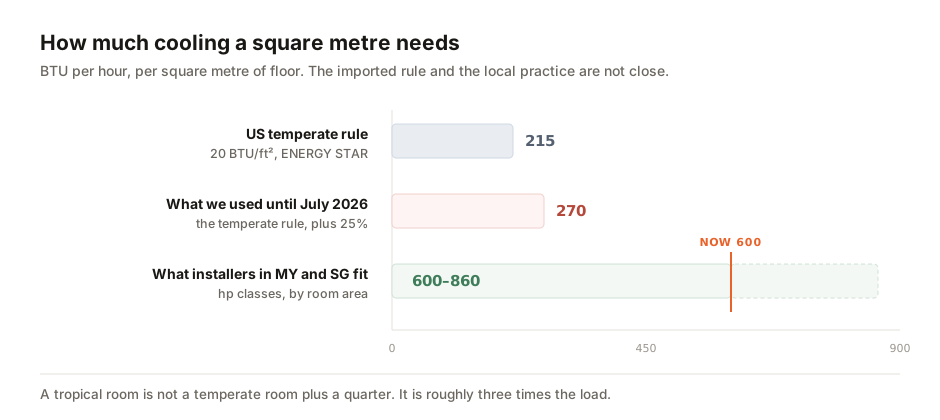
Collect the horsepower-to-room-area bands that Malaysian and Singaporean installers publish and the implied load lands between roughly 600 and 860 BTU per hour per square metre. Not 270. Around three times the temperate rule, not a quarter more.
It is about three times higher because almost every assumption behind the temperate figure is absent here. That number describes an insulated envelope with a conditioned space above it and a whole-house system sized for the building. A flat in Johor Bahru or a terrace house in Klang is uninsulated masonry, frequently with the sun on the roof directly above the ceiling, often single-glazed, and cooled by one split unit per room that has to carry that room alone. Then add the moisture, which is the part that never shows up on a thermometer.
If this argument feels familiar, it is the same one we made about bodies. Western BMI thresholds are also an imported default that does not fit the population using it — the reasoning is in our guide on why your BMI is probably being read against the wrong scale. It is the same failure mode: a number that was correct where it was written, travelling further than its assumptions.
What size you actually need
Both our calculators now work to 600 BTU per hour per square metre for a normally-exposed tropical room — the conservative end of trade practice rather than the middle, because oversizing has its own costs. They agree at every room size, and the BTU calculator now answers in the horsepower classes you can actually buy.
Three adjustments matter more here than the arithmetic. A west-facing room takes the afternoon sun through the hottest hours and installers routinely go one class up for it; do the same for a ceiling above three metres, or a wall that is mostly glass. Count the people, because a body is roughly a 100-watt heater and the load is per-body. And treat a top-floor room under an exposed roof as its own category — the heat coming down through that ceiling is the single largest gain in most tropical houses, and no amount of wall insulation touches it. If you are pricing that problem, our R-value calculator will tell you what a given roof build-up actually resists, which is usually less than the brochure implies.
Bigger is not safer
The instinct when a room is hot is to buy more machine. In a temperate climate that mostly wastes money. Here, it makes the room worse by leaving it damp.
An air conditioner does two jobs at once. It lowers the temperature, which is the part you asked for, and it condenses water out of the air, which is the part you notice only when it stops happening. The split between them is usually put at about 70 per cent temperature and 30 per cent moisture — but in hot humid climates, at the partial loads where a unit spends most of its running hours, the moisture share commonly rises to 40 or 50 per cent.
An oversized unit hits the set temperature quickly and switches off. It has done the first job and abandoned the second. The result is a room that is cold and damp at once: the clammy feeling, the smell in the curtains, the sense that 22 degrees is somehow not comfortable. Meanwhile the compressor is starting and stopping all evening, which is both the least efficient way to run it and the fastest way to wear it out.
Undersizing fails differently and more obviously: the unit runs flat out, never quite catches the afternoon, and costs a fortune because it never gets to rest. Neither failure is cheap.
The cheapest degree is the one you do not buy
Once the unit is the right size, the setting on the wall does more for your bill than anything else you can change. The rule of thumb is roughly 10 per cent of cooling energy per degree Celsius. Set 21 instead of 25 and you are paying something like 40 per cent more for the privilege of sleeping under a blanket.
Malaysia's Energy Commission puts the sensible band at 24 to 26 degrees, and says so in the same briefing that set the current tariff. Air movement is what makes that range liveable, not merely aspirational. Under ASHRAE's comfort standard, moving air lets you hold the same comfort at a higher temperature; the effect is large enough that the standard has a formal method for it. In one study, the only setting that cleared the standard's acceptability threshold was 26 degrees with ceiling fans running — 91 per cent of people found it comfortable.
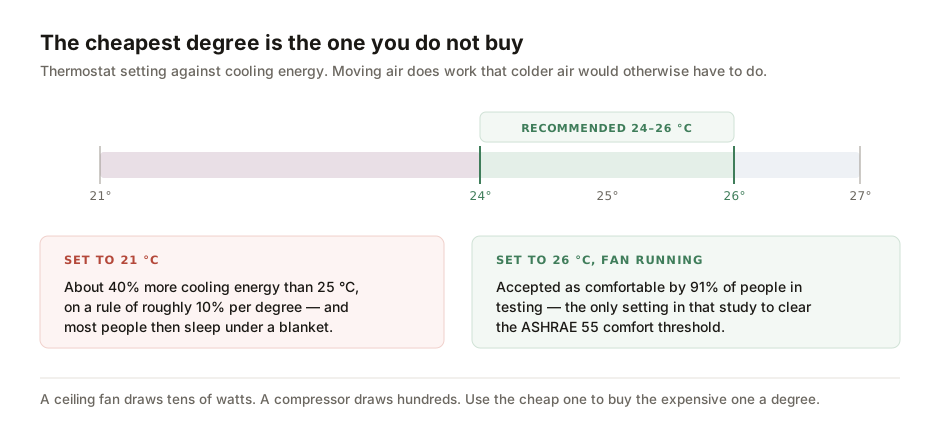
The arithmetic is not subtle. A ceiling fan draws tens of watts; a compressor draws hundreds. Running the cheap machine so the expensive one can sit a degree or two higher is the closest thing to free money in a tropical house — and it is the one recommendation in this guide that costs nothing to try tonight.
What it costs to run, and why the answer changes at the border
Here our own tool was carrying a different kind of error: not a wrong method, just an old number.
Singapore's regulated tariff is refreshingly simple. One flat rate per kilowatt-hour, no tiers, revised every quarter against gas prices. For 1 July to 30 September 2026 it is 31.91 cents before GST, 34.78 cents with it — up 17.0 per cent on the quarter, an increase of 4.64 cents, and the highest household rate on record. SP Group attributed it to fuel costs driven by the conflict in the Middle East.
Our sizing calculator had been pricing Singaporean electricity at 29.94 cents, a 2024 figure. On its own default scenario — that same 14 square metre bedroom, an inverter unit, eight hours a day — the difference is S$6.30 a month. Over a year, S$76. Not catastrophic, but precisely the sort of quiet drift that makes a calculator worse than useless, because it is wrong with a straight face. Both figures are now current, and the factor set carries the date.
Correction, 4 September 2026. This passage first gave S$8.75 a month and S$105 a year, and said the calculator was understating your bill. Both were wrong, and for the same reason: the arithmetic assumed a coefficient of performance of 3.5, while Singapore has required at least 4.86 of every new single-split since April 2025. The default scenario draws about 130 kWh a month, not 181. That moves the tariff gap to S$6.30 — and it flips the sign of the complaint, because against the true consumption the calculator was overstating a compliant unit’s bill by roughly S$8.85 a month rather than understating it. A guide about one stale constant was resting on another.
Malaysia is a different animal entirely, and if you last looked at a TNB bill before July 2025 you are working from a structure that no longer exists.
The five-block domestic tariff — the one where the first 200 units were cheap and everything above 900 was expensive — was abolished. Since 1 July 2025, a single domestic category is billed in four parts. The bill combines an energy charge of 27.03 sen per unit (for households under 1,500 kWh a month), a capacity charge of 4.55, a network charge of 12.85, and a flat RM10 monthly retail charge. That comes to 44.43 sen a unit, plus RM10.
For most people, however, it does not, because two other mechanisms sit on top. There is an Energy Efficiency Incentive worth between 0.5 and 25 sen per unit for any household using 1,000 kWh or less, and the rate is set by your monthly total and then applied to every unit you used. And there is the Automatic Fuel Adjustment, which replaced the old six-monthly ICPT with a monthly figure. For July 2026 the AFA is +3.59 sen per unit. The official projection for August to October is between +8.04 and +8.94 — more than double.
The 601st kilowatt-hour costs RM32
Now the part that no flat-rate calculator can see, including ours.
A Malaysian household using 600 kWh a month or less is exempt from the retail charge, the fuel adjustment, and SST. Cross that line and all three switch on — and the fuel adjustment then applies to every unit consumed that month, not merely to the ones above 600.
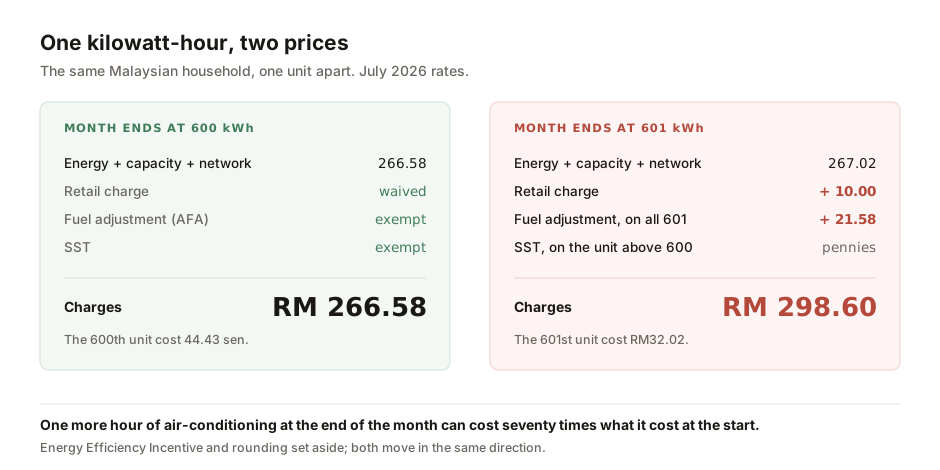
At July 2026 rates, a month that ends at 600 units carries RM266.58 in charges. A month that ends at 601 carries RM298.60. The last unit cost RM32.02 — about seventy-two times what the one before it cost.
That is roughly four hours of a one-horsepower inverter. Four hours, at the wrong end of the month, priced like a week.
The number moves with the fuel adjustment, so it will be larger in August than it was in July. This is not a permanent feature of the universe but a defensible policy choice, as the exemption shields 85 per cent of households from fuel-price swings. The honest answer to "what does another hour of air-conditioning cost me?" in Malaysia is therefore "it depends where you are in the month". No calculator we know of tells you that, ours included, which is why our sizing tool now explains the threshold instead of quietly presenting one rate as the whole story.
The practical response is unglamorous. Find out what you actually use — the figure is on every bill — and if you habitually land in the high 500s or low 600s, that threshold is worth more attention than any efficiency upgrade you could buy. Our home electricity and appliance calculator will tell you which appliances are getting you there; in most Singaporean homes air-conditioning alone is around 37 per cent of the bill, and Malaysian households are not structurally different. If your answer is that you cannot get under the line, that changes the arithmetic on going solar, because a rooftop system's real value is the expensive marginal units it removes, not the average ones.
SST at 8 per cent is the third thing that switches on above 600 kWh; we have written separately about what SST covers and how it is charged.
What to do about all of it
- Size for the room, then stop. Roughly 600 BTU/h per square metre, one class up for a west-facing room, a high ceiling, or a wall of glass. Resist the extra half-horsepower "to be safe" — in this climate it makes the room damp.
- Set 25, and run the fan. Every degree is about 10 per cent of the cooling bill. The fan costs tens of watts and buys back a degree or two of comfort you would otherwise pay the compressor for.
- Learn your monthly number. In Malaysia the 600 kWh line is worth real money. In Singapore the rate moves every quarter, so a bill you understood in April is out of date by July.
- Deal with the roof before the walls. In a top-floor or landed home the ceiling is the dominant heat gain. Wall insulation is where temperate advice starts; here it is rarely where the heat is.
- Distrust a calculator that will not show its factors. Including ours. Every number in both tools is now dated and sourced in the panel beneath the result — if a tool cannot tell you where its constants came from, you have no way of knowing when they went stale.
The cooling rule of thumb that circulates in this region was written for insulated houses in temperate countries, and it is roughly a third of what a tropical room needs — which we discovered by finding it inside our own calculator, contradicting the correct advice printed on the same page. Size at about 600 BTU per hour per square metre, go one class up for the afternoon sun, and stop there, because an oversized unit in the tropics leaves the room cold and damp rather than comfortable. Then spend your attention on the two things that actually move the bill: the setting on the wall, where each degree is worth about 10 per cent and a ceiling fan buys you one or two for almost nothing, and the shape of your local tariff. Singapore's is flat and was revised upward by 17 per cent in July, to the highest rate on record. Malaysia's is not flat at all — crossing 600 kilowatt-hours in a month turns on the retail charge, SST and a fuel adjustment applied to every unit you used, which at July 2026 rates makes the 601st unit cost RM32 against a headline 44 sen. No single rate per kilowatt-hour can describe that, so do not trust one that claims to.
The grid these decisions run on is under pressure from a direction most households never think about: Malaysia set 22 peak-demand records in a single month this year, and the data-centre boom is now large enough that Johor has started turning projects away over power and water. Household tariffs and industrial demand draw on the same system.
- Suruhanjaya Tenaga (Energy Commission) — Penstrukturan Semula Tarif Elektrik, press briefing, 20 June 2025, and the gazetted Jadual 1 tariff schedule for 1 July 2025 to 31 December 2027 (energy 27.03, capacity 4.55, network 12.85 sen/kWh; retail RM10, waived at or below 600 kWh; the 24–26 °C recommendation). Accessed 29 July 2026.
- Single Buyer Malaysia — Automatic Fuel Adjustment: July 2026 at +3.59 sen/kWh, August to October projected at +8.04 to +8.94, and the exemption for domestic consumption of 600 kWh and below. Accessed 29 July 2026.
- TNB — Understand Your Electricity Tariff: the Energy Efficiency Incentive as a discount of between 0.5 and 25 sen depending on total consumption. Accessed 29 July 2026.
- SP Group — Electricity Tariff Revision, 1 July to 30 September 2026 (30 June 2026), and EMA — Buying at Regulated Tariff: 31.91 cents before GST, 34.78 with, a rise of 17.0 per cent. Accessed 29 July 2026.
- US EPA / ENERGY STAR — Room Air Conditioners: the room-area to capacity table, and the shaded, sunny, occupant and kitchen adjustments our calculator had reproduced verbatim. Accessed 29 July 2026.
- ANSI/ASHRAE Standard 55 — Thermal Environmental Conditions for Human Occupancy, the Elevated Air Speed Comfort method; and the Center for the Built Environment's Fans for cooling people guidebook for the 26 °C-with-fans acceptability result and the setpoint-energy relationship. Accessed 29 July 2026.
- Our own audit of both calculators, 29 July 2026. The sizing comparison, the ENERGY STAR curve and the 600 kWh arithmetic are reproducible from
scripts/audit/tropical-sizing-audit.cjsin our repository; the full working is published asdocs/guide15-tropical-home-sources.md.
Tariffs in both countries move — Singapore's every quarter, Malaysia's fuel adjustment every month. The figures here are July 2026. The structure is what to remember; look up the rate.

View author profile → · Editorial policy