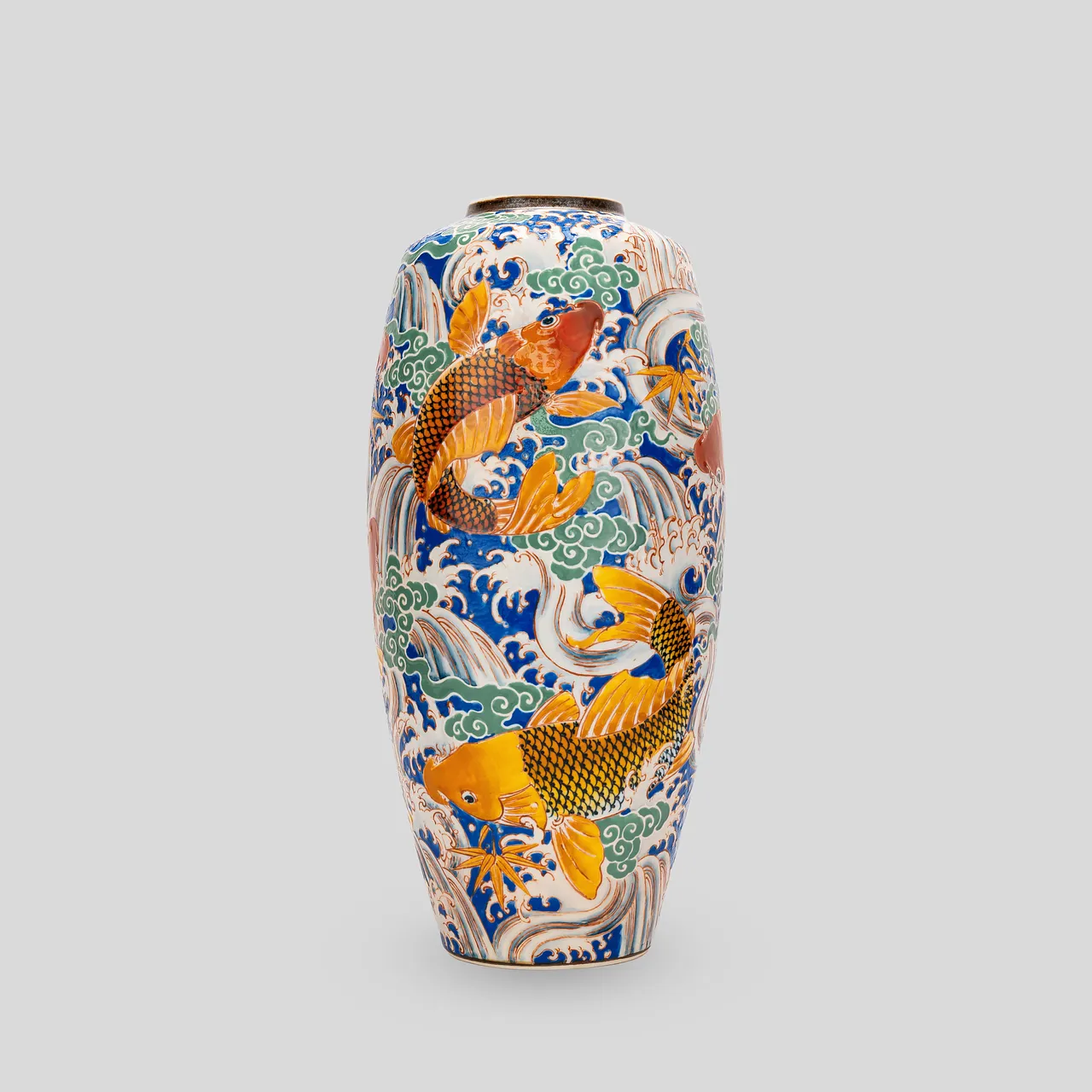
A Chinese rebus motif is a picture that stands for a word by its sound: a bat, 蝠 fú, painted to mean fortune, 福 fú. We checked the 21 character pairs behind rebus motifs the Palace Museum in Beijing documents online against Unicode's Unihan database and a Cantonese dictionary from the Chinese University of Hong Kong (CUHK). In Mandarin, 16 pairs sound exactly alike, tone included. In Cantonese, 13 do on the dictionary's main reading of the magpie, 鵲, and 14 on its variant. Twelve match in both, the bat, fish, deer and monkey among them.
Ten pairs work as puns by the Palace Museum's own account
The museum's glossary entry on auspicious designs says designs carrying a wish by meaning or by sound were widespread from the Ming and Qing dynasties on, without saying which examples work by sound. A glass vase with peaches and bats pairs the bat with fortune and the butterfly, 蝶 dié, with 耋 dié, great age, but reads the bee for meaning alone. A sandalwood ruyi sceptre sets an egret, a vase and a quail together so their sounds spell 一路平安, a safe journey. An exhibition page for a Year of the Monkey show ties 猴 hóu, monkey, to 侯 hóu, a noble rank.
Across seven object pages and that exhibition page, the museum calls 10 pairs a pun or close in sound; a lecture listing and the glossary add motifs without pairing the characters. Of those, 8 are exact in Mandarin and 6 in Cantonese. The glossary lists the fish beside a wish for plenty without calling it a pun, so we count it apart. The other 10 pairs are our own interpretations of phrases where the museum doesn't specify which character stands for which.
Bats, fish, deer and monkeys work in Mandarin and Cantonese alike
Readings are Unihan 18.0's Mandarin and Cantonese fields, the latter in Jyutping, where the digit marks tone. Bat and fortune are fú and fuk1 on both sides. Fish and surplus (鱼/余) are yú and jyu4, deer and rank (鹿/禄) lù and luk6, monkey and noble hóu and hau4. Eight more match in both, among them the square-holed coin, 钱 qián, against 前, before.
Our Chinese folk symbols guide holds 19 cards. Until 4 November 2026 it said Cantonese was unchecked, its descriptions counted 18 symbols, and searching "fish" found nothing because the carp card was indexed by name only. That day's revision stores Unihan readings for its five puns and computes each verdict: the bat, fish, deer and upside-down 福 exact in both languages, the gourd in neither. Search "fish" and the carp card shows a Sound line: yú and yú, jyu4 and jyu4.
Gourds rest on an approximate sound, even in Mandarin
The museum's gold gourd-shaped box calls 葫芦 a pun on 福禄, fortune and rank, while its vase with clouds and bats describes the words as close in sound. Unihan's readings fit the second wording. In Mandarin, hú and fú differ in their first consonant and lú and lù in tone. In Cantonese, wu4 lou4 against fuk1 luk6, both syllables differ.
Five of the 21 pairs miss in Mandarin. Two are a tone apart: the gourd's second half, and bamboo, 竹 zhú, against 祝 zhù, to wish. Three differ in sound: the gourd's first half, the magpie 鹊 què against 爵 jué, a title, and the Buddha's-hand citron against fortune. All eight Cantonese misses differ in sound, none in tone alone.
Butterflies, quail and catfish hold their puns in Mandarin alone
Four pairs match in Mandarin and part in Cantonese. Three part on how a syllable ends: catfish 鲇 nim4 against year 年 nin4, quail am1 against peace on1, which also differ in vowel, and butterfly dip6 against dit6. The fourth, lotus 荷 ho4 against harmony 和 wo4, differs in its first sound. These are present-day readings, with no claim about history.
Whole motifs follow their weakest link: in Cantonese the sceptre's quail misses, and 年年有余 matches on its fish and misses on its catfish. In this small set, which is not a random sample and includes five pairs with a character outside China's level-one standard list, 4 of the 16 Mandarin matches come apart in Cantonese, a smaller share than the 64.7% of level-one exact pairs that came apart in an earlier count of ours on Unihan 17.0.
Bamboo and the 桔 tangerine succeed in Cantonese alone
Bamboo is the one pair of the 21 that matches only in Cantonese: 竹 and 祝 are both zuk1. The magpie may be a second. CUHK's dictionary lists 鵲 under coek3 and gives zoek3, the reading of 爵, as a variant. Unihan reads the traditional form zoek3 and the simplified 鹊 coek3, the only character here whose two forms differ. Hence 13 or 14; both-language matches stay at 12, since the magpie misses in Mandarin.
The tangerine, from greeting lists rather than the museum, turns on one character. Unihan reads 橘, tangerine, as jú and gwat1, and 吉, auspicious, as jí and gat1, so 橘 matches in neither language. The variant 桔 reads gat1 in Cantonese, the same as 吉. In Mandarin Unihan gives it jié, with jú among its recorded readings, and neither is jí.
An upside-down 福 works in Cantonese only through the reading in 倒貼
In Mandarin 倒, upside down, and 到, to arrive, are both dào, so an inverted 福 reads as fortune arriving (the custom is in our spring couplets guide). In Cantonese, Unihan's one customary reading for 倒 is dou2, a tone away from 到 dou3. The CUHK entry gives dou2 for 跌倒, to fall over, and dou3, with 到 among its homophones, for words including 倒貼. On dou3 the pun matches.
The Buddha's-hand citron runs the other way. Unihan's kMandarin gives 佛 as fú, which made 佛手 look exact on our first pass; its field for the 2013 《通用规范汉字字典》 lists fó first, and CUHK gives fat6 against fuk1, so we scored a miss in both. With the magpie, these are the three characters where one database field alone would mislead.
Hokkien lettering on a Javanese Peranakan altar cloth falls outside this count
Unihan has no Hokkien or Teochew field. The nearest local source we found is the National Heritage Board's BeMuse article "Auspicious Designs: Batik for Peranakan Altars" by Maria Khoo Joseph (volume 7, issue 3, July to September 2014). It describes batik altar cloths made in Java and given to the Peranakan Museum in 2012, one lettered with the names of its phoenix and dragon in Hokkien romanisation. That is labelling rather than a pun, and we measured no pun in Hokkien.
The pairs come from one museum's pages on court objects and say nothing about usage in Singapore, Malaysia, Hong Kong or Taiwan. We checked CUHK's alternative readings for every Cantonese miss and for 倒, but not for each match. A 2024 rebus-art dataset by Zhang and colleagues never mentions Cantonese, and we found no published count comparing these pairs across the two languages.