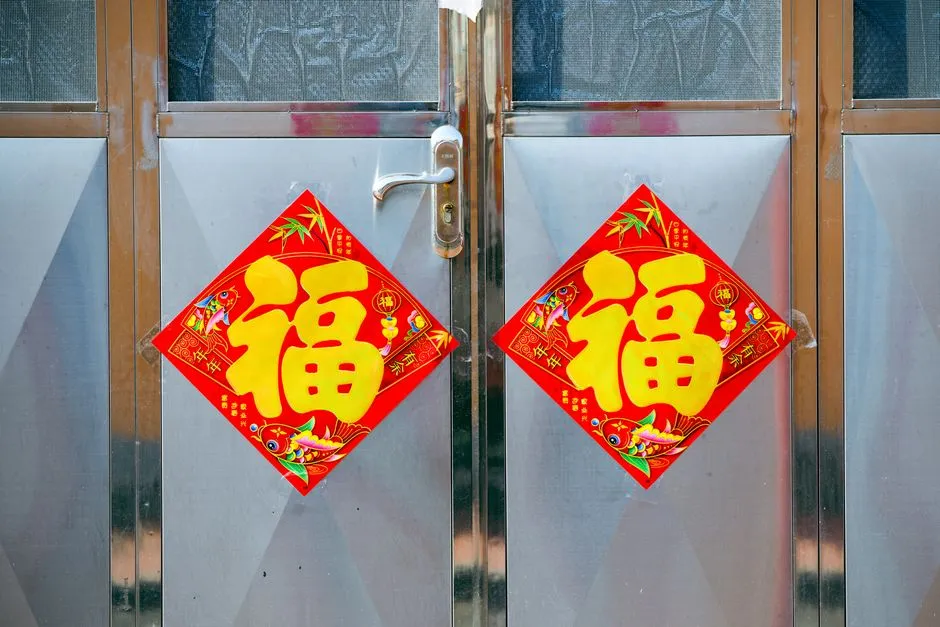
福, the character many spring couplets (春联, 春聯) are built around, is the one the usual tone shortcut gets wrong. Classical rhyme books count it as an oblique (仄) tone, but Mandarin reads it fú, a level (平) tone. Across the 198 characters with a single tone class in the lines of 40 common couplets we checked on 1 October 2026, Mandarin agreed with the classical rhyme book on 185, and all 13 misses were old entering-tone (入聲) characters like 福.
The tone of the final character is what tells the two lines apart. The upper line (上联) must end on an oblique tone, the lower line (下联) on a level one. Mainland sources say the upper line goes on the side of the door where the horizontal banner (横批, 橫批) starts reading. We found no official statement on placement for Taiwan, Hong Kong, Singapore or Malaysia.
The banner sets the reading order, and the upper line follows it
Qin Zhifa (秦志法), president of the Jiangsu couplet research society, put the rule in one sentence to China News in 2016: 「春联的上联要贴在横批起头那个字的一侧」, the upper line goes on the side where the banner's first character is. If the banner reads right to left, as writing traditionally did, the upper line goes on the right as you face the door; if it reads left to right, on the left. With no banner at all, he said, the upper line goes on the right. A 2025 CCTV explainer, reprinted by Guangming Online, says banners now mostly read left to right, so the upper line "也可以", may also, go on the left, and the Shenzhen municipal archives give the same rule.
For a reader who cannot read the banner, the fixed four-character phrases printed on most sets, such as 万象更新, show which end they start from. The question is also a different one from the order of columns inside a block of vertical text, which our guide to vertical Chinese punctuation covers; a couplet's two lines hang on two separate door-posts.
The couplet society sets six tests, yet it leaves the choice of tones open
The mainland's China Couplet Society (中国楹联学会) publishes the rulebook for the form, the 《联律通则》, in a version that took effect on 1 January 2024 and replaced its 2008 predecessor. In the text as reprinted, its six basic rules are equal length (字句对等), matching parts of speech (词性对品), matching structure (结构对应), matching rhythm (节律对拍), opposed tones (声调对立) and related meaning (语意关联). Article 5 specifies the tone rule: 「上联收于仄声,下联收于平声」, the upper line closes on an oblique tone and the lower on a level one.
A later article lets the writer choose the tone system: 「或依古汉语旧声韵(即平水声韵),或依现代汉语新声韵,但在同一副对联中不得混用」, either the classical rhyme-book tones or modern Mandarin ones, but not both in one couplet. Article 12 gives looser treatment to pairs lifted from poems. The rulebook says nothing about which side each line is pasted on. Taiwan's Ministry of Education dictionary also separates two words that are easily confused: 橫批 is the banner that goes with a couplet, while 橫披 is a horizontal hanging scroll.
Mandarin reads 福 as level, so the tone shortcut misplaces its couplets
The common shortcut is to treat Mandarin's third and fourth tones as oblique and its first and second tones as level. This works for most characters but fails for the old entering tone, whose characters were later redistributed across all four Mandarin tones. Of the 24 pure entering-tone characters in the 40 couplets we checked, Mandarin reads 11 as level. Taiwanese calligraphy teachers already make this point about 福, 國 and 竹. A couplet such as 和顺一门有百福 / 平安二字值千金 passes on the classical track, where 福 is oblique, and ends level-level on the Mandarin one. Cantonese, which keeps the entering tone's clipped endings, agreed with the classical tones on all 198 characters in this set, using the first reading Unicode's Unihan data lists; that is no exception in these couplets, not a general law.
The four-tone theory itself is younger than the claim that it goes back to the Book of Songs. The History of the Southern Dynasties credits it to Shen Yue (沈約) in the Liang dynasty, who wrote that poets before him had not grasped it in a thousand years. Until 1 October 2026 our couplet generator offered 40 couplets, 7 of which broke the end-tone rule on the classical track, two of them with the lines reversed; it now offers 35 that pass, and says which two fail in Mandarin because of 福.
福 hangs upside down for a pun, but some keep it off the front door
Upside down is 倒 and arriving is 到, and in Mandarin both are read dào, according to Unihan, so an inverted 福 reads as "fortune arrives". We have not checked whether the pun works the same way in Cantonese. The folklorist Feng Jicai (冯骥才), as chair of the China Folk Literature and Art Association, said in 2006 that inverting 福 on the front door departs from custom: 「大门上的福字,从来都是正贴」, the front-door 福 has always gone upright, while the inverted one belongs on water vats, rubbish bins and cupboards, where something is poured out or kept. Qin Zhifa said the same in 2016. Both describe a widespread practice they disagree with.
Meng Chang wrote a blessing for his door, and it named the governor who replaced him
The couplet usually called the first is Meng Chang's (孟昶), ruler of the Later Shu kingdom. The History of Song says that 「每歲除」, every New Year's Eve, he had his scholars write verses on peach-wood boards for his bedroom door; in the last year the scholar 幸寅遜's lines displeased him, so he wrote his own: 「新年納餘慶,喜節號長春」. Another Song text, 蜀檮杌, spells the scholar 辛寅遜, says his lines were good, and gives the second line as 「嘉節賀長春」. The form usually quoted, 嘉節號長春, matches neither text we could read, and a 2012 China News article argued that the scholar, not the king, was the author.
Both texts record why the lines were remembered. Within days of that New Year, Later Shu surrendered, and the Song court sent 呂餘慶, whose given name is the couplet's 餘慶, to govern Chengdu, while 長春 was the name of the Song emperor's birthday festival. By our reckoning with Academia Sinica's calendar converter, that New Year's Eve fell on 4 February 965 in the Julian calendar. A researcher at the Dunhuang Academy has also identified New Year inscriptions on the back of a Dunhuang manuscript copied no earlier than 723, which, if read that way, are older still.
Peach-wood charms came before couplets, and paper followed
The Book of the Later Han records a 桃印, a peach-wood seal six cun long and three wide and inscribed in five colours, placed on doors at midsummer, and peach-wood figures at the year-end exorcism. The Jingchu Suishi Ji, from the sixth century, describes peach boards on the door and two painted door gods, 神荼 on the left and 鬱壘 on the right. By the Qing, the Yanjing Suishi Ji could say simply 「春聯者,即桃符也」, spring couplets are the peach charms.
The same Qing record says couplets were written on vermilion or red paper, except that 「惟內廷及宗室王公等例用白紙」: the palace and the imperial clan used white paper, edged in red or blue, and anyone outside the clan was forbidden to use it. Our guide to what colours mean in Chinese culture takes up how white came to be read the other way.