Yuelao (月老, Yuèlǎo), the Old Man under the Moon, is the god who ties couples together in Chinese folk belief, and a set of a hundred numbered lines circulates online as his oracle under the name 月老聖籤一百籤. Almost none of it was written for the purpose. We traced 98 of its 100 lines, 97 of them to an older book and one to common speech. By our count 52 come from the Confucian classics, or 51 if lot 56 is credited to the Shiji rather than the Zuozhuan, where its words appear earlier. The Book of Songs, the Analects and the Mencius give 11 lines each.
The Confucian canon lends the set half its lines
We sorted the 100 lots by the work each line is credited to.
| Source group | Lots (of 100) |
|---|---|
| Four Books and Five Classics | 52 |
| Single poems and prose pieces | 15 |
| Yuan to Qing plays | 12 |
| Other books, such as the Zhuangzi | 10 |
| Sayings | 5 |
| Histories | 4 |
| Untraced | 2 |
Inside the classics, the Book of Rites gives 9, four of them from the Great Learning and two from the Doctrine of the Mean. The Zuozhuan, counted here under the Spring and Autumn, gives 7, two of them odes it quotes. Four works, the Songs, the Analects, the Mencius and the Book of Rites, supply 42 lots between them. The Four Books in the strict sense supply 28.
Lot 56's 鳳凰于飛,和鳴鏘鏘, a phoenix pair calling in harmony, comes from a divination over a daughter's marriage in the Zuozhuan, Duke Zhuang year 22 on Wikisource, which writes 鳳皇於飛 and which the Shiji later retells. Across the set, 93 lots quote 36 identifiable works. Five more are sayings: four turn up in a later book that quotes them, and lot 27 is credited to no book at all.
Mencius contributes a line about a neighbour's daughter
Lot 5 reads 踰東家牆而摟其處子,則得妻;不摟,則不得妻: climb the east neighbour's wall and drag off his daughter and you get a wife; refrain and you get none. In Mencius, Gaozi II, a man from Ren has asked the disciple Wuluzi whether ritual outweighs food and sex. Wuluzi cannot answer and takes it to Mencius, who gives him a reply to carry back. The sentence ends 則將摟之乎, "would you then drag her off?" The lot stops one clause short of that question.
Lot 96 comes from the biography of Han Xin in the Shiji. The persuader Kuai Tong is warning Han Xin that his merit frightens his own ruler: go over to Chu and Chu will not trust you, go to Han and Han will fear you.
Four plays lend the set its love scenes
The 12 drama lots come from four plays: The Western Chamber (西廂記) six times, The Lute (琵琶記) three times, The Palace of Eternal Youth (長生殿) twice and The Peony Pavilion (牡丹亭) once.
They are also the least stable lines. On our count, 10 of the 12 differ from the play in the web copy. Seven keep the set's own wording, with the play's reading beside it. Three were miscopied and have been corrected, among them lot 23, the silkworm spinning its thread until death. Only lots 64 and 86 read as the plays have them.
Borrowed lines come back from the web copy with 22 copying slips
The text of record is the hundred as published on the website 台灣好廟網, consulted on 3 November 2026. It prints no grades and no sources. Our Yuelao love oracle follows its wording and numbering, and every count above was made from the attributions on that card, checked against texts on Wikisource. Type 29 and press Look up, and the card shows 山窮水盡疑無路 with the note that Lu You wrote 山重水複.
| Web copy against the book | Lots | Example |
|---|---|---|
| No slip and no variant wording | 44 | lot 17, Great Learning |
| Set's own wording kept, book's reading noted | 26 | lot 14, 燕爾新婚 where the Songs has 宴爾新昏 |
| Copying slip | 22 | lot 15, 訐詐 for 姦詐 |
| Character form or punctuation only | 6 | lot 24, 湏 for 須 |
| Untraced | 2 | lots 13, 68 |
Several slips swap a look-alike character: 十畝九間 for the Songs' 十畝之間, 舊王 for 歸王. A spot check, punctuation aside, of 16 lots found 11 exact matches; the other five differed in variant characters or in wording the card notes.
Until 5 November 2026 the card kept lot 18's 外感 as a variant where the Shiji has 外戚, a consort's family. It also credited lot 56 to the Shiji alone, gave lot 61 no note where the Zuozhuan writes 妃, and the page called every lot "a line or two", though lots 11 and 30 run to eight lines of verse. The revision dated that day changes all four.
An older deck borrowed the same lines under other numbers
Before 3 November 2026 our page carried an older deck, of unknown provenance. We matched its lines against the current hundred by similarity. Each paired with exactly one current line, and 72 of the 100 sat under a different number: the old 13 is the current 29. A lot number alone does not identify a line across copies; the words do.
Xiahai City God Temple borrows the red-thread story and sets it at an inn
The story behind Yuelao is "The Inn of Betrothal" (定婚店) in juan 159 of the Taiping guangji, which credits it to the Xu youguai lu. Wei Gu, lodging at an inn, goes at dawn to a temple gate and finds an old man on its steps reading a book by the moon (向月檢書). His bag holds red cord, 以係夫婦之足, "to tie the feet of husband and wife".
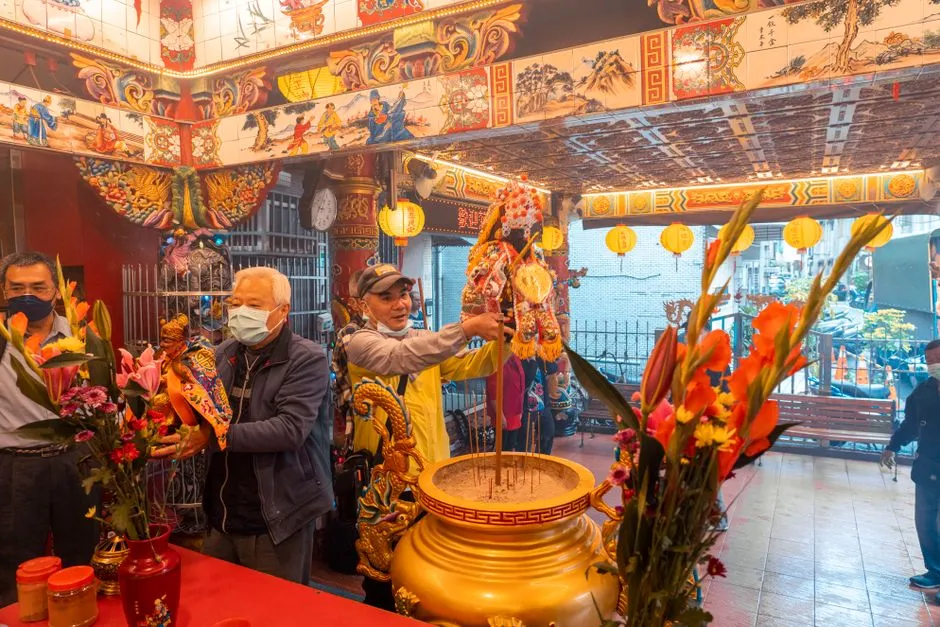
The Taipei Xiahai City God Temple tells it differently on its own Yuelao page, seen on 5 November 2026: Wei Gu meets the old man at the inn itself, leafing through a register of marriages. In 1971, the page says, a woman offered to donate a statue, and the temple's head, Chen Guo-ting (陳國汀), had Wang Dao-rui (王稻瑞) of Luzhou carve one 43 cm tall. On the four Yuelao and FAQ pages we read there, the character 籤 does not appear once.
A Taipei thesis traced Yuelao borrowings in 2020
Guo Jia-Wen (郭珈妏) wrote 《臺灣月老廟及其月老百籤研究》 as a master's thesis in Chinese literature at National Chengchi University (2020, supervised by 楊明璋). Its abstract says it discusses the sources, forms and allusions of the Yuelao hundred in detail. We have seen only the abstract, so whether its hundred is this one, and whether its tally agrees with ours, is still open.
At least one temple has issued a Yuelao slip. On 14 February 2019 the Tainan City Government and the Grand Matsu Temple of Tainan (祀典台南大天后宮) put out one in Chinese, Japanese and English, PTS reported. The report names no set and gives no count. No printed temple edition of these hundred lines was readable to us, and which temple first put them in this order is unknown.