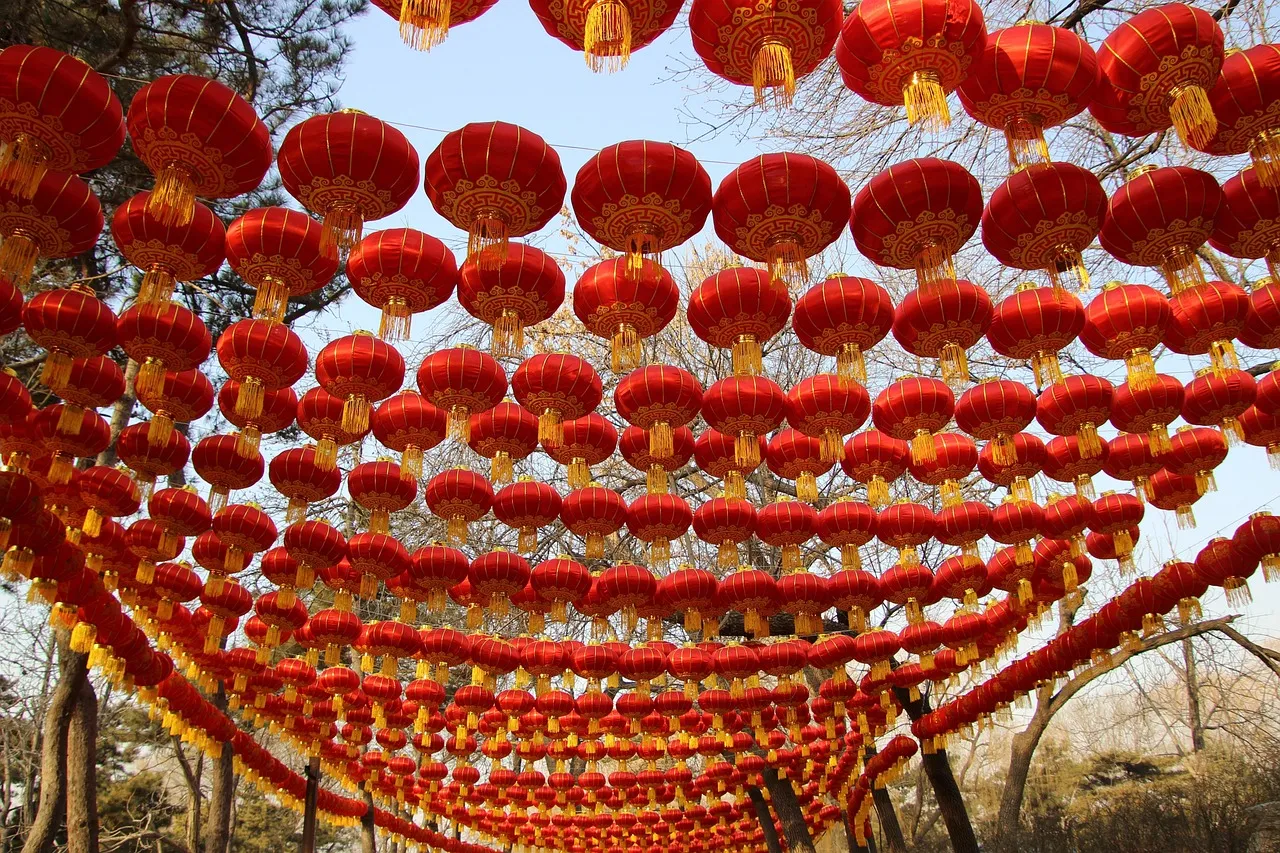
Red means luck, celebration and protection in Chinese culture, and that one is solidly attested — it runs from wedding clothes to the red packets handed out at New Year. Most of the rest of the colour chart you will find online is shakier than it looks, and a few of its most repeated claims are checkably wrong.
Start somewhere most charts never go: a dyeing vat. The oldest Chinese text on colour, the 考工記 chapter of the 周禮, describes how feathers were dyed: 「三入為纁,五入為緅,七入為緇」 — dip three times and you get 纁, five times 緅, seven times 緇. Before a Chinese colour was a symbol, it was a count: the name told a craftsman how many times the cloth had gone into the dye. Everything else in this guide is the story of what later centuries built on top of that.
Our Chinese colour symbolism tool used to repeat several of the claims below, including one that was simply invented. We checked its 24 colour meanings against the texts: 21 carried no source we could find, and 13 were contradicted by something we read. This guide is what the texts actually support.
Red is for luck, and at a Singapore funeral it is also for protection
The red-is-festive rule is real, but it doesn't cover all of red's uses. Singapore's National Library, in its reference article on Chinese death rituals, cites the sociologist Tong Chee Kiong's study of Singapore funerals to describe how red works at a funeral: the idols and mirrors at home are covered with red cloth or paper, small pieces of red paper are stuck to the seams of the coffin to ward off evil, and mourners may take away a piece of red thread for protection. Red there is not celebration. It is a guard.
The inverse of the red packet appears at the same funeral. Condolence money is 白金 or 帛金 — peh kim in Hokkien, "white gold" in English — and it goes in a white envelope.
Another claim to drop is that the red in Singapore's flag "echoes Chinese tradition". Singapore's own law says otherwise. The National Symbols Act 2022, in force since August 2023, states that red symbolises "universal fellowship and equality" — a deliberately non-ethnic meaning, and a change from the older wording, "universal brotherhood and equality of man", that several government websites still carry.
The oldest list announces five colours and then names six
Ask about Chinese colours and you will be shown the five colours of the five elements — green-blue in the east, red in the south, white in the west, black in the north, and yellow in the centre. It is a real scheme. It is not what the oldest text says.
The 考工記 opens its passage on painting with 「雜五色」, five colours mixed — and then names six: 東方謂之青,南方謂之赤,西方謂之白,北方謂之黑,天謂之玄,地謂之黃. Four directions, plus 玄 for the sky and 黃 for the earth. There is no centre, and yellow belongs to the ground rather than the middle.
The version with yellow at the centre comes from a different classic, the 月令 chapter of the 禮記, which dresses the Son of Heaven in the colour of each season and puts him in yellow for 中央土, the central earth. Both texts are old and canonical. They just disagree — and the disagreement is more interesting than either tidy chart.
The same classics also show that 玄 and 黑 are not the same colour. The 月令 winter entry has the emperor fly a 玄 banner and wear 黑 clothes in one sentence, and the earliest dictionary defines 玄 as black with red showing through — which is what you get from that dyeing vat when you dip once more.
Yellow was a soldier's colour before it was the emperor's
The yellow story everyone repeats is that commoners were forbidden to wear yellow, on pain of death, from the Sui and Tang onwards. Almost every part of that is wrong.
The Old Book of Tang records that under the Sui, commoners wore white and soldiers wore yellow. Early Tang law then went further the other way: it assigned yellow to commoners and to low-ranking clerks as their ordinary colour, and even after a rule was issued, allowed them to keep wearing it. The prohibition of 621 did not ban yellow; it banned 赤黃, reddish yellow. A general ban on commoners wearing yellow came only in 668.
And it was never a capital offence. The penalties for wearing a forbidden colour, across the dynasties that legislated about it, were beatings, penal servitude and the cangue — the heavy wooden collar. We checked the codes, and none made it a matter of death. Our own tool's facts section carried the death-penalty version as a heading until this month.
The mourning classic never says white
"White is the colour of mourning" is repeated as flatly as "red is lucky". The classical text on mourning dress, the 喪服 chapter of the 儀禮, never uses the character 白 at all. Instead, it grades mourning clothes by how coarse the hemp is across five degrees of kinship, with the roughest cloth for the closest relatives.
That grading survived, and Singapore is where it is best documented. The National Library's article, again drawing on Tong's study, describes each family member wearing a different-coloured mourning garment according to their relationship to the dead, with the colours and patterns differing between dialect groups, and small pieces of coloured cloth pinned to the sleeve whose grades follow the same order. Plain white or black is the modern simplification; visitors are expected to come in dark colours. So "white means mourning" is not wrong, but it flattens a graded system into one colour.
The green hat began as a punishment and became a joke
戴綠帽子 — wearing a green hat — means a man's wife is unfaithful. You will find a dozen origin stories for it, usually offered one at a time with complete confidence. The evidence supports several threads rather than one.
- Green as a low colour. Tang officials of the sixth and seventh ranks wore green and the eighth and ninth wore blue, at the bottom of the ladder; a commentator on the History of Han calls a green headcloth "the dress of the lowly".
- Green headwear as a shaming punishment. A Tang anecdote records a county magistrate who, instead of beating offenders, made them wear a headcloth — in the colour word 碧 rather than 綠 — for a number of days, which the locals took as a great disgrace.
- Green as the entertainers' mark. A Ming regulation, dated 1379 by two independent Ming sources, ordered the musicians and actors of the court entertainment bureau to wear green headcloths to set them apart from gentry and commoners. An earlier Yuan rule had them in blue, not green; the green is a Ming change.
- The cuckold meaning itself is first recorded in the sixteenth century, in a Ming writer's note that people in the Suzhou region called a man with an unfaithful wife a "green headcloth".
The best single account is a peer-reviewed article on Ming dress reform by 張佳, published by the Chinese University of Hong Kong, which traces the vernacular phrase to that 1379 regulation. And in 1751 the Qing scholar 翟灝, collecting these sources himself, concluded that the true origin could not be settled from them. Two and a half centuries later, that is still the honest answer.
A traditional colour has no hex code
Search for 中国传统色 and you will find sites offering hundreds of traditional Chinese colours, each with a hex code for web design. None of those hex codes comes from a standard, because the standard does not give any.
China does have a national standard for traditional colour names, GB/T 31430-2015. It names 164 traditional colours and specifies each one in CIE colour coordinates — a measurement of the colour under standard light — not in the red-green-blue values a screen uses. Every hex code you meet for 朱红 or 天青 is somebody's conversion, and nobody says whose.
We did the conversion for the three names our own tool shares with the standard. We then measured the difference with ΔE, the usual metric for perceptual distance between colours, where a value of 1 is about the smallest difference a trained eye can see. The standard itself allows its physical sample book a tolerance of 3.
| Name | Standard, converted to screen colour | What our tool showed | Difference (ΔE) |
|---|---|---|---|
| 朱红, vermilion | #D05232 | #E60026 | 27.1 |
| 天青, sky blue | #55ACC5 | #74AEDF | 16.6 |
| 月白, moon white | #CCE5E2 | #D8E3E7 | 6.5 |
All three are outside the standard's own tolerance, the vermilion by nine times. Our tool's 朱红 was a bright screen red, far more saturated than the pigment the standard measures. Across all 24 of its colours, none matched the most widely copied traditional-colour list, and eight were not Chinese colours at all but values lifted from Western web and office palettes — CSS silver, CSS gold, a Microsoft Office "jade". If you are choosing a palette, the useful question to ask any hex code is simply: converted from what?
The classical passages here are quoted from the Wikisource transcriptions of the 周禮, 禮記, 儀禮 and 舊唐書, read on 25 and 26 September 2026; the Singapore funeral material is from the National Library's article on Chinese death rituals, citing Tong Chee Kiong's Chinese Death Rituals in Singapore (2004); the green-hat regulation is from 張佳's 2014 article on Ming dress reform in the Journal of Chinese Studies. We did the colour conversions ourselves; they are approximate to a few ΔE because the standard uses a different reference observer from screen colour — far smaller than the differences found. We found no comparable source for Malaysian Chinese practice, so we have not described it.

View author profile → · Editorial policy