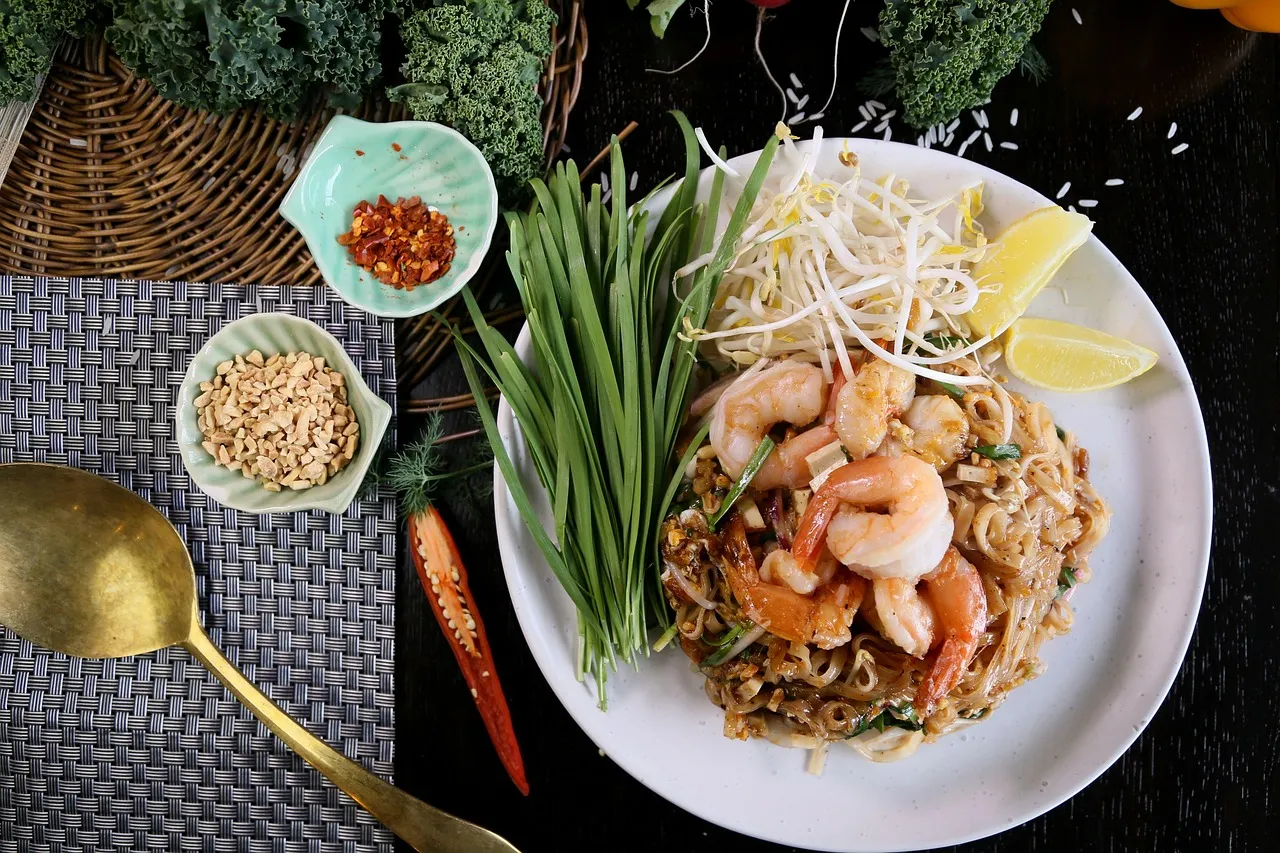
Thailand's official way of writing Thai in Latin letters is a table issued by the Royal Institute in 1999, and by our reading of that table ผัดไทย is phat thai. We applied the table by hand to 72 romanised Thai dish names on an English-language dish list of our own. Of the 72, 56 came out different from the English spelling. So did 89 of their 186 words. Five spelling habits account for every one of those words except Massaman. The table was published in the Royal Gazette on 11 May 1999, and it ignores tone and vowel length.
The Royal Institute's 1999 table sets the official letters
The Royal Institute signed its principles for transcribing Thai script into Roman letters on 11 January 1999. A Prime Minister's Office notice of 23 April 1999, signed by Chuan Leekpai, cancelled the system of 6 March B.E. 2482 and put the Royal Institute's announcement in its place. Both appear in the Royal Gazette, vol. 116, part 37 ง, dated 11 May 1999. Thai names and nouns are to follow the rules, though a person's name already written another way may keep its spelling.
The method is transcription: it follows how a word is said and sets aside spelling and tone marks. ก is k, ข ค ฆ are kh at the start of a syllable, ผ พ ภ are ph and จ ฉ ช ฌ are ch. ด is d at the start and t at the end. A short vowel and its long partner share one form, so อะ and อา are both a.
The UN Working Group on Romanization Systems, in its report on Thai (version 4.0, September 2013), says the revised system "was officially endorsed by the government of Thailand in 2000" and was approved at a UN conference in Berlin in 2002 (resolution VIII/13). We found no record of what happened in 2000, so both years stand here.
Five menu habits produce almost every stray letter
Our count, over 72 names and 186 words. A word can show several habits, so the columns do not add up.
| Habit | Example (list, then ours) | Words | Names |
|---|---|---|---|
| Vowel written English-style | Moo, mu | 41 | 29 |
| Aspiration h left out | Prik, phrik | 29 | 23 |
| Final b, d or g for p, t or k | Krob, krop | 20 | 19 |
| g for ก | Gaeng, kaeng | 15 | 15 |
| r as a length mark | Hor Mok, ho mok | 5 | 5 |
Pad shows two habits at once, a lost h and a final d. The j of Jeen and Jeow appears in three words, all of which also differ in their vowel. The one word outside the five is Massaman. Our transcription of แกงมัสมั่น is kaeng matsaman, with an inserted syllable of the kind the UN report shows in รัตนา, rattana. Sixteen names, Som Tam and Khao Soi among them, already match.
Without the h, the egg in kai jeow reads as chicken
The Gazette's first note on the consonants explains the h: kh, ph and th are aspirated sounds, k, p and t unaspirated ones. Applied by us, the table makes ไก่ (chicken) kai and ไข่ (egg) khai. The dish list writes chicken as Gai in seven words and egg as Kai once, in Kai Jeow, ไข่เจียว, which we transcribe as khai chiao. In effect, the menu spells the egg dish using the official transcription for chicken. Pla Pao, ปลาเผา, likewise gives two consonants the same p, where our transcription is pla phao.
Chin, sai and kha are each two Thai words once tone is dropped
The UN report says tone marks and the vowel shortening mark "are completely ignored". Short and long vowels already share a form. จีน in Khanom Jeen and ชิ้น in Look Chin Pla both come out as chin, since จ and ช are both ch. ไส้ in Sai Ua and สาย in Roti Sai Mai are both sai. ข่า in Tom Kha Gai and ขา in Khao Kha Moo, apart only by a tone mark, are both kha.
The English list merges sai and kha the same way. Only for chin does its j happen to keep two words apart, as Jeen and Chin.
Rule-only romanising software writes som tam as smtam
The UN report adds that "one must know how to read and pronounce" Thai words to transcribe them. PyThaiNLP 5.1.2, an Apache-2.0 Thai library, documents a royin engine in its transliteration module, built on letter rules in its source file. We ran it, with the newmm word splitter, on all 79 Thai names on the list.
It matched our hand transcriptions on 19 of the 79, ignoring spaces and hyphens, and three outputs still held Thai characters. ส้มตำ came out as smtam, ปลา as pna and ผัดไทย as phattai. The library offers other engines, which we did not run.
Thai script holds each dish to a single spelling
Of the forms in this guide, the Thai name is the one that does not vary. All 79 dishes in our Thailand food picker carry their Thai name beside the English one. In the revised picker, set the region to Hat Yai and the spice level to Very hot, and it returns Gaeng Tai Pla, แกงไตปลา, or Khua Kling, คั่วกลิ้ง. The first differs from our kaeng tai pla only in its g; the second matches.
Until 20 November 2026 the picker spelled six Thai words two ways each, ยำ as Yam and Yum among them; its spice menu stopped at Hot, leaving five very-hot dishes unreachable through that filter; and its Thai names carried no language tag. The revision of that date enforces one English spelling per word, settling on *Yum* (further from our transcribed *yam*). It also adds the "Very hot" spice level, tags each Thai name with the correct language code, and aligns two English names with their Thai counterparts.
Every transcription here is ours, applied by hand from the 1999 table
No form printed here is official. Each is our transcription from the Gazette's consonant and vowel tables, read as page images and checked against the UN report's adapted tables. One person made them, unreviewed by a Thai linguist.
Seven of the 79 names are plain English, such as Green Curry, so the comparison covers 72, ignoring case and spacing. Spacing word by word is our choice: the Gazette's own example writes น้ำปลา as nampla. Forms are in lower case with place names capitalised, as the rules ask for proper nouns. ซีอิ๊ว takes a hyphen, si-io, because its second syllable opens with a vowel. Kuai tiao ruea mu, for ก๋วยเตี๋ยวเรือหมู, is given in full, though the English romanises only part of it.
Earlier work made a similar comparison. Theera Roungtheera's 2022 study in the Journal of Language and Linguistics, vol. 40, no. 1, compared the menus of 15 Thai restaurants in France and four Thai literary works translated into French with the Royal Institute's system and found that none of the romanisations followed it. The Office of the Royal Society, as the Royal Institute is now named, could not be reached on 20 November 2026, so any later revision of the rules is unchecked.

View author profile → · Editorial policy