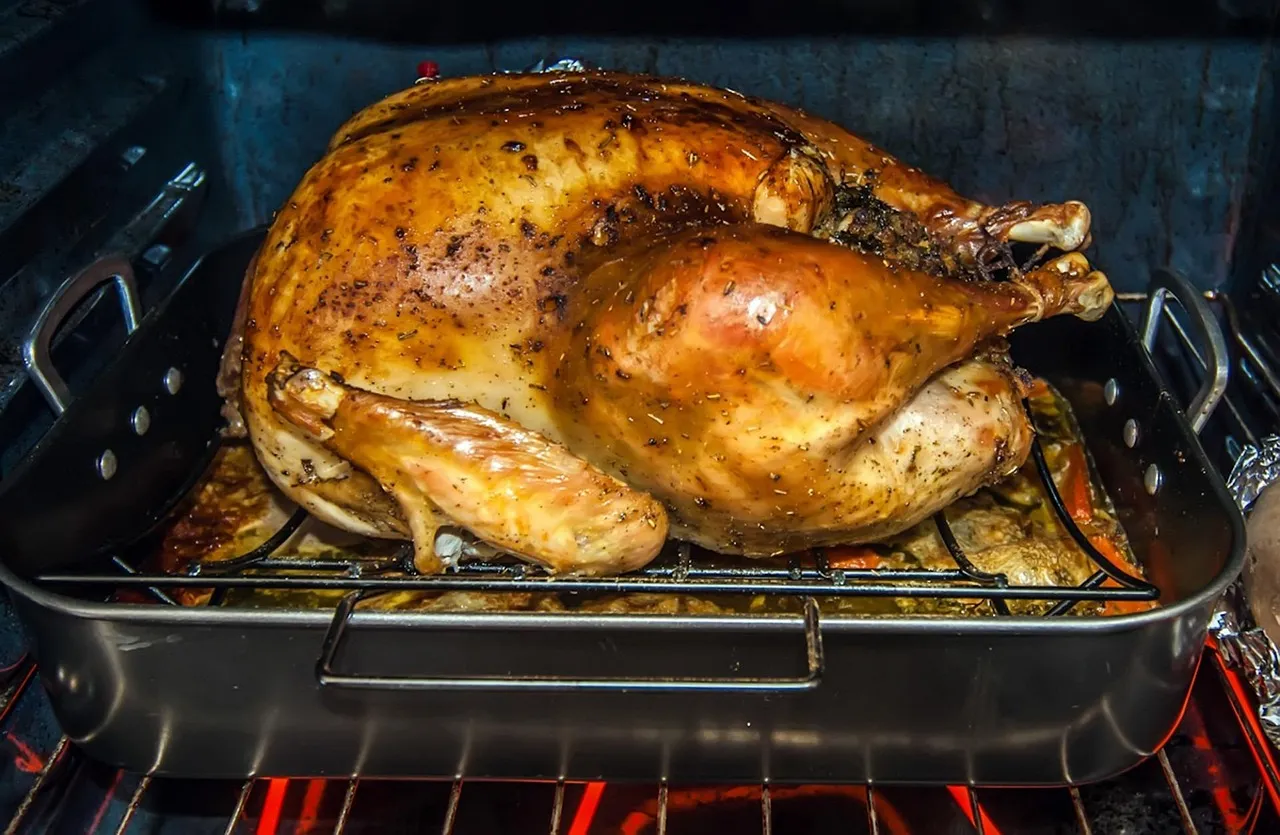
A roasting chart turns a weight into a time, while a food agency publishes a temperature, so the two answer different questions. We set two published charts side by side for an 8 kg turkey at Gas Mark 5, a British gas-oven setting. One lists 320 minutes. The other lists 250, 70 minutes less, with any stuffing counted in the weight. Agency figures for cooked poultry vary too. Food Standards Australia New Zealand (FSANZ) recommends at least 75°C in the centre, the US Department of Agriculture's FSIS lists 165°F (73.9°C), and Health Canada lists 82°C for a whole bird. The Food Standards Agency (FSA), for England, Wales and Northern Ireland, writes of food generally: 70°C for 2 minutes in the middle, or 60°C for 45 minutes, 65°C for 10 minutes, 75°C for 30 seconds or 80°C for 6 seconds.
Turkey comes out over an hour apart on charts at the same gas mark
The UK Metric Association's turkey guide states 40 minutes per kilogram at 190°C, Gas 5, and works an 8.0 kg bird through to 5 h 20 min. British Turkey, a British Poultry Council site, asks for the weight "including stuffing" and quotes "180°C (Fan) / 375°F / Gas Mark 5". Its line is 20 minutes per kilo plus 70 under 4 kg, and plus 90 from 4 kg up.
| Whole turkey | UKMA, minutes, our arithmetic | British Turkey, minutes, our arithmetic |
|---|---|---|
| 4 kg | 160 | 170 |
| 8 kg | 320 | 250 |
| 10 kg | 400 | 290 |
Both are straight lines: a rate per kilo, one with a fixed allowance and one without. UKMA stays at 40 minutes per kilo at every weight, while British Turkey's overall figure falls from 42.5 at 4 kg to 29 at 10 kg, on our arithmetic, as its allowance spreads over more meat.
Big birds cook fewer minutes per kilo in the FSIS timetable
The USDA FSIS turkey timetable, last updated 17 November 2023, prints weight bands for an unstuffed bird at 325°F (163°C), and it bends.
| Whole turkey | FSIS band, minutes | Minutes per kilo, our arithmetic |
|---|---|---|
| 4 kg | 165–180 | 41–45 |
| 8 kg | 225–255 | 28–32 |
| 10 kg | 270–300 | 27–30 |
We fitted a power curve to the five whole-bird rows. Across the bands' low ends, midpoints and high ends the exponent comes to roughly 0.6 to 0.7, and five coarse bands support nothing closer. That sits near the 2/3 a scaling argument in BYU lecture notes gives for bodies of the same shape. Across a limited range, a straight line with a low rate and a large allowance can imitate that bend.
FSIS's chicken page, last updated 30 September 2024, lists 75–90 minutes for an unstuffed 1.4–1.8 kg broiler-fryer at 177°C, and 120–135 for an unstuffed 2.3–3.2 kg roasting hen.
Beef of equal weight roasts for very different published times by cut
FSIS's holiday meats chart, last updated 5 December 2024, covers all three of these joints at 4 lb, which is 1.81 kg.
| Beef joint, 1.81 kg | FSIS oven | Minutes |
|---|---|---|
| Tenderloin, whole | 218°C | 45–60, as listed |
| Rib, bone-in | 163°C | 92–120, ours from 23–30 per lb |
| Rib, boneless | 163°C | 156–172, ours from 39–43 per lb |
The tenderloin row uses a hotter oven. The two rib rows share oven and weight, and the boneless joint lists 52 to 64 minutes more.
Whole chicken cooks to several different agency figures
Hold times differ, so we make no ranking, and none of these pages says why its figure differs from another's.
| Body and scope | Whole chicken or poultry generally |
|---|---|
| USDA FSIS, United States, 14 Apr 2025 | "165 degrees F (73.9 degrees C)" |
| FSA, England, Wales and Northern Ireland, published 18 Dec 2017 | "cooked all the way through"; for food generally, the pairs given at the top |
| FSANZ, 8 Jul 2025 | "at least 75°C in the centre" |
| Health Canada, 4 Jun 2024 | "Whole 82°C (180°F)"; pieces 74°C |
| Centre for Food Safety, Hong Kong, undated | All foods "at least 75℃"; poultry "should not be pink" |
| Singapore Food Agency, consumers | Juices "running clear"; a general line of "above 75°C" |
No SFA figure for a home roast exists on any page we opened. Its advisory of 6 December 2024, with "at least 75˚C for 2 minutes", is addressed to food businesses.
For whole beef, FSIS lists "145 degrees F (62.8 degrees C)" with a rest of at least 3 minutes. The FSA, for England, Wales and Northern Ireland, says such cuts can be served "pink in the middle according to taste", with the outside seared. SFA's consumer page says "Meat that is pink indicates that it is not cooked thoroughly".
Rolled joints cook by the mince rules at two food agencies
A rolled joint is meat rolled up and tied. The FSA, for England, Wales and Northern Ireland, says whole cuts other than poultry and pork "only ever have bacteria on the outside surface", then lists rolled joints with sausages and kebabs as meats that "need to be cooked all the way through". It reasons that mincing or skewering "moves any bacteria from the outside all the way through the meat".
FSANZ's list for at least 75°C in the centre reads "all meat that has been minced or rolled" and names "rolled roasts". FSIS's temperature chart doesn't mention rolled joints, but its holiday meats page notes that they take longer to cook: "Boned and rolled meats require more cooking time per pound than bone-in cuts because it takes longer for the heat to penetrate through the solid meat."
Medium beef finishes at a target each chart sets for itself
A label such as "medium" answers a different question from the agency figures above. Beef charts we opened that state a target for medium put it around 65–70°C, a chart-maker's culinary figure and no agency's.
Our meat roasting time calculator is a line of the same kind, from rates we cannot trace to a publisher. Until 1 November 2026 it printed a blank weight as 20 min and a negative one as "-30 min", offered reliability wording it could not support, and quoted USDA figures alone. The revision of that date refuses those weights, rounds to 5 minutes and quotes each agency. Enter 1.5 kg of beef at medium and it gives 1 h 35 min at 190°C, plus a 15-minute rest. Enter a 9 kg turkey and it gives 6 h 20 min at 180°C, beside FSIS's row of 4 h 15 min to 4 h 30 min at 163°C. The calculator's line runs longer than FSIS's band at 9 kg. Its model holds no core temperature, so its times say nothing about what a joint reaches.
Frozen and stuffed birds roast on separate FSIS figures
FSIS's turkey figures above are for an unstuffed bird, and it calls them "approximate". Its turkey page says cooking from frozen takes "at least 50 percent longer" than for a fully thawed bird, and it prints a separate timetable for a stuffed one.
We have not cooked or probed anything; every time here is a chart's or a calculator's, and every core temperature an agency's or a chart-maker's. Advice for particular groups of people is not covered here. Each body's page is linked above.

View author profile → · Editorial policy