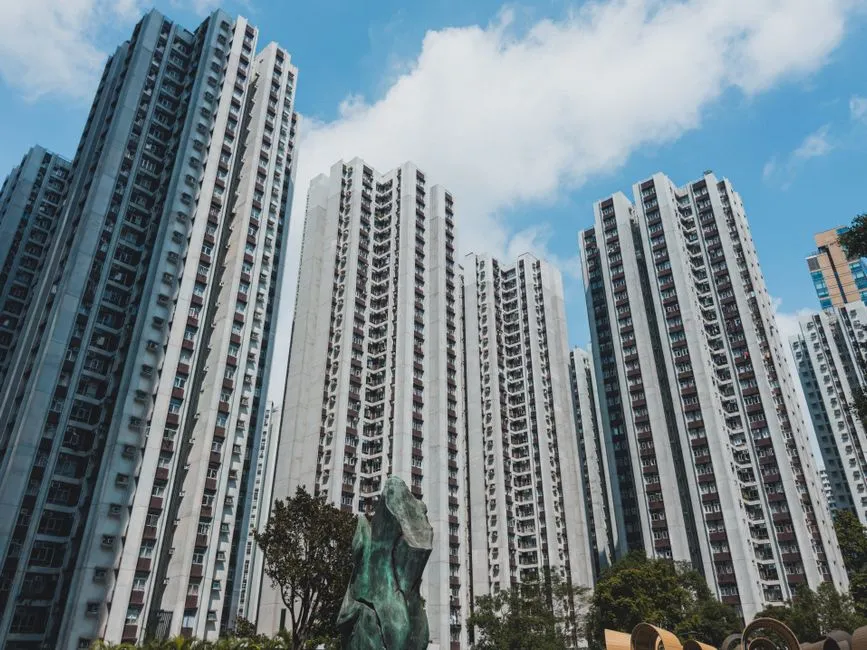
Picture a lift panel in a Hong Kong tower that runs 3, 5, 6: the fourth storey is built, but the number 4 is left off it. That panel is an illustration, and not every building follows it. On the Housing Authority's 2024 price list of 342 recovered flats for sale, we counted 45 on a floor ending in 4 and 15 on 13/F. The Buildings Department's practice note ADV-3, issued in May 2010 for projects from 1 September 2010, accepts leaving out 4, 13 and any number ending in 4. Any other omission "would not be allowed", though the note is a code the industry adopts on a self-discipline basis, with no force of law.
A 1998 practice note asked for a lobby notice wherever builders skipped floors
PNAP 128, first issued in November 1988 and last revised in July 1998, named the habit plainly: "Another problem arises from the practice to omit the name of the 1st, 4th, 13th, or the 14th floor and the like, in a building." From 1998 it called it "important" to display the real floor arrangement in Chinese and English in the main entrance lobby, and asked for the scheme on the plans submitted for approval.
The government told LegCo in 2009 it could not refuse plans that skipped floors
On 4 November 2009 the Secretary for Development answered a Legislative Council question (LCQ6) about a residential development on Conduit Road. The Building Authority "cannot refuse to approve a building plan because of the floor numbering arrangement", the reply said, because section 16 of the Buildings Ordinance does not cover it. Any suggestion it made was "advisory in nature without statutory effect".
The building had left out the 4th, 13th, 14th, 24th, 34th and 44th floors, which the reply called "a very common practice in Hong Kong". The plans showed the six real labels from 40/F to 46/F each "also known as" a higher number, climbing to 88/F. The reply called that "a very rare arrangement", and the Authority saw no need to advise changes.
Hong Kong's 2010 note accepts the usual skips and rules out also-known-as floors
ADV-3, "Standardization of Floor Numbering", replaced PNAP 128 in May 2010. It calls itself "a code of good practice for floor numbering for the industry to adopt on a self-discipline basis". Every floor bar the ground floor and roof, refuge floors and sky gardens included, should be numbered "in a logical and consecutive numerical series". The exception is in paragraph 6, which states that "the omission of floor numbers "4", "13" and those ending with a "4" may be accepted." Other omissions "would not be allowed", and alias names or "also known as x/F" would not be accepted. Floor 44 qualifies because it ends in 4; 40 to 43, 45 to 49 and 113 do not.
The note is still advisory. Answering LCQ4 on 29 February 2012, the government said: "Despite that the Practice Note is advisory in nature, according to past experience, the industry will follow it." The case was six Ma On Shan towers whose ground-level floor was named the podium floor, with floors above numbered 5/F to 30/F and a clubhouse on 1/F to 3/F. The Authority found that acceptable.
Skipping every allowed number still leaves 88/F for very tall towers only
Our arithmetic below takes ADV-3 at its ceiling, which no building need reach: number from 1/F up, skipping 13 and every label ending in 4. Eleven of the labels from 1 to 100 can go.
| Numbered floors above G/F | Top label, every allowed skip taken | Labels skipped |
|---|---|---|
| 20 | 23/F | 3 |
| 40 | 46/F | 6 |
| 60 | 68/F | 8 |
| 80 | 90/F | 10 |
| 100 | 112/F | 12 |
A top label of 88/F needs at least 78 numbered floors; 77 stop at 87/F. The highest real label the Conduit Road reply names is 46/F, with six numbers left out below it, which is exactly the ceiling for a 40-floor tower numbered straight from 1/F. That floor count is our inference.
The reason usually given for the habit is how the numbers sound. Unicode's Unihan database gives 四 as sì in Mandarin and sei3 in Cantonese, and 死 as sǐ and sei2: one syllable, two tones, so close and never identical. For 14 our Chinese number culture tool sets 十四 shí sì beside 实死 shí sǐ. In Mandarin 十 and 实 are both shí; in Cantonese they are sap6 and sat6, which end in different stops. Until its fix of 3 November 2026 the tool said the 14 pun worked only in Cantonese, and it found 十四 inside strings such as 4114, which are read digit by digit; 890 of the 10,000 four-digit strings got a card for 14, 18, 28 or 250 that way. The fix reads 14 as 十四 only when 14 is the whole input. Other number puns are in our homophones guide.
Sales brochures have listed every skipped number since April 2013
The Residential Properties (First-hand Sales) Ordinance, Cap. 621, was enacted as Ordinance No. 19 of 2012 and came into full operation on 29 April 2013 (LCQ22, 15 May 2013). Schedule 1, Part 1, section 1(3) requires a sales brochure to give each multi-unit building's storey count, its floor numbering as approved, "the omitted floor numbers in each multi-unit building in which the floor numbering is not in consecutive order", and any refuge floors. The consolidated text on e-Legislation (version of 1 September 2023) carries the same wording.
Housing Authority flats for sale sit on floors a private tower could skip
We counted the Housing Authority's "Price List No. 1, GSH2024(TPS)", for recovered flats from Tenants Purchase Scheme estates. It lists 39 estates, 38 with flats on offer. Our 342 parsed rows match the list's own total. Every floor label from 1 to 35 has at least one flat in the list, and floor 4 alone has 13. In all, 45 flats (13.2%) sit on a floor ending in 4 and 15 (4.4%) on 13/F.
A flat can be listed on 4/F only if its block has a 4/F. Split by each estate's own total in the list, such flats appear in 27 of the 38 estates. One estate holds 79 of the 342 flats and 15 of the 60 on 13/F or a floor ending in 4. We cannot show that any one block numbers straight through. The list covers recovered TPS flats only, without Home Ownership Scheme courts or rental stock, and we compared no prices by floor.
Singapore's fire code sets a 125 mm storey sign, and we found no rule on skipping
Singapore's Fire Code 2023, clause 2.3.1b on exit staircase signage (dated 1 March 2021 on SCDF's clause page), covers exit staircases in all buildings except purpose group I. Their sign "shall contain" the storey number, "at least 125mm in height", and an identification of the staircase. We found no Singapore rule on omitting floor numbers, though we did not search BCA, URA or HDB material page by page. For Malaysia we found none, without opening the Uniform Building By-Laws 1984. The clause we read sets the height of the number and says nothing about which numbers a building uses.

View author profile → · Editorial policy