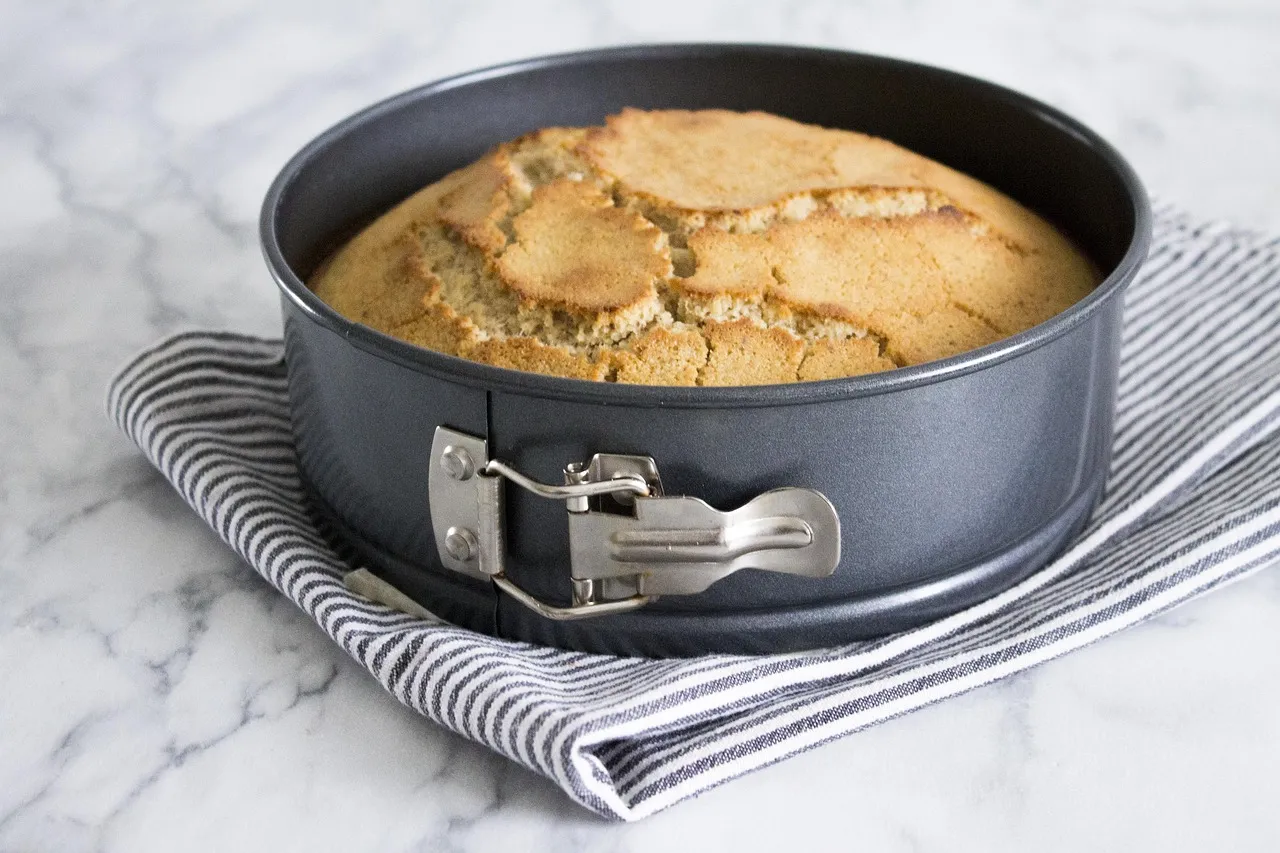
To move a recipe into a different cake tin (a pan, in US recipes), scale every ingredient by the ratio of the two tins' base areas. That keeps the batter as deep as the recipe intended. Whether the scaled batter then fits is a separate question, answered only by the tins' capacities. The round-to-square step-down holds up on area: of the ten distinct round-to-square pairs that five baking sources publish, nine come within 10% of the same base area, by our arithmetic. The cups-per-tin tables do far worse: Wilton's two current charts, both posted in late 2025, give different batter amounts for the same 8 in (20 cm) round: 4 US cups on one, 3 on the other.
Base area tailors a substitute tin to the original batter depth
Base area is the tin's floor, measured inside edge to inside edge; batter depth is how high the unbaked batter stands; capacity, or brim volume, is what the tin holds filled to the top. Joy of Baking puts the principle plainly: "The ideal pan substitution is one that keeps the same batter depth as in the original recipe, by keeping the same pan area." Its example: an 8 in square (64 square inches) for a 9 in round (63.5).
Area says nothing about fit. King Arthur's August 2025 post notes that swapping a 9 x 3 in springform for a 9 x 2 in round trades roughly 13 cups of capacity for 8.8. Those are capacities to the brim rather than the batter a recipe makes. With equal base areas the scale factor is 1.00 and the batter depth unchanged, yet the shallower tin has a third less room. One caption on that page says an 8 in round holds 26.6% less than a 9 in; that is the gap measured upward, and the figure downward is 21.0% (64 ÷ 81), by our arithmetic.
Round tins size down about an inch to become square
A square has 4 ÷ π, about 27.3%, more base than a round of the same width; olive magazine rounds that to "about 25% more". So UK-style charts drop a size: olive pairs a 20 cm round with an 18 cm square, and Baker Gatherer, in January 2026, a 25 cm round with a 23 cm square.
With Ask Nigella, King Arthur and Joy of Baking, the five sources give 21 listings, which reduce to ten distinct pairs because several appear in both units. Nine of the ten fall within 10% of equal area. The exception is 6 in round to 5 in square, 11.6% short, which olive and Baker Gatherer both list; their metric version, 15 cm to 13 cm, comes within 4.4%. Ask Nigella phrases the step as "2 cm (1 inch)"; an inch is 2.54 cm, so those are slightly different steps.
Cups tables let out some tins and take in others
Joy of Baking labels its column "Approximate Volume (cups)", with 1 cup as 237 ml. Against straight-sided brim geometry, its 21 straight-sided rows run from 2% above to 28% below, median 10% below. The 8 x 4 x 2½ in loaf is listed at 4 cups where geometry gives 5.54. In 24 of the 27 pairs of tins sharing a cups figure, base areas differ by more than 10%, so equal cups mean unequal batter depth.
Wilton's cake serving chart (29 Oct 2025) and wedding cake guide (17 Dec 2025) share 12 tins 2 in deep, and their batter cups differ by more than 10% on 8. That count rests partly on inference: the wedding guide labels its rounds, but its squares sit unlabelled beneath its heart entries, identified by us from servings that match the serving chart's squares. On labelled rounds alone, 3 of 7 differ. The wedding guide says its amounts are for pans "2/3 full", about 1.33 in (3.4 cm) of batter, yet its own cups imply 0.80 to 1.21 in, on our arithmetic.
Baker Gatherer's map, "Based on a standard depth of 5cm", errs upward: four of its five rows overstate straight-sided geometry by 18–25% on a US cup of 236.6 ml, or 25–32% on a 250 ml cup, and its 15 cm round by 7%. Which cup a recipe means matters first, as our guides to cup sizes and to kati, tahil and cups set out.
Sloped sides make a nominal tin run about a tenth small
Many tins flare toward the rim. Rose Levy Beranbaum wrote in 2019 that some manufacturers had been making pans smaller, "especially true with cake pans that have sloped sides". In a worked example of our own, a tin 5.1 cm (2 in) deep and 22.9 cm (9 in) across the rim holds 5.5% less than a straight cylinder if its base is 21.6 cm (8½ in), and 10.7% less at 20.3 cm (8 in). We treated it as a frustum, a cone with its top cut off. Joy of Baking advises holding the ruler straight up for depth, and Bake or Break suggests "the non-math route" of water for sloped tins.
Oven-dial advice for a shallower bake comes apart at the seams
The sources split on the oven, two of them in opposite directions.
| Source | Shallower batter | Deeper batter |
|---|---|---|
| Joy of Baking | Shorter time, slightly hotter | Longer time, slightly cooler |
| Baker Gatherer | Drop 10 °C, check 10 minutes early | Loaf tins: add 10–15 minutes |
| King Arthur | Larger tin: check 10–15 minutes early | Smaller tin: may take 10–15 minutes longer |
| olive magazine | Round to square: same temperature | No advice |
| Wilton | No advice | Largest tins at 325 °F against 350 °F |
Those Wilton settings are about 163 °C and 177 °C, our conversion. Until 15 Oct 2026 our baking pan size converter stated "keep the oven temperature the same" as a rule, had no depth input, and took a square tin's area from a hidden starting width instead of the side typed in, so nearly every square was wrong: a 10 in square read 80 square inches and ×1.26 where 100 and ×1.57 were right. The revision that day fixed the square, gave each tin its own unit, attributed the temperature advice and added optional depths. King Arthur's springform-to-round swap now reads ×1.00 on area and ×0.67 on capacity: a springform filled halfway becomes a round three-quarters full.
Fill ceilings hem the batter well below the brim
Water measures the one thing charts estimate. Joy of Baking pours it "by the cupful until the pan is filled to the brim"; Bake or Break weighs it, since a gram of water is a millilitre. Baker Gatherer's author reckons a tin holding 6 cups of water will take 4 of batter.
The ceilings differ by source. King Arthur fills "between half and two-thirds full", Baker Gatherer never more than two-thirds, and Ask Nigella expects batter "roughly half way up the side". Wilton allows half to two-thirds, and only half in tins 3 in deep.

View author profile → · Editorial policy