Published tempo charts put Andante anywhere from 56 to 108 beats a minute (BPM), and by our count only two tempos, 76 and 77, sit inside the Andante range of all six sources we compared on 15 October 2026. Adagio and Moderato have no tempo that every source includes. The six are a 2006 Wittner metronome manual, Wikipedia, an open textbook on LibreTexts, the app makers Yousician and Soundbrenner, and Dolmetsch Online. The disagreement is old news: Dolmetsch already sets three metronomes side by side, and the first edition of Grove's Dictionary of Music and Musicians said a tempo word on a metronome "means nothing at all" without its note value. What we added is a count.
Metronome scales graft numbers onto Italian words that predate the machine
The words came first. Christoph Meinel's 2023 study of a Maelzel metronome kept in Regensburg notes that earlier timekeepers generally carried the classical tempo names with no fixed measure. Maelzel patented his metronome in London and Paris in 1815, and his change, Meinel writes, was to calibrate the scale in beats per minute, as on his 1813 chronometer. That gave music M.M., for Maelzel's Metronome, and the metronome mark: ♩ = 72 means 72 crotchets (quarter notes) a minute.
According to Meinel, Maelzel's 1815/16 Paris brochure already included a table matching the conventional tempo terms to the metronome's numbers. We have not seen its figures. Printing the words on the scale itself drew scorn. W. S. Rockstro's "Metronome" article in Grove called it "a new, and utterly useless contrivance": if 100 to the crotchet means Moderato, then 100 to the minim (half note) is Allegro and 100 to the quaver (eighth note) is Largo.
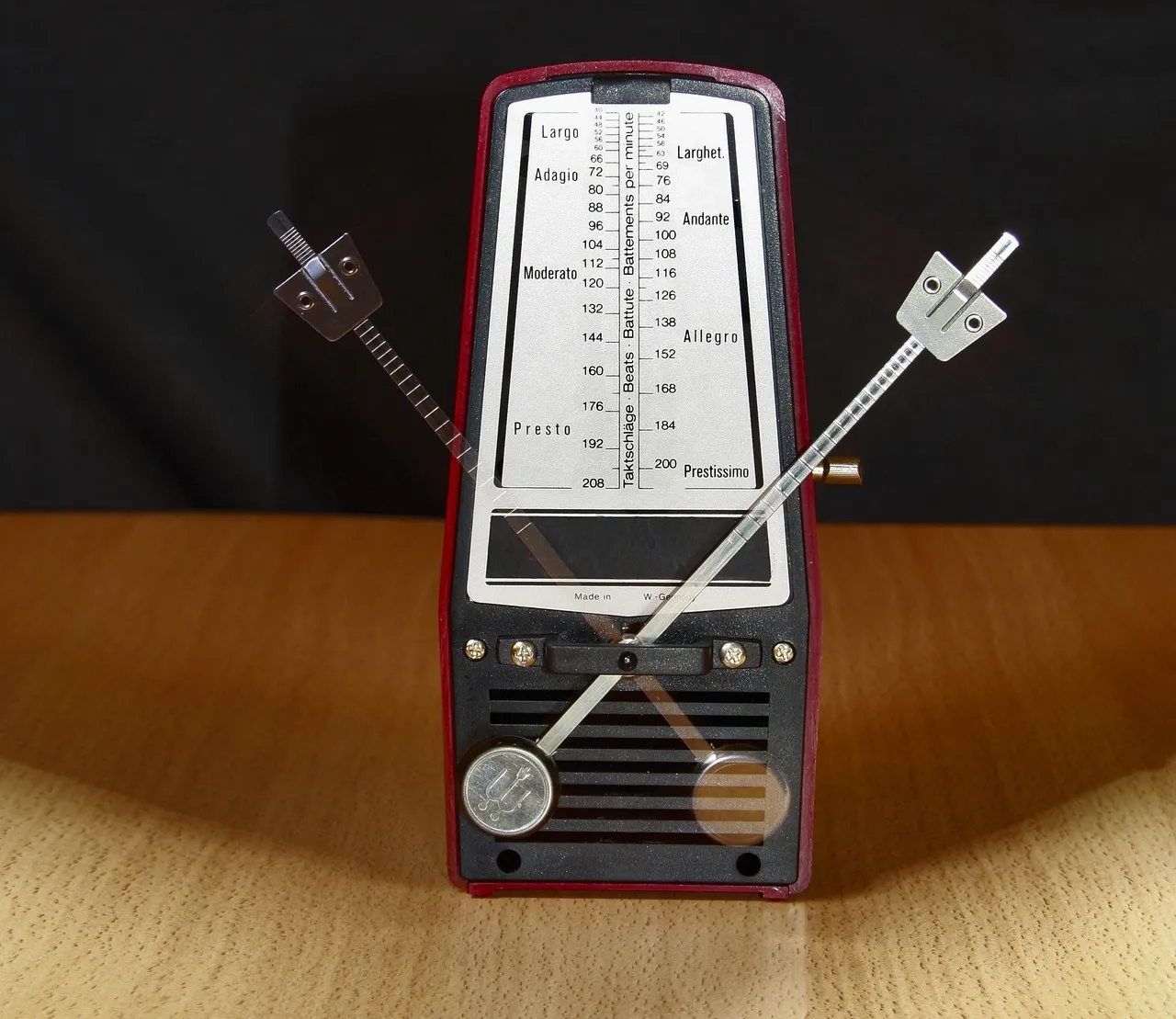
Wittner's Taktell manual for its Serie 830 metronome, dated 2006, carries "Richtwerte", or guide values, running from Largo at 40 to Prestissimo at 208, with Andante at 76–108.
Andante takes root at just two tempos common to every chart
We transcribed every term each source prints with a BPM range, as whole numbers with endpoints included. Wikipedia was read at its revision of 4 October 2026, which calls its own figures "very rough approximations for 4/4 time". The last column holds the tempos every range for that term includes.
| Term | Sources giving a range | Lowest to highest (BPM) | Inside every range (BPM) |
|---|---|---|---|
| Largo | 5 | 40–66 | none |
| Lento | 5 | 40–108 | none |
| Adagio | 6 | 44–97 | none |
| Andante | 6 | 56–108 | 76–77 |
| Moderato | 6 | 66–126 | none |
| Allegro | 6 | 84–168 | 120–132 |
| Presto | 6 | 100–200 | none |
Andante's shared band is 2 of the 53 whole numbers in its span and held when we stopped each range one beat short of the next. Moderato splits cleanly: LibreTexts ends it at 97, while Wittner, Wikipedia, Yousician and Soundbrenner start it at 108. Presto runs from Dolmetsch's 100 to Wittner's 200, though Dolmetsch adds that "some sources suggest 168–208"; with that range instead, Presto shares one tempo, 177.
Nor are the six independent. Wikipedia's Moderato and Presto match Wittner's, Yousician largely repeats Wikipedia, and Soundbrenner's narrow bands describe labels "in this metronome", its own app. The intersection measures agreement on the page, which differs from accuracy.
Tempo names overgrow some settings and leave others bare
At 66 BPM the six sources use six of the main names: Largo, Larghetto, Lento, Adagio, Andante and Moderato, or seven with Wikipedia's Adagietto. At 100 BPM Wittner says Andante and Wikipedia Andante or Andantino, while Dolmetsch's broad ranges cover Lento, Moderato, Allegro and Presto, five names in all. LibreTexts, Yousician and Soundbrenner give 100 no name. Of the 169 whole-number tempos from 40 to 208, LibreTexts leaves 84 unnamed and Dolmetsch 57. Yousician leaves 48, Soundbrenner's per-term pages 45, and Wittner and Wikipedia none.
A metronome that names the tempo has to choose. Until 15 October 2026 our online metronome took its names from an unsourced table, mostly Wittner's and Wikipedia's figures with a Largo starting at 45 that matched neither, and no Larghetto, Lento, Allegretto or Andantino. Its "Moderato 100" preset set a tempo its own readout called Andante. Its FAQ said a hidden page queued three seconds of clicks ahead, while the code queued 20. A tempo change also restarted the bar with an extra click: in a simulation running the page's own code, all 1,082 changes we tried sounded a click at once, about three times in four a downbeat that was not due.
The revision made that day takes the names from Wittner's 2006 table alone. A tempo on a shared edge, such as 76, shows both names, and each preset label matches the readout. When the tempo changes, the next click comes one beat at the new tempo after the last one heard, and the bar keeps counting from where it was.
Readings from three metronomes transplant the same words to different beats
Dolmetsch Online's table of tempo markings got to the instrument question first. It gives readings for the same words off a nineteenth-century Maelzel metronome, one from 1950 and a modern electronic one. Andante reads 69 on the Maelzel and 80–100 on the electronic machine. The 1950 metronome breaks any trend: on the eight terms where both older instruments give one figure, by our tally, it reads slower on five, Adagio at 54 against 60 among them, and faster only on Largo.
Three instruments on one site illustrate how loosely the words were set and are too few to show tempos drifting either way. Software makes its own picks: MuseScore Studio's tempo palette inserts Andante at 92 by default (source code of 14 October 2026), outside the band all six sources share.
Elijah plants three tempo words on the same metronome mark
Ebenezer Prout's "Andantino" entry in Grove points to Mendelssohn's Elijah, where three movements marked andante con moto, andante and andantino all carry ♩ = 72. Prout called it "striking proof of the uncertainty which prevails in the use of these time-indications". By our check, 72 falls outside the shared Andante band. Wittner's table names it Adagio, three sources give it no name, and only Wikipedia and Dolmetsch would call it Andante.
The note matters as much as the number. Wittner's manual says that for a mark given with a half note, "each pendulum movement indicates a half note (minim)", so 72 to the minim is 144 crotchets a minute on our arithmetic, a speed none of the six calls Andante.
The ABRSM piano syllabus hedges editorial metronome marks
ABRSM, the UK exam board, attaches no BPM to any tempo word in its piano syllabus for 2025 and 2026. Its single sentence on the topic says that "Printed editorial suggestions such as fingering, metronome marks, realisation of ornaments, etc. do not need to be strictly observed." The weight falls on editorial. The sentence covers marks an editor added to a printed edition and says nothing that would make a composer's own mark optional. For the Italian word above the stave, the syllabus gives no number at all.