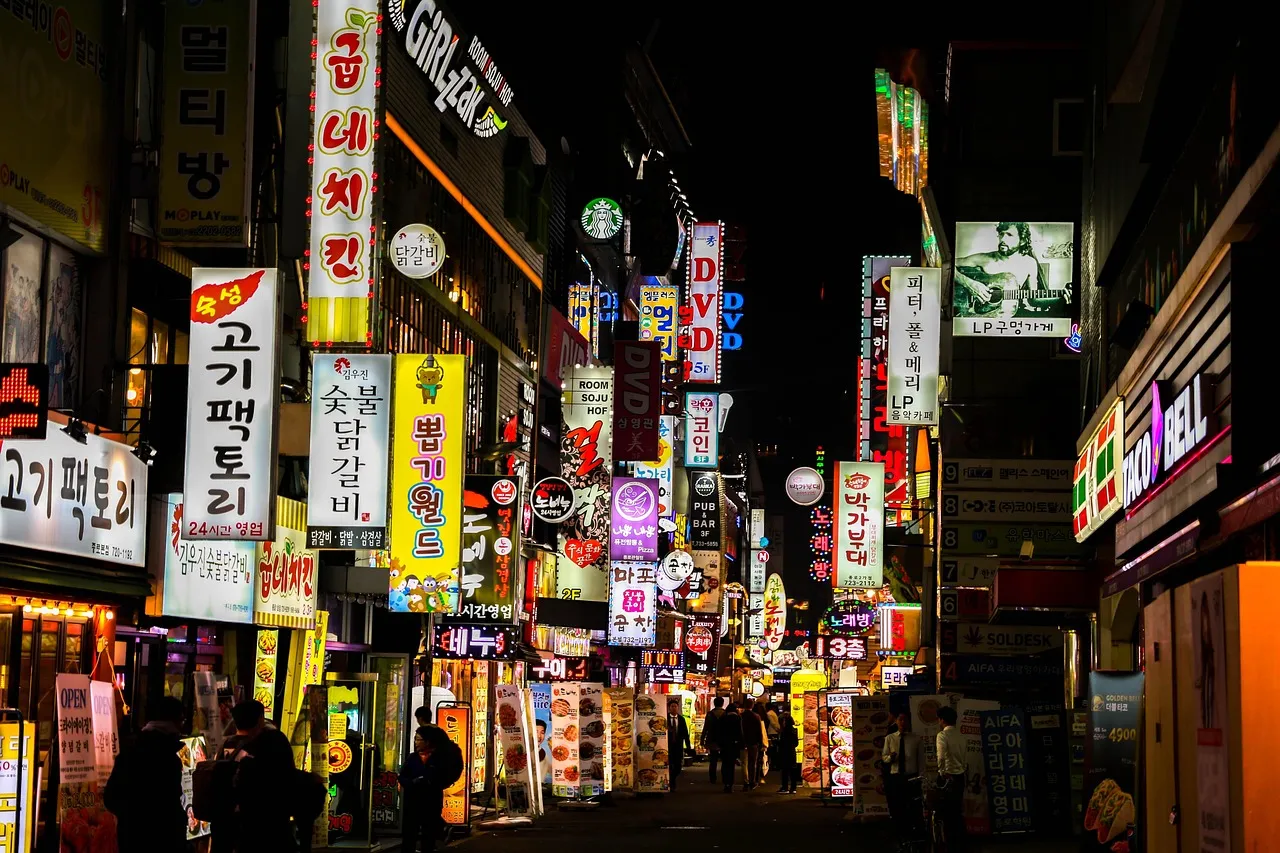
Revised Romanization (RR) and McCune-Reischauer (MR) spell only 15.8% of a Korean learner's dictionary identically, even though both spell Korean by its pronunciation. We spelled all 44,034 headwords (entry words) of the National Institute of Korean Language's (NIKL) Basic Korean Dictionary in both systems, taking our own default reading where the rules leave a choice, and 6,976 came out the same. The port city 부산 is Busan in RR and Pusan in MR, because MR writes a plain ㅂ at the start of a word as p. The Seoul district 종로 is said [종노], so RR writes Jongno and MR Chongno.
Sound rules respell about 9% of a learner's dictionary
RR writes four kinds of sound change. Neighbouring consonants assimilate, so 신라, the old kingdom, is said [실라] and written Silla. An ㄴ or ㄹ can be added, so 알약 (a pill) is allyak. A final ㄷ or ㅌ before ㅣ becomes j or ch, so 같이 (together) is gachi. And ㅎ merges with a neighbouring consonant, so 좋고 (good, and) is joko, though nouns keep the h, as in the place name 묵호 Mukho.
Against a speller that knows only RR's letter table, those rules changed the letters of 3,898 of NIKL's 44,034 headwords (licensed CC BY-SA 2.0 KR), or 8.9%, on our implementation's default readings. Verbs and adjectives changed in 17.3% of cases, more than three times the 5.2% for words tagged as nouns, mostly verbs ending in 하다 (to do) after ㄱ or ㅂ, like 가득하다 gadeukada (to be full). The count is a floor, since an inserted ㄴ counted only where the rules print one.
Three things stay unwritten: tensing (the Seoul neighbourhood 압구정, Apgujeong), changes inside a personal name (the notice's 한복남, Han Boknam) and changes across the hyphen before an administrative unit (the village 인왕리, Inwang-ri).
A rule-following converter renders all but a handful of the notice's printed examples
The RR rules in force are the culture ministry's notice 2024-27 of 23 May 2024, on Korea's national law information site. It renamed one category of names, and the 2014 notice before it changed one example, putting 굳히다 guchida (to harden) where 맞히다 machida (to hit a target) had been, so the rules are those of 2000.
The notice prints 98 worked examples, counted in NIKL's 2014 text because law.go.kr shows the 2024 ones as images. Our Korean Romanization Converter reproduces 95 exactly when given the setting each section calls for. The other three, the city 청주시, the county 함평군 and the town 순창읍, appear in permitted short forms such as Cheongju, where the converter gives the also-permitted Cheongju-si.
Until 12 October 2026 the converter read ㄺ before ㄱ as [ㄹ] in every word, so 닭갈비, a grilled chicken dish, came out dalgalbi where the standard pronunciation rules give dakgalbi. It wrote "Jongno 2Ga" for the notice's Jongno 2(i)-ga, capitalised a syllable after a digit (2026년, the year 2026, became "2026Nyeon") and by default left the inserted ㄴ out of 학여울 Hangnyeoul (a Seoul place name) and 알약 allyak (a pill). That version reproduced 90 of the 98 exactly.
McCune-Reischauer stripped of its marks spells about seven times as many words alike
South Korea set out its reasons for leaving MR in a 2006 working paper to the UN Group of Experts on Geographical Names. MR marks two vowels with breves (ŏ, ŭ) and aspirated consonants with apostrophes (k', ch'), and the paper says these were often dropped as inconvenient to type or search for. Without them, the given names 영숙 Yeongsuk and 용숙 Yongsuk were both written Yongsuk, and the place names 정주 Jeongju and 청주 Cheongju both Chongju.
The first of the government's two reasons holds up on our count. With the marks dropped, 3,293 of the 44,034 headwords share a spelling with another, against 454 in RR, about seven times as many. With the marks kept, MR collides slightly less than RR, at 420. RR's collisions are what its optional hyphen is for: 가을 (autumn) and 개울 (a stream) are both gaeul until they are written ga-eul and gae-ul. Our test uses dictionary words; the paper's examples are names. Its second reason, that MR's voiced-voiceless split "is meaningless" to Korean speakers, concerns hearing, which a count cannot test.
At least three systems transcribe Korean under the McCune-Reischauer name
George McCune and Edwin Reischauer published their system in 1939, in volume XXIX of the Transactions of the Korea Branch of the Royal Asiatic Society (Internet Archive scan). Its table gives ㅅ as sh only before ㅟ, so 시 is si, and it has the two syllables of a given name "written together".
South Korea's own 1984 version (notice 84-1) writes 시 as shi, as in 신촌 Shinch'on, a Seoul neighbourhood. It hyphenates a given name with no sound change across the hyphen, as in its example Kim Pok-nam, and let printers drop the marks only where no confusion of meaning resulted. The Library of Congress's 2009 table (ALA-LC) writes si again and hyphenates given-name syllables. We read it in a Wikisource transcription, as the Library's own file refused us. Of the 93 examples the 1984 notice gives for its system, 33 come out differently under the Library of Congress rules as we implement them; 사건 (an incident), for one, is sakŏn in 1984 and sagŏn in ours.
Passports romanize a name syllable by syllable
The Passport Act's enforcement rule, in force from 1 June 2026, has the romanised name follow the culture ministry's method syllable by syllable, the given name's syllables joined, with a hyphen allowed between them. RR treats names the same way, so a passport name skips the sound rules altogether. A separate decree lists grounds for correcting or changing one.
The foreign ministry (MOFA) lists spellings in wide use from passport statistics. Its current notice 2024-10, in force from 31 December 2024, sets the bar at 50% of the holders of a Hangul surname or given-name syllable, or 10,000 people. We could not read its list, counted on 31 October 2024. The 2018 version (notice 2018-1) listed a spelling used by 1% of holders or 10,000 people, for 100 given-name syllables. In RECATOOLS' transcription of that list from MOFA's online viewer (the spreadsheet itself would not open for us), the RR form is the commonest listed spelling for 69 of the 100 syllables. RR's notice leaves surnames to be set separately, a gap our guide to Korean surname romanisation covers.
Western map agencies write South and North Korean names in different systems
Inside South Korea, the 2000 notice gave road signs until 31 December 2005 to conform, and lets people, companies and organisations keep spellings they have long used.
The US Board on Geographic Names has used MR since 1943, and the UK's Permanent Committee on Geographical Names uses it too. Their joint note on South Korea, checked in September 2022, records that in 2011 the two boards agreed to use RR for geographical names there. The same note says MR "remains the approved system for use as it relates to the Democratic People's Republic of Korea". Their table for North Korean names applies it "with minor modifications", citing North Korea's 1966 language guidelines for an optional word-initial ㄹ written r.