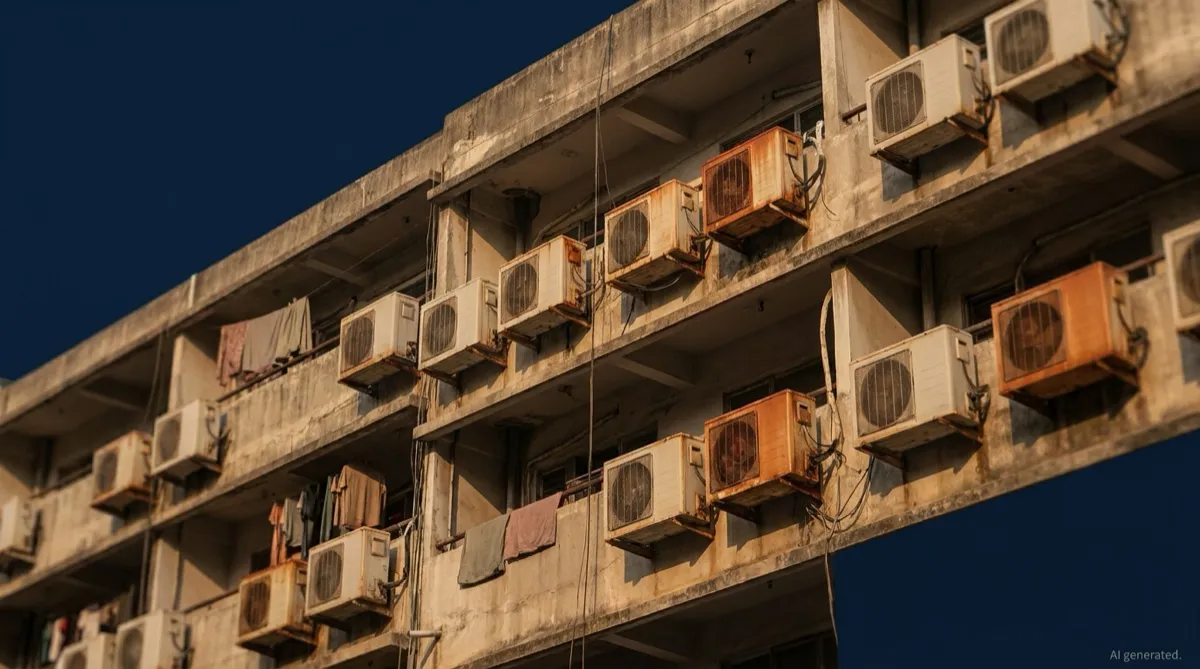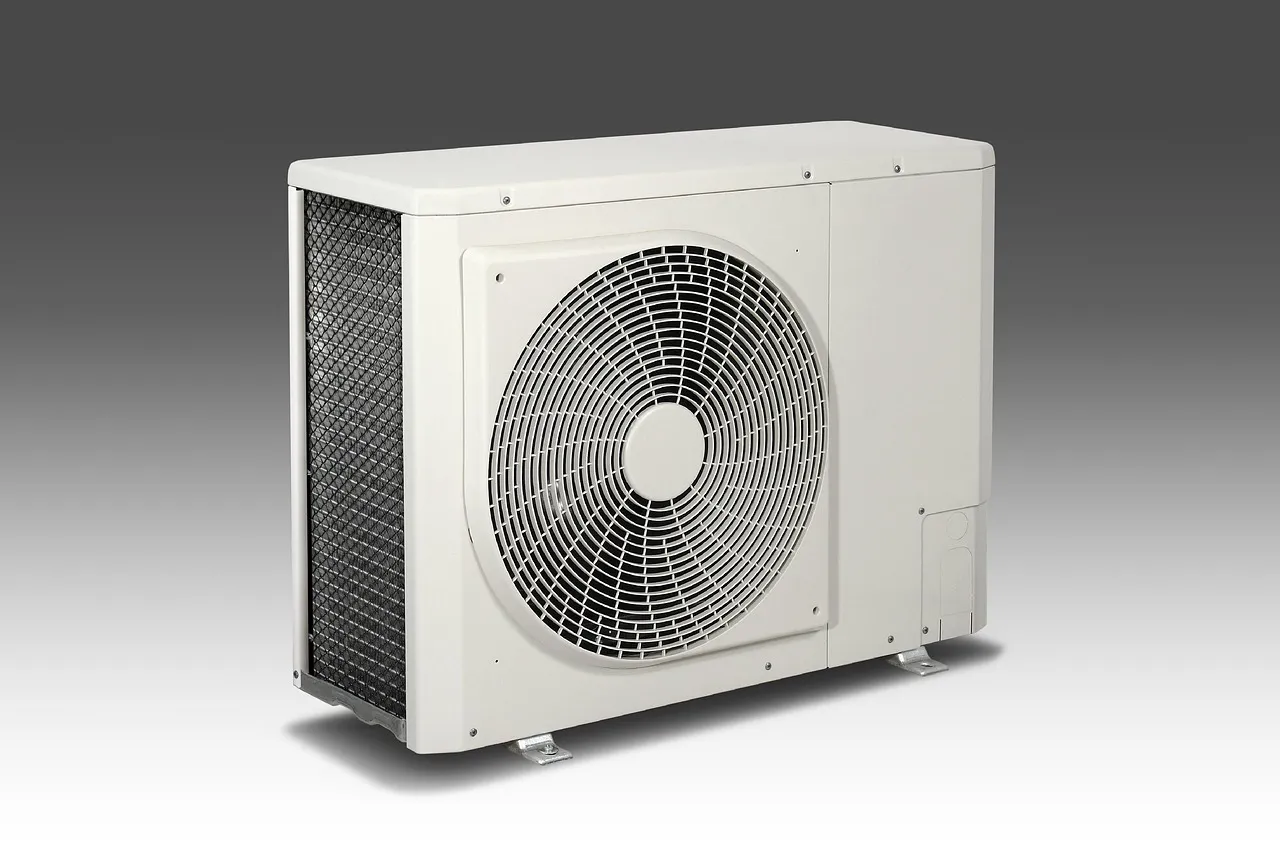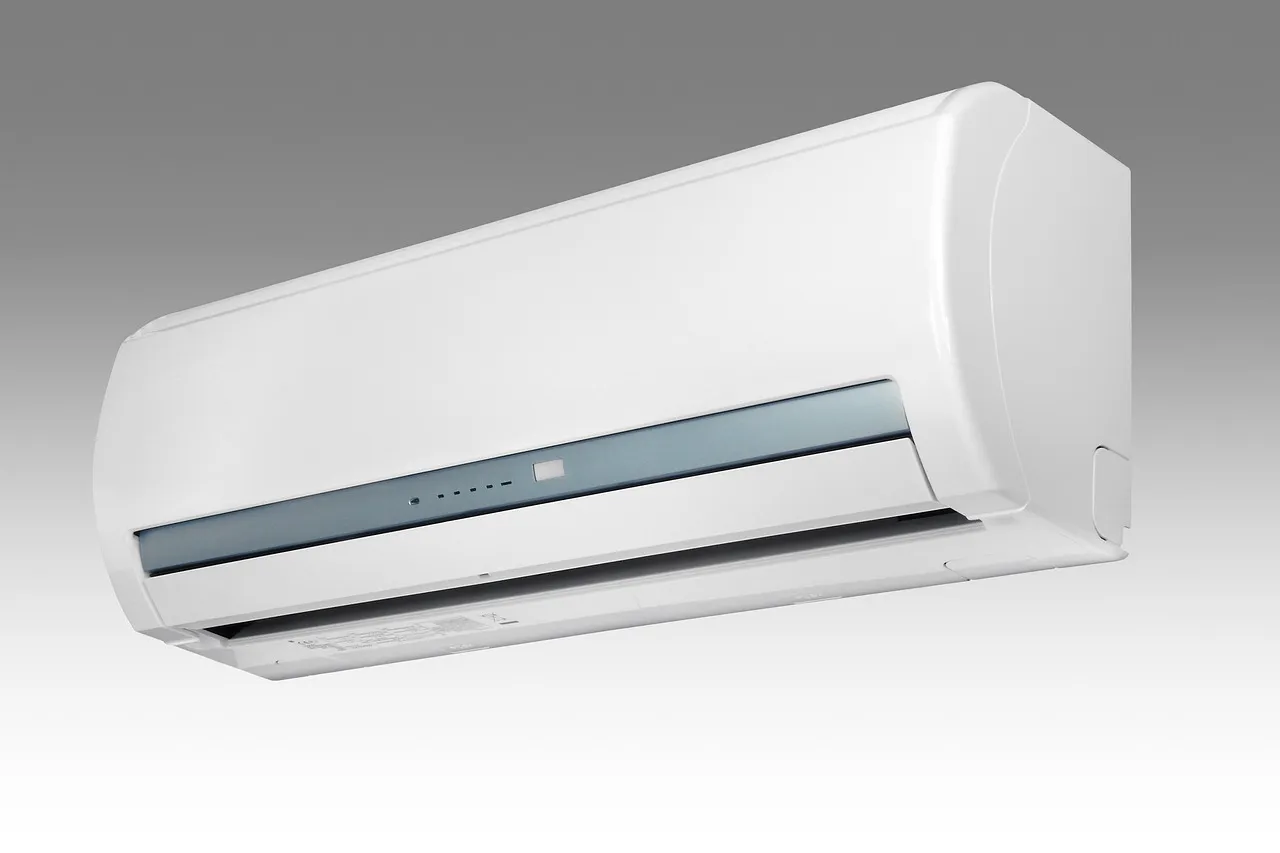
Air conditioners sold in Indonesia, Malaysia, the Philippines, Thailand and Viet Nam carry a seasonal efficiency figure called the CSPF. It is computed against a reference cooling season defined in ISO 16358-1, and the machine is measured at exactly two outdoor temperatures: 35 °C and 29 °C.
Everything else is a straight line drawn between those two points and extended downward. Seventy-eight per cent of the reference season lies below the lower one.
The reference season, as the standard defines it
ISO 16358-1 §6.3 sets out a bin table — how many hours the season spends at each outdoor temperature — and instructs that the "cooling seasonal performance factor (CSPF) shall be calculated at the reference climate condition in Table 3". The table runs from 21 °C to 35 °C and sums to 1,817 hours, which we re-derived cell by cell.
| Outdoor temperature | Share of the season's hours |
|---|---|
| 21–24 °C | 33.0% |
| 25–28 °C | 44.9% |
| below 29 °C, the measurement floor | 77.9% |
| 35 °C, where the machine is actually rated | 0.2% |
Weighted by cooling energy rather than hours the picture softens, because colder hours carry less load — but only to a point. 62.9% of the season's cooling energy still sits below the lowest temperature anyone measured.
What the straight line asserts
Take the standard's own default values for the 29 °C point: capacity multiplied by 1.077, power by 0.914. That implies efficiency 17.8% higher at 29 °C than at 35 °C, or about 2.8% per degree. Extend the same line to the bottom bin:
at 29 °C:  EER ratio 1.1783   (measured)
at 21 °C:  EER ratio 1.4758   (extrapolated, 8 °C below any measurement)
⚠️ Following that linear extrapolation, the reference season credits a unit with being 47.6% more efficient at 21 °C than at 35 °C, from two constants and a straight line. The 21 °C bin is not a corner case; it accounts for 5.5% of the season's hours on its own.
Whether the tropics have those temperatures
We pulled the Meteorological Service's Changi records for 2024 and 2025 — 731 daily observations, all three temperature columns intact.
| 2024 | 2025 | |
|---|---|---|
| Mean of daily mean | 28.44 °C | 28.10 °C |
| Mean of daily minimum | 25.91 °C | 25.43 °C |
| Absolute minimum recorded | 22.4 °C | 22.1 °C |
| Days whose minimum reached 22.0 °C | 0 | 0 |
| Days whose maximum reached 35.0 °C | 4 | 5 |
Compared against the ISO bin table, the Changi data shows:
- ISO assigns 13.2% of the season's hours to 21–22 °C. Changi's daily minimum reached 22.0 °C on none of the 731 days. The temperature was not rare; it was absent from this station's two-year record.
- ISO assigns 33.0% of hours to 24 °C and below. Changi's daily minimum touched 24 °C on 99 days, so on 86.5% of days the air never got that cool at any hour — let alone for a third of them.
- ISO assigns 0.2% of hours to 35 °C, where all the measuring happens. Changi's daily maximum reached it on nine days out of 731, for part of an afternoon each.
The hour-weighted mean of the reference season is 26.05 °C. Singapore's annual mean was 28.44 °C. The standard's season is about two degrees cooler than the climate, and it has a shape — a season that starts and stops — that the tropics do not have at all.
What this does not mean
The CSPF is not junk, and the standard is not pretending. ISO says plainly in the same section that "the calculation of cooling seasonal performance factor may also be done for other climate conditions" — the reference climate is a common yardstick, offered as one, and a later amendment adds a hotter reference set.
A common yardstick is useful. Two machines rated against the same fictional season can be ranked against each other, and that ranking will mostly survive being moved to a real one. What it cannot do is predict a bill.
⚠️ This is not evidence of manufacturers gaming the standard. The two measurement points, the interpolation rule and the default multipliers are all defined by the standard itself, and a manufacturer following it exactly produces the number described above. If there is a criticism here it is of a reference climate, not of the people computing against it.
And the single figure it produces is an integral. Even a perfect seasonal number compresses a year into one scalar, which is a lossy thing to do to a machine whose efficiency varies with every hour.
What to do with it
Read the CSPF as a ranking rather than a prediction. It orders machines fairly against a common reference; it does not estimate what yours will do in Johor in April.
Where a spec sheet gives both a measured rating point and a seasonal figure, the measured one is the one somebody actually observed. Prefer it when you are sizing or budgeting, and use the seasonal figure to choose between two units.
The whole annual rating, incidentally, is equivalent to 733 hours at full capacity — under two hours a day. If your unit runs longer than that, and in this region many do, the reference season is not describing your year in any sense, and the gap is not a small one.
Where this comes from, and what will date it
The bin table, the load definition, the measurement points and the quoted sentences are from ISO 16358-1:2013, read from the publisher's preview PDF — 486,024 bytes, twelve pages, from which we extracted 41,455 characters of text. Our transcription of the bin table sums to the standard's own printed total of 1,817 hours, which is the check that it is right. The climate figures are re-derived from the Meteorological Service's Changi daily records, 24 monthly files covering 731 days.
⚠️ One limit worth stating plainly. We read a publisher's preview, not the whole standard. It carries the sections this piece turns on — §5.2, §6.2, §6.3 and §6.4 — and the arithmetic reproduces against the printed totals, but a preview is not the full document and we are not claiming otherwise. A 2019 amendment, not present in the preview we read, adds a hotter reference climate that would alter these figures.
⚠️ And Singapore is the odd one out here in a way worth flagging: it does not use the ISO CSPF on its own labels. The five markets named at the top do. We checked an international efficiency-metric survey and found Singapore absent from its CSPF table, against nine or ten appearances each for the other five — a real absence, confirmed by the survey's own controls, and one we are reporting rather than explaining.
This dates if a jurisdiction adopts the amended hotter reference climate, which would be the right fix and would not change the argument so much as move its numbers. The bin table itself has been stable since 2013.

View author profile → · Editorial policy