Eight. That answer is correct, which is exactly why people get this wrong.
The number eight is only right for one specific cup: the US customary one (236.588 mL), which is exactly 8 US fluid ounces. There are five other cups in ordinary use, the largest is 57.9% bigger than the smallest, and the cup most likely to be in a Singapore or Malaysian kitchen drawer is not the American one.
The five steps
- Find out where the recipe is from.
American recipes mean 236.588 mL. British ones mean 284.131 mL. Australian, New Zealand, Singaporean and Malaysian recipes mean the metric cup, 250 mL. Japanese recipes mean 200 mL — and if the instruction came with a rice cooker rather than a cookbook, it means the 180 mL gō that ships in the box. Origin decides this, not the cup in your cupboard.
- Check whether it is a nutrition label rather than a recipe.
American nutrition labelling uses its own cup of exactly 240 mL, set by regulation, and rounds the fluid ounce to 30 mL for the same purpose. So a "cup" on a packet and a "cup" in the recipe on the back of that same packet can be different volumes. This is the one case where the round number is the legal one.
- Identify which fluid ounce the recipe uses.
A US fluid ounce is 29.5735 mL. An imperial fluid ounce is 28.4131 mL — about 4.1% smaller. This difference accounts for the two famous answers. A US cup is exactly 8 US fluid ounces; a UK cup is exactly 10 imperial ones. Both are "right"; they are answers to different questions.
- Convert once, and only for liquids.
Divide the cup's millilitres by your fluid ounce's millilitres. That is the whole calculation. It is reliable for water, milk, stock and oil — anything that pours and settles level.
- For flour, sugar and anything you scoop, stop converting and weigh.
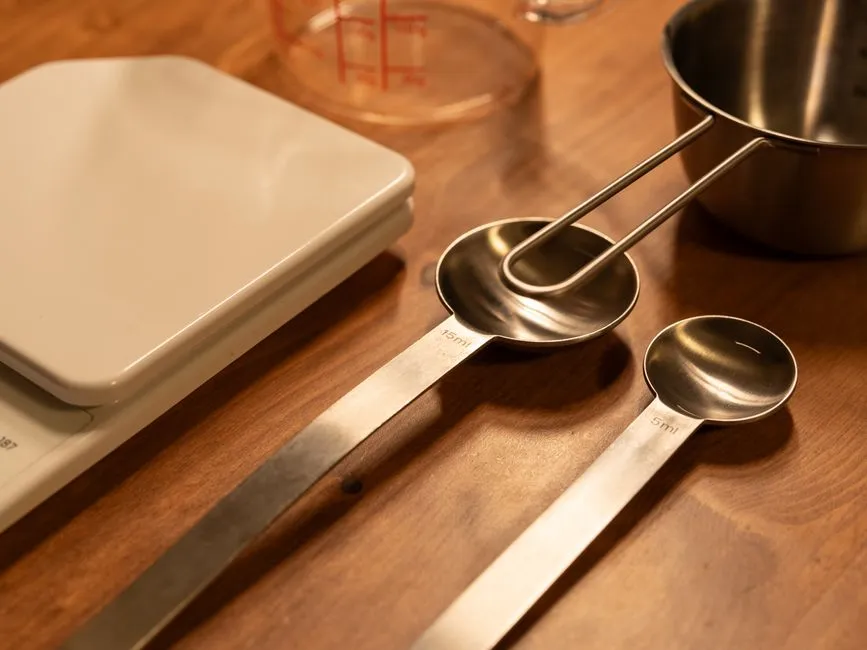
A cup is a volume, and dry ingredients do not have a fixed weight per volume. A US cup of water is 236.588 g; the same cup of all-purpose flour is about 120 g, and of white sugar about 198 g. No conversion factor can bridge that gap; the variable is the ingredient, not the unit. A cheap kitchen scale removes the entire problem.
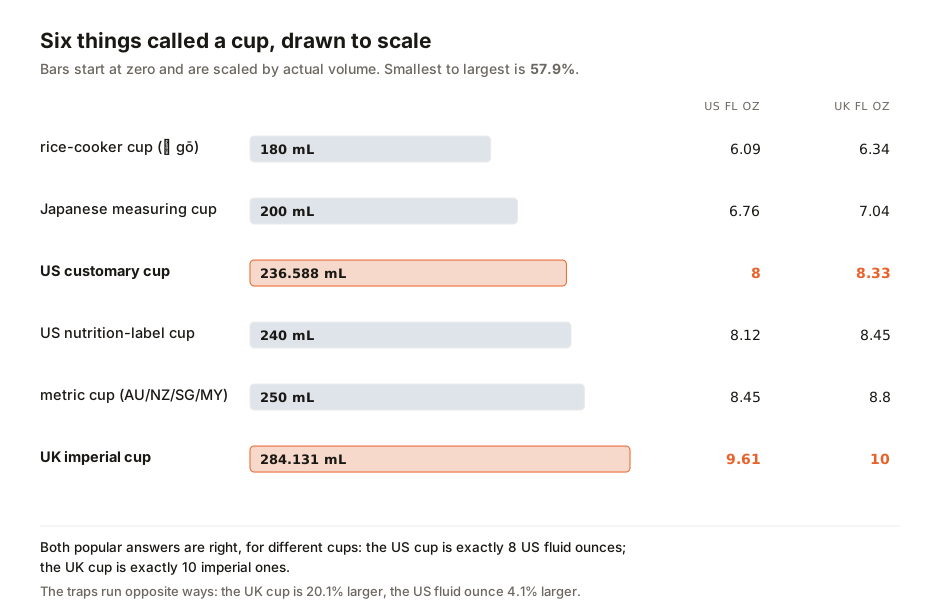
The full table, if you want to look yours up
| Cup | Millilitres | US fl oz | Imperial fl oz |
|---|---|---|---|
| rice-cooker cup (合 gō) | 180 | 6.09 | 6.34 |
| Japanese measuring cup | 200 | 6.76 | 7.04 |
| US customary cup | 236.588 | 8 | 8.33 |
| US nutrition-label cup | 240 | 8.12 | 8.45 |
| metric cup (AU/NZ/SG/MY) | 250 | 8.45 | 8.8 |
| UK imperial cup | 284.131 | 9.61 | 10 |
Why this is harder than it looks
The two mistakes run in opposite directions, which tends to mask both of them.
The imperial cup is 20.1% larger than the US cup. The imperial fluid ounce is 4.1% smaller than the US one. So a British recipe asking for a cup wants noticeably more than an American one, while a British recipe asking for an ounce wants slightly less. If you mix them up, the errors do not cancel — they compound. And neither is large enough on its own to look obviously wrong in a bowl.
The word "ounce" also does two jobs. A fluid ounce is a measure of volume, while a standard ounce is a measure of weight. The two are unrelated, except by coincidence for water. "8 oz of flour" and "1 cup of flour" are different quantities, and which one the recipe means usually depends on which side of the Atlantic it was written.
What this audit found in our own tools
Every guide here audits the tools it links. This one found two of our own converters that disagreed — an issue we have since fixed. The sources card below records the correction.
Our cooking converters handle this properly. The volumes above are read directly out of the shared kernel they use, which carries all six cups with a source note on each — and a comment that states the problem more bluntly than this guide has: "THE CUP IS NOT ONE THING."
Our general-purpose unit converter did not. It offered a single entry, Cup (US), with no indication that the question has more than one answer. A search for this question is most likely to land on that tool, so for a reader holding the 250 mL cup sold across Singapore and Malaysia it returned a number that was confidently 5.7% out — more against a British recipe. The arithmetic was never wrong; the unit list was incomplete, and the page did not warn you. That converter now carries all six cups from the same shared kernel, so the two tools agree.
Before you convert anything, answer the question "whose cup?" A recipe's origin determines all the other numbers. Use 8 US fluid ounces only for American recipes, and 10 imperial ounces only for British ones — both are exact, neither is general. Assume the metric 250 mL cup for local recipes in Singapore, Malaysia, Australia and New Zealand. Never convert a dry ingredient by volume if a weight is available, because the conversion depends on the ingredient rather than the unit. And treat any recipe that mixes cups and ounces without specifying which kind as one that has not been tested carefully.
Run your own numbers
Our cooking measurement converter lists all six cups by name, letting you pick the one your recipe means. For spoons and other volumes, use the cooking unit converter. If you are also scaling a recipe, the recipe scaler handles both conversions at once. All other units — length, weight, area and so on — are in the general unit converter.
- Correction, 11 August 2026. This guide reported that our general-purpose unit converter offered a single
Cup (US)entry, and left it logged for its next review. That was true when the audit read its source, and it was rebuilt on 9 August in direct response to this guide: it now carries all six cups from the same shared kernel these figures come from, and both fluid ounces, which it had previously lacked entirely. A kernel test now asserts the two cannot drift apart again. The finding is left standing in the past tense rather than deleted, because the audit is the reason the tool changed. - Every millilitre figure in this guide is read straight out of
kitchenpet-kernel.js, the shared table our own cooking converters use, by a script committed alongside the guide. Nothing was retyped, so the guide cannot drift from the tools it links — if the kernel changes, the script changes with it and the figure check fails until the prose is updated. - The fluid ounces come from the same kernel: US 29.5735 mL, imperial 28.4131 mL. The ounce columns are computed from those, not quoted from elsewhere, which is why the US customary cup lands on exactly 8 and the UK imperial cup on exactly 10 rather than on rounded approximations.
- The 240 mL cup is the United States nutrition-labelling cup defined in 21 CFR 101.9(b)(5)(viii), the same regulation that fixes 1 fluid ounce at 30 mL for labelling purposes. It is a labelling definition, not a cooking one.
- Grams per US cup for water, all-purpose flour and white sugar are read from the kernel's own ingredient table by exact entry. The entry matters rather than the word: that table carries four flours and three sugars, and they do not weigh the same. These are properties of the ingredient rather than of the cup, which is the entire reason step five says to weigh instead of convert.
Volumes here are the standard definitions, not measurements of any particular piece of kitchenware. Retail measuring cups vary from their nominal size, and a cup filled by scooping holds more flour than one filled by spooning and levelling. That is one more argument for using a scale.

View author profile → · Editorial policy