Ask this site how many bags of concrete a cubic metre takes and you can get 80 or you can get 7.
Both are right. They are answers to different questions, and the word "bag" is doing the damage.
We publish two concrete tools. Our concrete calculator works out the volume of a slab, footing or column and converts it into bags of ready-mixed concrete — the kind you tip into a barrow, add water to, and pour. Our concrete mix ratio calculator takes a volume and a ratio and works out the ingredients you would batch yourself, reporting the cement as bags. Cement is one of three things in that barrow. The other two are sand and aggregate.
Carry a number from the second tool to the first and you will arrive on site with roughly a tenth of the material the job needs.
The two answers, for one cubic metre
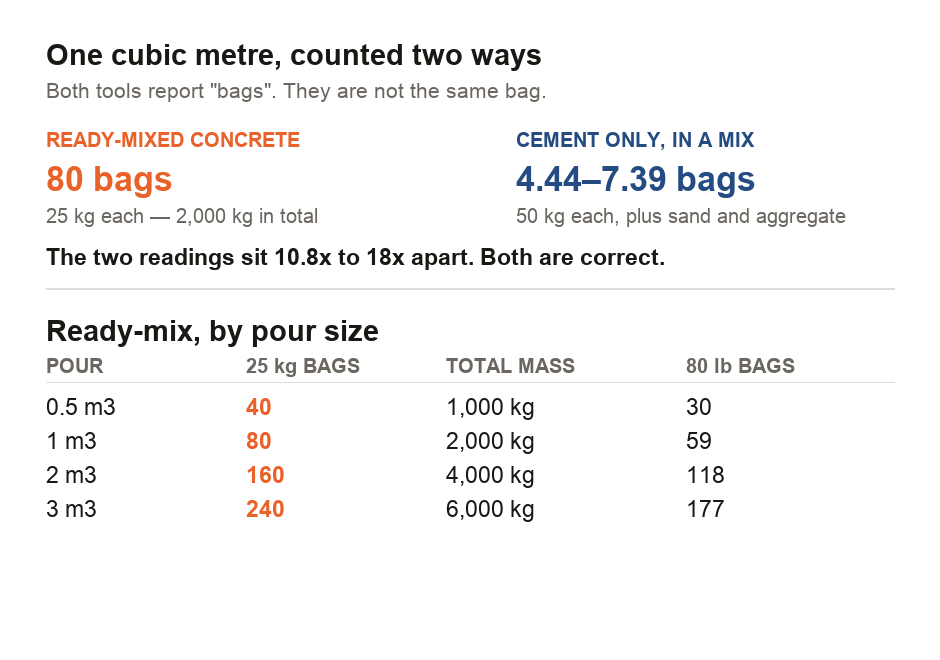
A 25 kg bag of ready-mixed concrete yields 0.0125 cubic metres. That figure is not a rounding of ours — it is the constant the calculator itself uses. One cubic metre therefore needs 80 bags, which is 2,000 kg of material.
The mix calculator answers the same volume differently. It takes the wet volume, multiplies by 1.54 to get the dry volume the ingredients occupy before water closes the gaps, splits that by the ratio, and converts the cement share to 50 kg bags at a density of 1,440 kg per cubic metre. For the three ratios it offers:
| Mix ratio | Cement per m³ | 50 kg cement bags |
|---|---|---|
| 1:2:3 | 369.6 kg | 7.39 |
| 1:2:4 | 316.8 kg | 6.34 |
| 1:3:6 | 221.8 kg | 4.44 |
So the same cubic metre is 80 bags in one tool and between 4.44 and 7.39 in the other — a factor of 10.8 to 18, depending which mix you pick. Neither tool is wrong. They are counting different objects.
What 80 bags actually means
The bag count matters less than what it weighs. One cubic metre of ready-mix is two tonnes of material, arriving as eighty separate sacks that each have to be lifted twice — once into the vehicle, once into the mixer — before anything is poured.
Scale that up and the arithmetic makes the decision for you:
| Pour | 25 kg bags | Total mass | 60 lb bags | 80 lb bags |
|---|---|---|---|---|
| 0.5 m³ | 40 | 1,000 kg | 40 | 30 |
| 1 m³ | 80 | 2,000 kg | 79 | 59 |
| 2 m³ | 160 | 4,000 kg | 157 | 118 |
| 3 m³ | 240 | 6,000 kg | 236 | 177 |
A modest garden slab — three metres by two, at 100 mm — is 0.6 m³, which is comfortably in bag territory. A single-car parking bay at the same thickness is closer to 1.5 m³, or 120 bags and three tonnes. At that point, the question is not about arithmetic. It is about how many times you are willing to lift 25 kg.
We are deliberately not putting prices on any of this. Bag and ready-mix pricing moves by market and by week, and a figure quoted here would be wrong somewhere by the time you read it. Mass and bag counts are properties of the material and do not move.
Where bags stop being the answer
There is no single volume at which bags become wrong, because the limit is not the concrete. It is the pour.
Concrete has to be placed and finished before it stiffens, and a slab poured in stages develops cold joints where one batch has set before the next arrives against it. A cold joint is a plane of weakness running through the finished slab, and it is the reason a large pour is a continuous pour. One person with a mixer and eighty bags is not pouring continuously; they are pouring for an afternoon.
So the practical question is not "how many bags can I carry" but "how much can I place before the first of it goes off". For a footpath or a small pad, batching by hand across an hour is fine because each section is independent. For a single slab that has to act as one piece, the honest threshold arrives well below the point at which the bag count becomes tiring — somewhere around the volume one person can mix and place inside the working time of the mix, which is a judgement about your day rather than a number we can compute.
That is also why the 60 lb and 80 lb columns in the table above differ so little in practice: 79 bags against 59 for the same cubic metre is a difference in how many times you bend down, not in whether the job is a bag job.
Why the confusion is easy to fall into
The confusion is understandable. Both tools use the word "bags" to describe concrete, and neither page is inaccurate. The tools cannot notice that the reader has assumed a bag is a bag.
Be clear which question you are answering:
- Buying it ready-mixed — everything is in the bag, you add water. Use the bag count from the volume calculator: 80 per cubic metre at 25 kg.
- Batching it yourself — you are buying cement, sand and aggregate separately. The mix calculator's bag figure is cement only, and you need sand and aggregate on top of it.
- Ordering a truck — neither bag figure is relevant; you order cubic metres and the batching happens elsewhere.
Limits worth stating
The 0.0125 m³ yield for a 25 kg bag is nominal; actual yield varies with the mix and compaction. The 1.54 dry-volume factor is a standard allowance, not a law — it is the conventional number for how much loose material collapses into a given wet volume, and different references use figures either side of it. Both are the values our tools use, which is why they are the values here.
If you are pricing the job rather than mixing it, the same trap sits one step upstream: our guide on the digits your calculator invents covers what happens when a quantity is reported to more precision than the inputs justify, which is how a 0.6 m³ slab becomes an order for 0.63.
Neither figure includes waste, spillage, or the depth a sub-base soaks up before the pour sits level. Order to the calculated volume exactly and you will be short. How much to add depends on the ground and the formwork, and that is a judgement rather than a number we can compute for you.
Settle which job you are doing before you buy anything, because the word "bag" answers two different questions. Ready-mixed, a cubic metre is 80 bags at 25 kg — two tonnes through your hands. Batching it yourself, the same cubic metre is 4.44 to 7.39 bags of cement, plus the sand and aggregate that make up the rest. Those readings sit 10.8 to 18 times apart and both are correct. The one that will catch you out is the small number, because it looks like the easy afternoon.
- Every constant is read directly out of the two tools by
measure-concrete.cjs, committed with this guide — the 0.0125 m³ bag yield, the 0.45 and 0.6 ft³ US bag yields, the 1.54 dry-volume factor, the 1,440 kg/m³ cement density and the 50 kg cement bag. Nothing is retyped, so if a tool's constant changes this guide's numbers change with it and the wave guard fails until it is rewritten. - The three mix ratios are read from the calculator's own markup, so the table describes the choices the tool actually offers rather than ratios we picked.
- ⚠️ NO PRICES, DELIBERATELY. Bag and ready-mix pricing is per-market and per-week. A cost crossover quoted here would be wrong somewhere immediately, so the crossover is given in bags and kilograms instead — properties of the material rather than of a supplier.
RECATOOLS publishes both concrete calculators discussed here. This guide reports a discrepancy between two of our own tools; both compute correctly for what they describe.