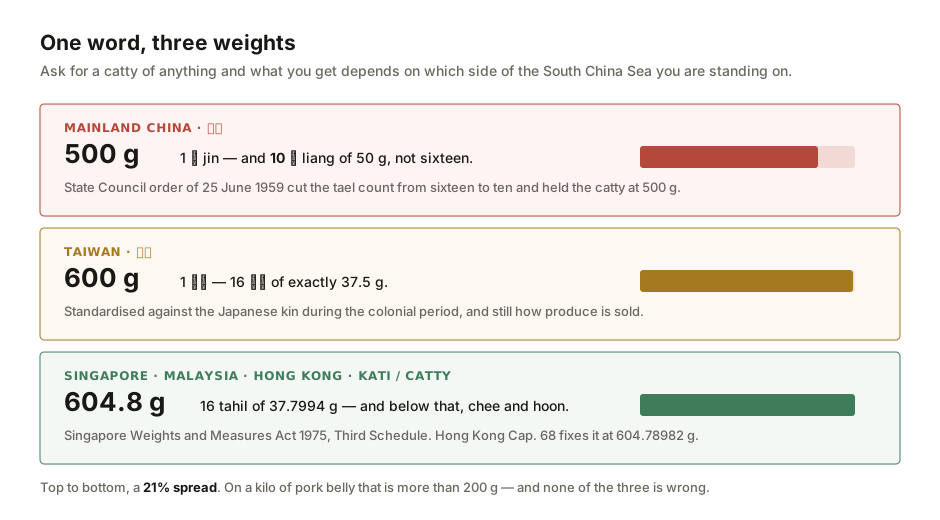
Ask for a catty of pork belly in a Guangzhou wet market and you get 500 g. Ask in Taipei and you get 600 g. Ask in Singapore, Johor Bahru or Hong Kong and you get 604.8 g.
All three are legally correct. Nobody is cheating anyone. The word is simply doing different work in different places, and no recipe, no market stall and no shopping list ever says which one it means.
The kati is still in the statute, and using it is still an offence
Singapore's Weights and Measures Act 1975 carries a Third Schedule headed "Customary weights", and it is more precise than most people expect:
"1 Hoon = 1/10 Chee = … = 0.377994 grams
1 Chee = 1/10 Tahil = … = 3.77994 grams
1 Tahil = … = 1 1/3 ozs = 37.7994 grams
16 Tahils = 1 Kati = 1 1/3 lbs = 0.6048 kilogram."
A four-rung ladder, defined to six figures, sitting in current law in a country that went metric in 1971. Hong Kong's Cap. 68 fixes the same catty at 604.78982 g, and Malaysia's Weights and Measures Act 1972 gives 0.604790 kg — the same colonial standard, three times over.
Meanwhile section 18(1) of that same Singapore Act says anyone who "uses for trade any weight or measure other than a weight or measure of the metric system … shall be guilty of an offence." A non-metric figure may appear on a package only as an addition to the metric one, and — the Act is fussy about this — printed "no larger than" it.
So which is it? Section 40 is the hinge: the Minister may prescribe "the transactions in which, despite anything in this Act, it is lawful" to use the Third Schedule's units. And the Weights and Measures Regulations 2005 still define the instrument for one of them:
"'liteng' means an unequal armed balance of a capacity not exceeding 16 tahil for traditional weighing of Chinese herbs"
Sixteen tahil is exactly one kati. The medicine-hall balance is written into Singapore law by name, a neat summary of the whole situation: the units survive where they are load-bearing and are illegal where they are not.
Ten taels or sixteen — the split that made the catties diverge
Everywhere the catty is traditional, it divides into sixteen taels. That is why a tahil is 37.7994 g and a Taiwanese 台兩 is exactly 37.5 g.
Mainland China broke that. The State Council's order of 25 June 1959 moved the market system from sixteen taels per catty to ten, holding the catty itself at 500 g — so a 两 became a round 50 g and the arithmetic got easy. Traditional Chinese medicine was allowed to stay on the old system until a further order in 1979 moved that trade to metric too.
The distinction matters when you follow a Chinese-language recipe. If it calls for 二两 of ginger, that is 100 g if the writer is in Shanghai and 75.6 g if the writer is in Hong Kong using tahil. On ginger, who cares. On salt in a cure, or on medicine, it matters.
Six cups, all called a cup
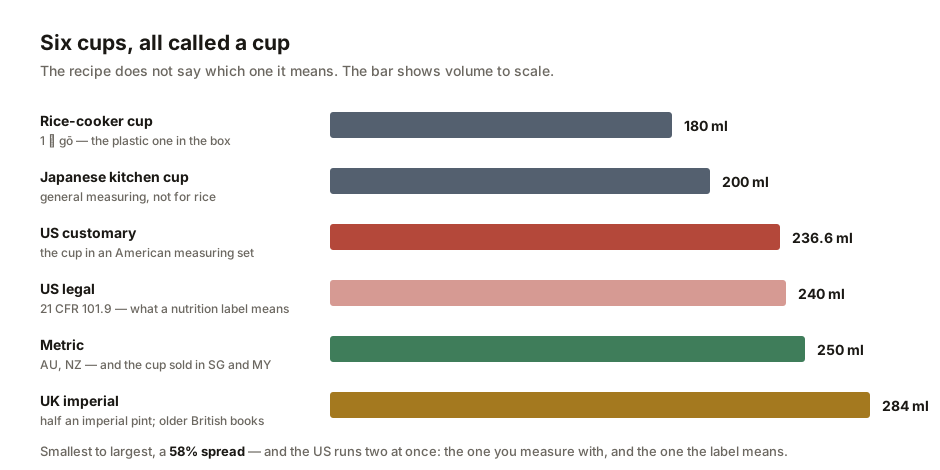
Smallest to largest is a 58% spread. Two of these cups cause most of the trouble.
The cup you own is probably 250 ml. Measuring cups sold in Singapore and Malaysia are metric — the Australian and New Zealand standard. American recipes, which are most of the internet, mean 236.588 ml. Using your cup on their recipe puts you 5.7% over on everything measured by volume, compounding in the same direction throughout the recipe.
America has two cups at once. The one in a measuring set is 236.588 ml. The one a nutrition label means is 240 ml, because 21 CFR 101.9(b)(5)(viii) says so:
"a teaspoon means 5 milliliters (mL), a tablespoon means 15 mL, a cup means 240 mL, 1 fl oz means 30 mL, and 1 oz in weight means 28 g."
And a trap that catches people who would never fall for the cup one: the Australian tablespoon is 20 ml — four teaspoons, not three. Britain, the US, New Zealand and Canada all use 15 ml. Australian cookbooks are common in Malaysian and Singaporean kitchens, and the error lands on baking powder, bicarbonate and salt, which is precisely where a third extra is not a rounding error.
Weigh the flour. Really.
A cup of plain flour weighs 120 g if you spoon it in and level it, around 100 g sifted, and up to 140 g if you scoop the cup through the bag and compact it. Same cup, same flour, ±20%, depending entirely on a hand movement nobody writes down.
Stack that on top of a 250 ml cup meeting a 236.588 ml recipe and you can be 25% out on the single ingredient that decides whether a cake is a cake.
Kitchen scales cost less than a bag of good flour and remove the entire problem. Every serious baking reference has switched to grams; the cup survives in home recipes because it is fast, not because it is good.
Two other ingredients show how much volume can hide. A cup of honey is 336 g against 236.6 g of water — nearly half again as heavy, which is why swapping honey for sugar by volume changes a batter's structure and not just its sweetness. And a cup of butter is 226 g, but not because butter is that dense: butter's density would give 216 g. An American "cup of butter" means two sticks — half a pound — and the wrapper defines it, not the measuring cup.
The rice-cooker cup is 180 ml, and it is not the Japanese cup
The little plastic cup in the rice cooker box is 180 ml. It is one 合 (gō), a traditional Japanese unit: ten gō make one 升 (shō) of 1.8 litres, and a gō of uncooked rice weighs about 150 g.
The general-purpose Japanese measuring cup is 200 ml. Different object, same word in English.
This matters because the water line inside your rice cooker's bowl is calibrated in gō. Measure your rice with a 200 ml cup and fill water to the line for that number of "cups", and you have put in 11% more rice than the line expects. The result is the soggy rice that people blame on the cooker.
Use the cup that came in the box. If you lost it, 180 ml is three-quarters of a US cup.
Why the knuckle works when a ratio does not
The finger-joint method — level the rice, add water until it reaches the first knuckle of your index finger resting on the surface — gets treated as folk approximation next to a proper ratio. It's the opposite. It's the more robust of the two, for a simple physical reason.
A ratio has to be recomputed every time the quantity changes. A depth does not. For a pot with near-vertical sides, the volume of water above the rice is depth × base area, and the volume of rice is also depth × base area — so the ratio of water to rice is fixed by the two depths alone. Double the rice and the rice layer gets deeper, so the same one-knuckle gap above it holds twice the water. The measurement corrects itself.
That is why it survives across households with wildly different pot sizes and no scales, and why it beats a memorised ratio when you are cooking an odd amount.
It fails exactly where the assumption fails. A bowl-shaped or strongly tapered pot has a base area that changes with height, and the self-correction goes with it. So does a very shallow layer of rice, where the knuckle gap is large relative to the rice depth. In a straight-sided pot with a reasonable quantity, trust it.
Gantang, cupak, and the second gantang
Malay volume measure rode in on the imperial gallon. One gantang is 4546.09 ml — an imperial gallon exactly — and it divides into four cupak of 1136.52 ml each, then to leng (an eighth) and kepul (a sixteenth). Rice was sold this way across the peninsula within living memory.
But there is a second gantang, and the two are not interchangeable. For agricultural zakat the gantang is the ṣāʿ, a measure defined by the mass of grain it holds rather than by any gallon, and the calibration work puts it near 3.1 litres — roughly 30% smaller, with a cupak around 786 ml. Same word, different institution, different volume. If you are calculating zakat, the gallon figure is not the one you want.
The oven table that agrees with itself
Gas marks look arbitrary until you see them in Fahrenheit, where the scale is perfectly regular: every gas mark is exactly 25°F. Gas 1 is 275°F, Gas 4 is 350°F, Gas 9 is 475°F.
In Celsius the same scale looks lumpy — 140, 150, 160, 180, 190, 200, 220, 230, 240 — jumping by 10 and then 20 with no pattern. That is not sloppiness; it is what happens when you round an arithmetic Fahrenheit series into round Celsius numbers.
The rounding causes the confusion. Gas 4 is 176.7°C exactly. British tables round it to 180. Recipes converted from American originals round it to 175. Both are printed constantly, both are fine, and no domestic oven holds a temperature to ±5°C anyway — most swing by 15 either side of the dial as the thermostat cycles.
Fan ovens run about 20°C below the conventional figure for the same result, which is the same adjustment an air fryer needs, because an air fryer is a small fan oven.
Buy a scale. It solves the cup, packing and density problems at once. Check which cup a recipe means before a baking recipe rather than after — American means 236.6 ml, your cup is probably 250. Use the cup that came with the rice cooker, because the water line is calibrated to it. Trust the knuckle in a straight-sided pot; distrust it in a tapered one. If a Chinese recipe gives 两 or 斤, find out where the writer is before you weigh anything — it is 500 g or 604.8 g, and there is no way to tell from the character.
What we fixed on our own tools while writing this
This guide began as an audit of our own kitchen converters, and they did not come out of it well.
No tool on this site knew a single Asian unit. Across 36 active tools in our cooking and unit-conversion categories there was no kati, no tahil, no jin, no gantang, no cupak. A wet-market weight was unconvertible on all of them. They are in now — the cooking measurement converter and the cooking unit converter both carry the Straits, Chinese and Taiwanese weights, all six cups, and the Malay volume ladder.
Our two cooking converters disagreed with each other, because each carried its own hard-coded table of ingredient weights and nothing ever compared them. Cocoa powder was 123 g per cup in one and 100 in the other; the published figure is 84. Rolled oats were about 20% low in both. Cornflour was 14% high in both. They also differed on flour, icing sugar, cake flour and wholemeal. We moved all those numbers into a single shared table, with the source recorded on each line, so both tools read from the same data. We added 47 automated checks to guard the values.
And one tool contradicted itself in public. Its own explainer said, correctly, that "rice cookers use a 180 mL rice cup, not the kitchen 200 mL cup" — while the code behind the same page labelled the 200 ml cup as the rice-cooker one. The prose was right and the calculator was wrong, on the same screen, for months.
We also removed a brown-rice weight rather than keep a number we could not re-source, and we are not publishing weights for gula melaka, glutinous rice or desiccated coconut, because we could not find a reference we trust and inventing one is how the errors above got there in the first place.
- The hoon, chee, tahil and kati values and the quoted schedule text: Singapore Weights and Measures Act 1975, Third Schedule (Section 40), read from Singapore Statutes Online on 1 August 2026. The offence provision is section 18(1) and the saving power is section 40(1), both quoted from the same source. The "liteng" definition is from the Weights and Measures Regulations 2005, regulation 2.
- Hong Kong's 604.78982 g catty is fixed by the Weights and Measures Ordinance (Cap. 68); the mace, candareen and picul relationships are from the Hong Kong Customs and Excise Department's weights and measures page, read 1 August 2026. Malaysia's 0.604790 kg kati is from the Weights and Measures Act 1972 — noted here at second hand, because the public copy of the Act returned HTTP 403 on the day of writing.
- The ten-tael reform: the State Council of China's Order on Unifying the Measurement System, 25 June 1959, which held the catty at 500 g while cutting the tael count from sixteen to ten; traditional Chinese medicine moved to metric under a further order in 1979. Taiwan's 600 g catty and 37.5 g tael date from standardisation against the Japanese kin; Article 10 of Taiwan's Weights and Measures Act, read from the Laws & Regulations Database of the Republic of China on 1 August 2026, provides that customary units are legal only where the competent authority designates them.
- Cup and spoon volumes: 21 CFR 101.9(b)(5)(viii) for the US legal cup, tablespoon and teaspoon, quoted verbatim. The gō is 180 ml with ten to the shō; a gō of uncooked rice weighs about 150 g. The Australian 20 ml tablespoon and 250 ml metric cup are the Australian and New Zealand standard.
- Ingredient weights per US cup are from King Arthur Baking's published ingredient weight chart, except rice (185 g per cup for long-grain raw, USDA FoodData Central fdcId 168877), rice flour (158 g, fdcId 169714) and canned coconut milk (226 g, fdcId 170173), all queried 1 August 2026.
- The gas mark table and the 20°C fan-oven adjustment are from Which?'s oven temperature conversion table, read 1 August 2026. The gantang as an imperial gallon and its division into four cupak follow the imperial standard; the separate zakat gantang near 3.1 litres is from published calibration work on the ṣāʿ.
General information about units of measurement and how recipes use them, not legal or dietary advice. The statutory figures above are quoted with the date they were read; weights-and-measures law changes rarely but it does change. Ingredient weights are from published references, but brand, humidity and how you fill the cup will all move the final figure. That, again, is the argument for a scale.

View author profile → · Editorial policy