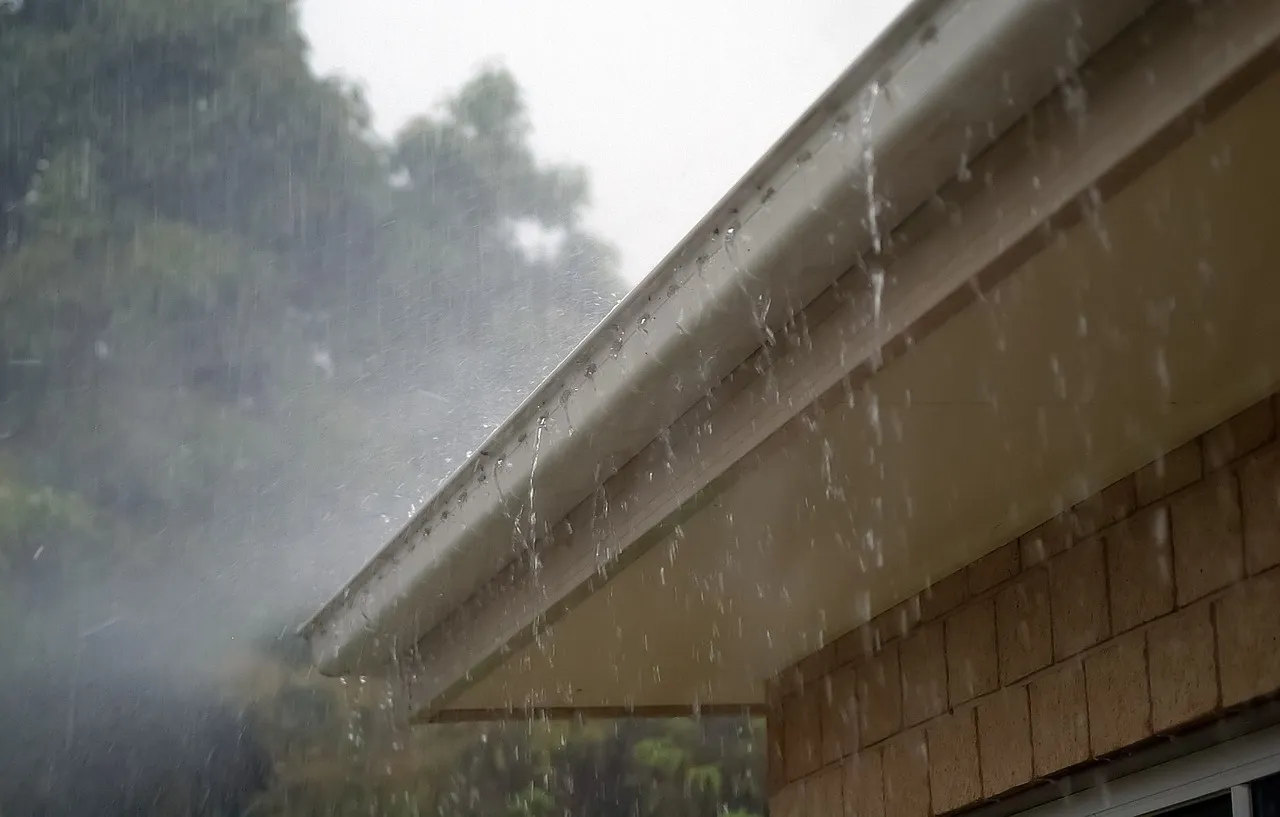
A roof gutter has to carry the water from the heaviest few minutes of rain a building should expect. That flow is rainfall intensity multiplied by the roof's catchment area, so the intensity a rule assumes decides most of the answer. We worked one case: a roof of 100 m² in plan, pitched at 30°, with all the rain running off. Read from PUB's surface-water drainage chart, Singapore's ten-year, five-minute rainfall is about 214 mm/h, which delivers about 7.7 L/s on that roof, by our arithmetic. The table in England's Approved Document H implies 2.7 L/s. Singapore's figure is 2.8 times that, and 1.28 times a widely cited US example from Washington, D.C.
PUB's Code of Practice on Surface Water Drainage sizes drains, not roof gutters. Singapore's roof standard, SS 525:2024, is sold through the Singapore Standards eShop and we have not read it, so this guide gives no Singapore gutter design figure. Every flow below is arithmetic, not a size to buy.
A Singapore design storm pours nearly three times the English table rate into a gutter
The sum is Q (L/s) = I (mm/h) × A (m²) / 3600, since a millimetre on a square metre is a litre. We take the runoff coefficient as 1, PUB's value for paved areas. The 30° pitch adds half the roof's vertical rise to its plan area, a factor of 1 + tan θ/2, so the catchment is 128.9 m².
| Rainfall figure (basis) | mm/h | L/s on the example roof (ours) |
|---|---|---|
| England, implied by Approved Document H Table 2 | 76 | 2.7 |
| Washington, D.C., ten-year, five-minute (1999) | 168 | 6.0 |
| Singapore, PUB chart, ten-year, five-minute | 214 | 7.7 |
| Singapore, PUB chart, hundred-year, five-minute | about 300 | about 10.7 |
Approved Document H (2015) states no intensity in its text. Its Table 2, for half-round gutters laid level with one end outlet, pairs roof areas with flows at a steady 0.021 L/s per m², about 76 mm/h. That is a ratio we derived, not a design storm the document prints. The US row is from Andy Engel's 1999 Fine Homebuilding article, which uses Washington's 6.6 in/h for "the most intense five-minute burst" likely in ten years. The roof cancels out of each ratio.
Rain in a short burst falls at over twice the hourly rate on the PUB chart
PUB prints its curves only as a scanned chart, with no table, so the Singapore values here are our readings, good to about ±3%. The code's overland flow time "varies from 5 minutes to 15 minutes", so five minutes is its shortest. On the hundred-year curve, going from 60 minutes to five multiplies intensity by 2.3. Going from ten to a hundred years at five minutes multiplies it by about 1.4. The two steps are of similar size, twelvefold in duration and tenfold in return period, and duration moves the intensity more.
Australia's National Construction Code, Malaysia's MSMA as IPM Group summarises it, and the US gutter calculator from SMACNA all use a five-minute storm. The US International Plumbing Code sizes leaders and storm drains on a 100-year hourly rate. BRANZ's 2009 Bulletin 509 adds a fourth convention: New Zealand's curves are based on a 10% annual chance over ten minutes.
Tropical design storms rain down at nearly the same rate in Kemaman, Darwin and Singapore
IPM Group's 2024 worked example applies the MSMA constants for one Terengganu station, Hulu Jabor in Kemaman, and gets 232 mm/h for a 20-year, five-minute storm, the eaves-gutter basis according to IPM's summary of MSMA. The NCC lists 233 mm/h for Darwin at 5% annual exceedance probability, about a 20-year return period, from the Bureau of Meteorology grid cell nearest the city's post office. PUB has no 20-year curve; interpolating between its 15- and 25-year curves gives about 240 mm/h, our estimate.
The three sit within a few per cent of one another, a spread of 3.4% that is inside our chart-reading error. They are also different objects: one station's equation, a gridded value and an island-wide chart.
Slanting rain wets the rise of a pitched roof as well as its plan area
Approved Document H Table 1 multiplies plan area by 1.29 at 30°, 1.50 at 45° and 1.87 at 60°, exactly 1 + tan θ/2. IPM's summary of MSMA uses the same rule and gives the reason: rain can slant at two vertical to one horizontal.
This Old House publishes US pitch factors of 1.1 for 6-in-12 to 8-in-12 and 1.3 for 12-in-12 or steeper, the same figures as the 1999 magazine article, whose example applies them to the sloped surface. This Old House does not say which area; we assume the sloped one. On that assumption and our arithmetic, the US factor on plan area is about 1% below England's at 30° and about 23% above it at 45°.
Roof runoff drains to an Australian downpipe from at most twelve metres of gutter
The "one downpipe per 12 m" figure has a primary source: NCC 2022 Housing Provisions 7.4.5(a) says a downpipe must "not serve more than 12 m of gutter length", for effective fall and adequate capacity. NCC 2025 keeps the clause; the Northern Territory has not adopted that edition, so Darwin still works under NCC 2022. The same clause has downpipes selected from Table 7.4.3a, which tabulates 30 to 70 m² of roof per downpipe against design rainfall.
Until 19 October 2026 our gutter and downspout calculator (downspout is the US term) applied the length half only. With no rainfall, area or pitch input, it gave the same count for any storm; a blank spacing printed "Infinity" downspouts; it quoted an unsourced 1:600 fall and called its answer "a reliable scoping estimate". The version on origin/main adds plan area, pitch and sourced rainfall presets. With 100 m² at 30° and PUB's ten-year preset it gives 7.66 L/s, and it says it does not size a gutter or downpipe.
Record rain at Changi came down at about PUB's hundred-year rate
The Meteorological Service Singapore's historical extremes page lists 96 mm in 30 minutes at Changi on 2 November 1995, the highest in climate-station records since 1957. That is 192 mm/h, against our reading of 187 mm/h on PUB's hundred-year, 30-minute curve. A station record and an island-wide design curve are different things, and we draw no conclusion from the pair.
Rainwater pools in roof gutters that NEA lists among larvicide sites
A gutter must also empty. The National Environment Agency uses larvicides "in areas where water cannot be completely removed, such as drains, roof gutters, and gully traps", according to a NEA Vox article of 21 April 2025. Codes state fall differently: the NCC's minimum is 1:500, IPM's summary of MSMA gives 1:500 for eaves gutters, and Approved Document H asks for "any fall towards the nearest outlet".
Designers work to SS 525:2024 in Singapore and MSMA in Malaysia, with local requirements; PUB's code covers the drains downpipes empty into. Annual rainfall, a separate question, is in our guide on why annual rainfall will not size a rainwater tank.

View author profile → · Editorial policy