Singapore gets 2,215 mm of rain a year. Manila gets 2,108. Within five per cent of each other, and both far above what any household could use.
Put the same roof, the same tank and the same family in each city and one of them runs dry for months.
The number that decides it
Annual rainfall is a sum, and a sum discards the thing that matters. What a tank has to survive is not the year. It is the driest stretch inside the year.
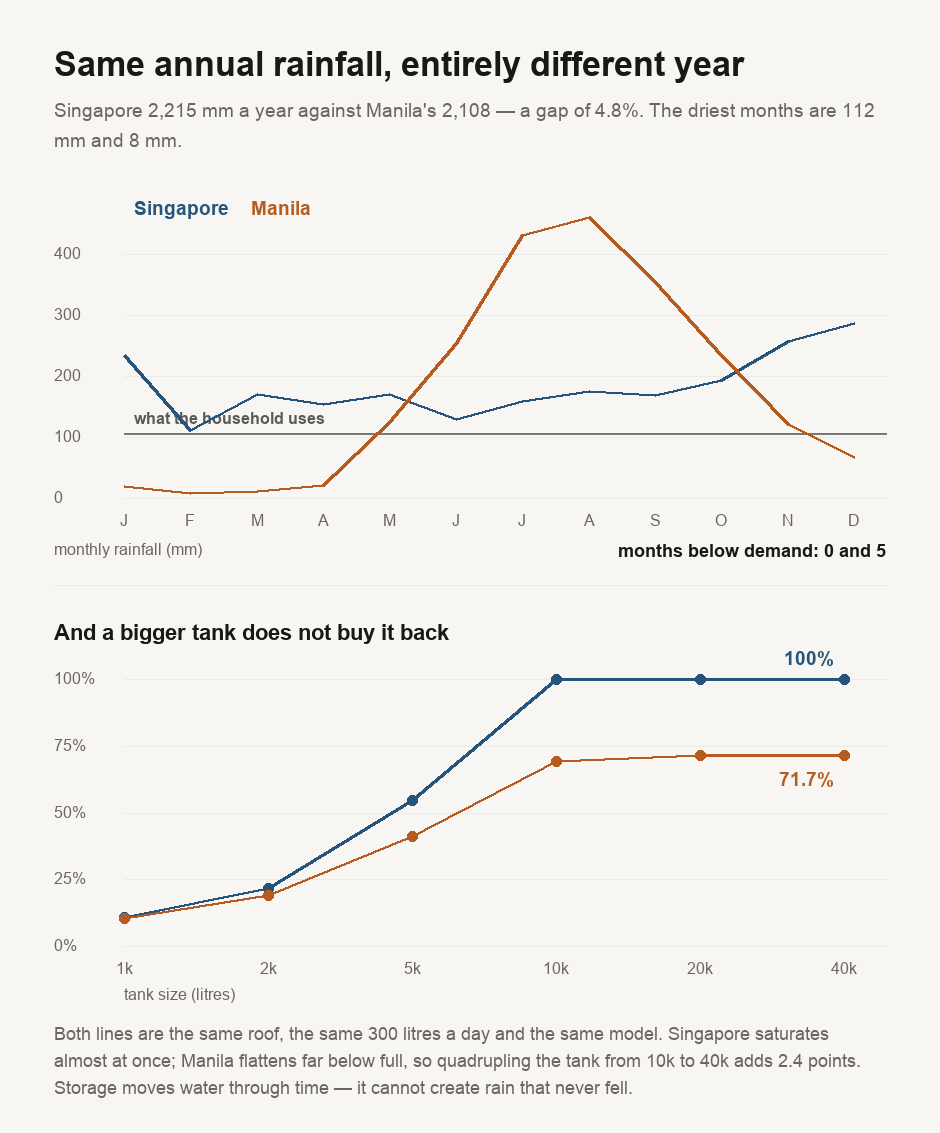
Singapore's driest month brings 112 mm. Manila's brings 8. That is a factor of 14, hiding inside two annual totals that look interchangeable.
Run a 100 m² roof against a 300-litre-a-day household and the consequence is immediate. In Singapore, 0 months of the twelve collect less than the household will use. In Manila, 5 do.
What the same tank delivers
Give both households a 10,000-litre tank. In Singapore it meets 100 per cent of demand. In Manila it meets 69.3 per cent.
The only difference between the two runs is the rainfall pattern. Roof, family, tank and model are all identical.
Why a bigger tank does not rescue it
The instinct is to buy more storage, but the arithmetic is unforgiving. A tank can only move water through time; it cannot create water that never fell.
Take Manila's tank from 10,000 litres to 40,000 — four times the volume, four times the cost, four times the space — and demand met goes from 69.3 per cent to 71.7 per cent.
Two and a half points for four times the tank. Past the point where storage carries you from one wet season into the next, extra capacity has nothing left to do.
The shape of the problem is this: in an evenly watered place, a modest tank is enough. In a sharply seasonal one, the first tank helps, but every litre of capacity after that delivers diminishing returns.
What our own model gets wrong, and why the comparison survives it
Our rainwater engine steps a month at a time. It drops the whole month's rain into the tank at once, spills whatever will not fit, and only then lets the household draw that month's water.
Real rain does not arrive in one lump. It falls across a couple of dozen days and the tank refills between draws, so the monthly step makes small tanks look worse than they are — always in that direction.
The model's own output shows the scale of this effect: in Singapore's wettest month, it has a 5,000-litre tank spilling 19,480 litres before the household takes a single drop.
This is why the guide will not tell you what size tank to buy. The model is not precise enough to support that kind of absolute claim.
What the model can support is comparison. Both cities are run through the same engine, so the bias sits on both sides of the comparison and cancels out. The gap between 100 per cent and 69.3 per cent is real, even if the numbers themselves are not specifications.
What else the averages hide
The rainfall profiles here are long-run monthly means, and a mean has no bad years in it. There is no drought, and no fortnight of dry weather inside a wet month.
Both omissions push the same way. A design worth trusting runs a daily series across many years and sizes for the worst one, not the average one — so treat everything above as the optimistic end.
If you are actually planning one
Find your own driest month before anything else. It is the constraint, and the annual figure on the tourist board's page will not tell you what it is.
Then count how many months fall below what you plan to draw. If no months fall below your draw, a modest tank is a convenience. If five months fall short, storage is a bridge that will not reach the other side, and the honest plan is to supplement the mains rather than replace it.
And decide what the water is for. Garden, laundry and flushing tolerate a dry spell. If a tank is carrying something that cannot go without, the driest month is the only month worth designing around.
Annual rainfall figures are deceptive. Singapore at 2,215 mm and Manila at 2,108 look similar, but their driest months, 112 mm against 8, are worlds apart — and that difference means a 10,000-litre tank meeting 100 per cent of demand in Singapore meets only 69.3 per cent in Manila. You cannot buy your way out of a dry season either: quadrupling the Manila tank gains 2.4 percentage points, because a tank cannot store rain that never fell. So find your own driest month and count the months below your demand. And read these numbers as a comparison rather than a specification, because our monthly time-step penalises small tanks — it spills over 19,000 litres in a wet month before the household draws anything — which makes the absolute figures pessimistic while leaving the gap between the two cities real.
Running it for your own roof
Our rainwater harvesting calculator holds the six ASEAN rainfall profiles used here and will run your own roof area and demand against them, or against an annual figure you supply. We also have a home electricity calculator that applies similar arithmetic to power. For more on how averages mislead, solar payback on a tropical roof applies this thinking to sunlight, a tree-year is not a tree looks at hidden timing, and flying against driving takes apart a comparison that fails on units.
- Every figure, including the six monthly rainfall profiles, comes from
sustainability-kernel.js— the module our own rainwater harvesting calculator runs on. The profiles are read back out of the kernel and checked against it by the committed script rather than retyped, so this guide cannot quietly diverge from the tool. - ⚠️ THE MODEL STEPS MONTH BY MONTH AND THAT BIASES SMALL TANKS DOWNWARD. It adds a whole month's rain at once, spills anything over capacity, and only then draws the month's demand, while a real tank refills between draws across many rain days. The effect is measured from the model's own output and always runs the same direction.
- ⚠️ NO ABSOLUTE TANK SIZE IS RECOMMENDED ANYWHERE IN THIS GUIDE, because the model above cannot support one. What it supports is the comparison between two cities run through the same engine, where the shared bias sits on both sides and cancels.
- ⚠️ THE PROFILES ARE LONG-RUN MONTHLY AVERAGES. They contain no drought year and no dry fortnight inside a wet month, and both omissions understate how often a tank runs dry. A design worth trusting uses a daily series across many years.
- One roof area, one daily demand and one runoff coefficient are used throughout, so the only thing separating the cities is when the rain arrives.
- ⚠️ NOT A DESIGN OR PLANNING DOCUMENT. Potable use, first-flush diversion, filtration, mosquito control and local regulations are all outside this arithmetic, and every one of them matters before a tank is installed.
This compares how the same rainwater system behaves in two climates using our own published model. It is not engineering or design advice, not a specification for any installation, and not guidance on making harvested water safe to drink.

View author profile → · Editorial policy