Malaysia gets more sun than Singapore. Our own calculator knew that — 4.3 peak sun hours a day against 4.0 — and it duly reported that a Malaysian roof paid for itself faster: 4.2 years against 5.7.
Both numbers were wrong, and the ranking was wrong too. Priced the way the two countries actually pay for rooftop solar, a Singapore system pays back in about 4.7 years and a Malaysian one in about 8.2. The sunnier country takes roughly twice as long.
This is not decided by sunshine. It is decided by the price of a system versus the price of the electricity it displaces—and, crucially, by what happens to power you generate but do not use at noon.
What changed, and when
If you last looked at rooftop solar in Malaysia before the middle of last year, the scheme you are thinking of no longer exists.
Net energy metering — the arrangement where every exported unit offset an imported one, ringgit for ringgit — ended in June 2025. It was replaced on 1 January 2026 by the Solar Accelerated Transition Action Programme, Solar ATAP, administered by SEDA. The new scheme is in several ways better: there is no quota, so you are no longer racing other households for an allocation, and a domestic system can be up to 5 kW on a single-phase supply or 15 kW on three-phase.
The arithmetic, however, is new and it changes the outcome completely. Under Solar ATAP, a domestic consumer receives bill credits "based on the applicable Energy Charge for every unit of excess Energy exported".
The Energy Charge is one component of a Malaysian tariff, not the whole of it. Since the tariff restructure of July 2025 a household under 1,500 kWh a month pays 27.03 sen for energy, 4.55 sen for capacity and 12.85 sen for network — 44.43 sen in total for every unit it imports. Export a unit and you are credited the first of those three figures alone.
The same kilowatt-hour, two values
A Malaysian roof therefore produces electricity with two different values, depending on where it goes. Used the moment it is made, a unit saves you 44.43 sen. Sent to the grid, it earns 27.03 — about 61 per cent as much.
Singapore has never had one-for-one export, but it is more generous than Malaysia now is. Households on SP Group's Simplified Credit Treatment are paid, in the Energy Market Authority's words, "based on the prevailing electricity regulated tariff minus grid charges", reviewed quarterly. Those grid charges are around 6.55 cents, so against an import cost of 34.78 cents including GST an exported unit earns roughly 25.4 — about 73 per cent.
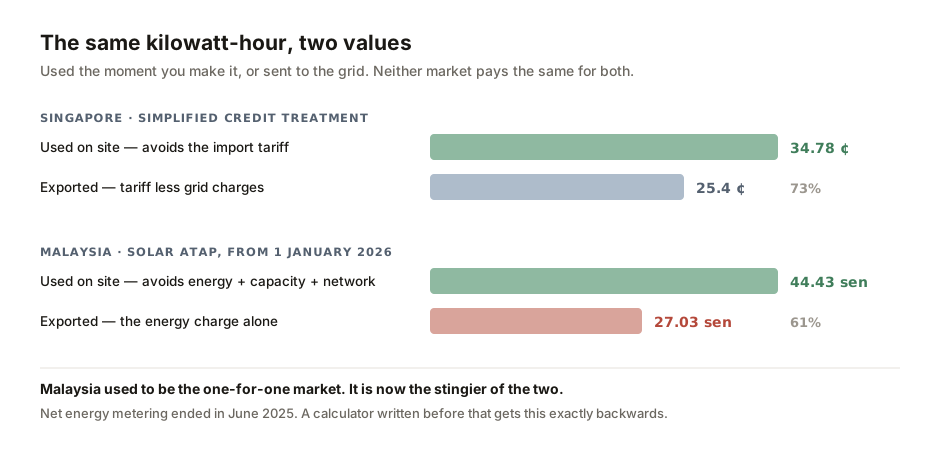
The roles, then, have reversed. Malaysia was the true net-metering market and is now the stingier of the two. Any calculator built on a pre-2025 understanding — ours included, until this week — gets it precisely backwards.
Being out during the day has a price
When export is worth less than self-consumption, the important figure is not total generation, but how much of it you are home to use.
Household solar runs into an awkward fact of household life. A roof generates hardest between about ten in the morning and three in the afternoon. That is precisely when a working household is empty, the air-conditioning is off, and the only things drawing power are the fridge and the router. Without a battery, self-consumption below half is entirely ordinary.
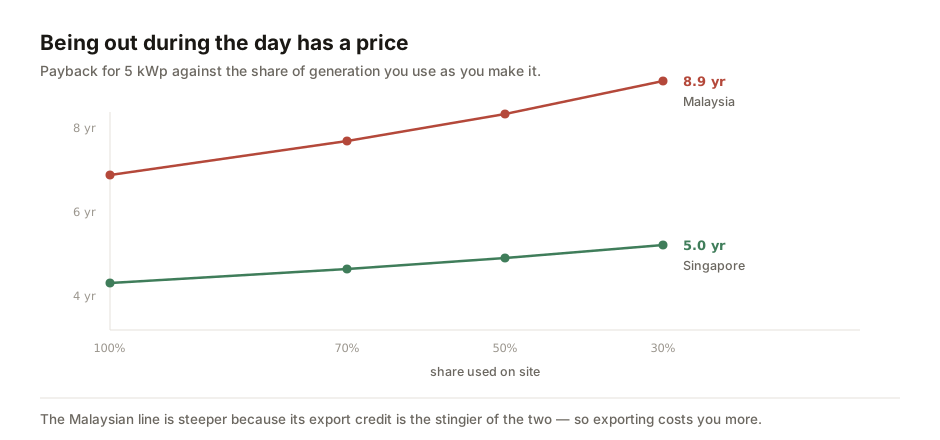
The Malaysian line is the steeper one, for the reason above: its export credit is worse, so every unit you fail to catch costs you more. Across a realistic range the Malaysian answer moves by more than two years. The Singaporean answer moves by under one.
This explains why the most effective advice is unglamorous. Run the dishwasher, the washing machine and the pool pump at midday rather than at night. Pre-cool the house in the afternoon instead of at bedtime — our air-conditioner running-cost calculator will show you what those hours actually draw. None of that is exciting, and all of it is worth more than another panel.
More sun, slower payback
Put the corrected valuation together with what systems actually cost and the two markets swap places.
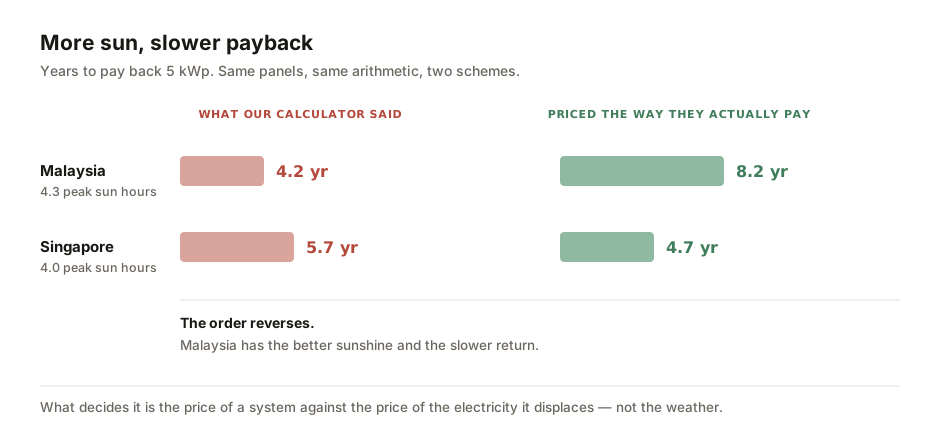
A 5 kWp system runs roughly RM15,000 to RM20,000 installed in Malaysia and about S$7,250 to S$9,750 in Singapore. In nominal currency the Singaporean system is the more expensive one. But Singapore's electricity is dear — 34.78 cents a unit, the highest on record after July's 17 per cent jump — and Malaysia's is cheap. Measure the cost of a system against the price of what it displaces and Singapore's roof is doing about twice the work per dollar spent.
For a guide about the tropics, the conclusion is slightly deflating. The best predictor of solar payback is not sunshine, but the price of grid electricity.
Three Malaysian details no calculator models
Three provisions in the Solar ATAP guidelines are easy to miss, and they can quietly remove a chunk of your return.
- Credits expire monthly. Exported energy offsets imports "within the same Billing Period". Anything left over "shall not be carried forward to subsequent billing periods and shall be deemed forfeited". A system that overshoots your consumption in a quiet month simply loses the surplus.
- There is a ceiling on credited export. The Maximum Allowable Quantity is "capacity (kWac) x 5 sun hour x Billing Period". For a 5 kWac system over 30 days that is 750 kWh. Export beyond it earns nothing.
- Credits cannot touch the fuel surcharge. Verbatim: the credit "cannot be used to offset the Automatic Fuel Adjustment (AFA) as stated in the tariff schedule". The AFA was +3.59 sen a unit in July 2026, and the official projection for August to October is +8.04 to +8.94 — more than double.
The fuel-surcharge rule is particularly important. The fastest-rising line on a Malaysian electricity bill is the fuel adjustment, and it is exactly the line solar credits are barred from reducing. You can still avoid the AFA on the units you consume yourself — self-consumption reduces your imported total, and everything scales off that — but you cannot export your way out of it.
The point of all three rules is the same: Solar ATAP rewards self-consumption and is indifferent to export. Size the system for what you use, not for how much roof you have.
The cost nobody quotes you
Panels are warranted for around 25 years and degrade slowly, about half a per cent a year. Inverters are not and do not. A string inverter is the component with moving electronics and heat, and it is the one that gets replaced somewhere in the second decade.
Our own 25-year projection did not contain one. It subtracted the system cost once, at year zero, and never bought another thing — which is a strange way to model a quarter of a century. The tool now offers an inverter replacement in year 12. If you enter one, you will see that the payback year usually does not move. Replacement falls after the crossover, so the date you break even is unaffected. What changes is the headline lifetime figure, by the whole cost of the inverter.
This is a useful lesson in what payback measures. The figure tells you when you stop being out of pocket, but it is silent on everything that follows.
A caveat Singapore readers will already have spotted
Everything above about Singapore's fast payback applies to people who own a roof. The large majority of Singaporean households live in HDB flats and cannot install panels on their own account — the solar on those blocks is deployed at the town-council and agency level, not by residents.
Residential solar in Singapore, then, is a landed-property decision with unusually good economics, not a mass-market one. In Malaysia, where landed housing is the norm, the decision is available to far more people and the economics are harder. That asymmetry is rarely stated, because it is inconvenient for everybody selling something.
What to actually do
- Start with your own consumption, not your roof area. Pull twelve months of bills and find your monthly kWh. Size so that most of what you generate can be absorbed on site. Our appliance and bill calculator will tell you where the units are going.
- Move the flexible loads into daylight. Laundry, dishwasher, pool pump, water heater, pre-cooling. Every unit shifted into the middle of the day is worth about 64 per cent more in Malaysia, and 37 per cent more in Singapore, than the same unit exported.
- Ask any quote for its self-consumption assumption. If a proposal shows a payback figure without stating what share it assumes you use on site, it is not a forecast. Ask, and ask what happens at half that number.
- Put the inverter in the model. One replacement in the second decade. It rarely moves the payback year and always reduces the lifetime figure, so any projection that omits it is overstating the total.
- Re-check the scheme, not the brochure. Malaysia's rules changed twice in eighteen months. Singapore's export rate is reset every quarter. Whatever you read about payback — including this — check the rate before you sign.
Rooftop solar payback in this region is driven by tariffs and scheme rules, not sunshine — which is why our own calculator had Malaysia and Singapore in the wrong order until this week. Malaysia's true net metering ended in June 2025, and Solar ATAP, which replaced it on 1 January 2026, credits domestic exports at the energy-charge component alone: 27.03 sen against an import cost of 44.43, or about 61 per cent. Singapore's Simplified Credit Treatment pays the regulated tariff less grid charges, roughly 73 per cent. In both markets a unit you use as you generate it is worth substantially more than one you sell.
When corrected for these factors and for actual system costs, a 5 kWp Singapore system pays back in around 4.7 years and a Malaysian one in around 8.2. The sunnier country takes about twice as long because the price of the grid electricity you displace is what matters most. Malaysian buyers should read three Solar ATAP rules before signing: credits expire at the end of each billing month, credited export is capped at capacity times five sun hours times the days in the period, and credits cannot offset the fuel adjustment, which is the fastest-rising line on the bill. And any 25-year projection should have bought a replacement inverter somewhere in the second decade.
This guide is the other half of house calculations for a tropical climate, which covers the demand side — sizing the air-conditioner that will be consuming most of what your roof makes, and the 600 kWh threshold that makes a Malaysian bill behave so strangely at the margin. The two decisions are the same decision. Rising demand across the region is not only domestic, either: Johor has begun turning data-centre projects away over power and water, and households draw on the same grid.
- SEDA — Guidelines for the Solar Accelerated Transition Action Programme (Solar ATAP), 30 December 2025. Source of the Energy Charge credit basis, the Maximum Allowable Quantity formula, the monthly forfeiture rule, the exclusion of the Automatic Fuel Adjustment from credit offset, the 5 kW / 15 kW domestic capacity limits and the 10-year tenure. Accessed 29 July 2026.
- pv magazine — Malaysia introduces rooftop solar scheme to replace net-metering program, 9 January 2026, for the transition dates. Accessed 29 July 2026.
- Energy Market Authority — Consumer Information: Solar, Payment Schemes, for the Simplified Credit Treatment basis and its quarterly review. Accessed 29 July 2026.
- Energy Market Authority — Buying at Regulated Tariff, and the SP Group tariff revision release of 30 June 2026: 31.91 cents before GST, 34.78 with, a rise of 17.0 per cent. Accessed 29 July 2026.
- Suruhanjaya Tenaga — Jadual Tarif Elektrik for 1 July 2025 to 31 December 2027, for the 27.03 / 4.55 / 12.85 sen build-up of a domestic unit. Accessed 29 July 2026.
- Single Buyer Malaysia — Automatic Fuel Adjustment: +3.59 sen/kWh for July 2026 and a projection of +8.04 to +8.94 for August to October. Accessed 29 July 2026.
- Installed system prices, Malaysian and Singaporean installers, multiple sources converging on RM3,000–4,000 and S$1,450–1,950 per kWp. Accessed 29 July 2026.
- Our own audit of the calculator, 29 July 2026. Every payback figure here is reproducible from
scripts/audit/solar-payback-audit.cjsin our repository; the full working is published asdocs/guide25-solar-payback-sources.md.
Payback figures assume 3% annual tariff inflation and 0.5% annual panel degradation over 25 years, at the system prices and self-consumption shares stated. Change any of those and the answer moves — which is the point. Use the calculator with your own numbers rather than ours.

View author profile → · Editorial policy