
Every year a version of this question arrives: my child has an IB score of 38, what is that in A-levels? My CGPA is 3.5, what percentage is that? I have STPM, what would that be as a GPA?
The first thing to know is that these aren't conversion questions. They look like unit conversion — inches to centimetres — but grades are not measurements of the same underlying thing. An IB 38 and three A-level As are not two readings of one quantity. They are outcomes of different courses, assessed differently, over different periods, by different bodies.
So any number you are given is somebody's judgement dressed as arithmetic. The useful skill is knowing whose judgement, and how much weight it carries.
Two systems, opposite answers
For a clear example, look at how two admissions systems in the same region handle the problem in opposite ways.
Singapore: do not convert, compare within
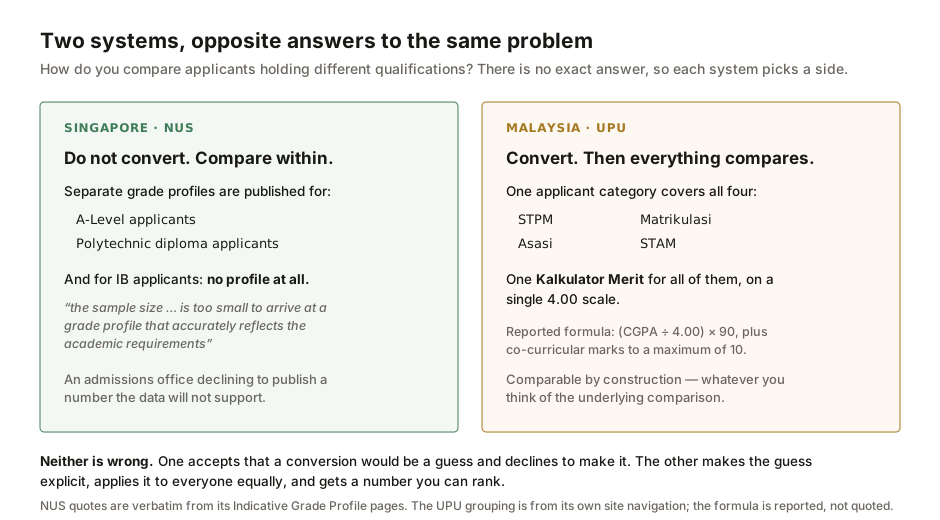
NUS publishes an Indicative Grade Profile so applicants can judge their competitiveness. What it does not do is put everyone on one scale. It publishes separate profiles — the 10th and 90th percentiles of "Singapore-Cambridge GCE A-Level Applicants offered places", and separately the 10th and 90th percentiles of "Polytechnic Applicants offered places". Two qualifications, two sets of numbers, no bridge between them.
And for the International Baccalaureate, it publishes nothing at all. The stated reason is worth reading closely:
"Applicants with IB and NUS High School qualifications are relatively fewer in number compared to those with the Singapore-Cambridge GCE A-Levels and Polytechnic Diplomas from Singapore. The sample size of applicants with these two respective qualifications is too small to arrive at a grade profile that accurately reflects the academic requirements."
An admissions office is saying, on the record, that the data won't support a number. If a university with every applicant's file in front of it will not put IB on a comparable scale, a conversion chart on the internet is not in a stronger position.
Even the numbers they do publish are not thresholds: "Meeting the previous year's grade/GPA scores of a programme does not guarantee admission."
Malaysia: convert, and then everything compares
UPU, the centralised application system for Malaysian public universities, takes the opposite view. Its own site groups applicants into a single category — "Lepasan STPM / Matrikulasi / Asasi / STAM" — covering four different pre-university qualifications, served by one Kalkulator Merit.
The merit score is widely reported as (CGPA ÷ 4.00) × 90, plus co-curricular marks up to 10, giving a mark out of 100. STPM and Matrikulasi both report on a 4.00 CGPA scale, so the formula treats them as directly comparable.
Which makes them comparable by construction. The formula doesn't ask whether a 3.80 earned over three penggal of STPM is the same as a 3.80 from a matriculation programme; it assumes an answer and applies it to everyone.
Neither approach is wrong; they're just different trade-offs. One system declines to guess at a conversion, leaving applicants without a reference point. The other makes an explicit guess and applies it evenly, asserting a comparability nobody has demonstrated.
Which scale is your number even on?
A more basic problem comes first: the same figure means different things on different scales, and transcripts rarely say which one they used.
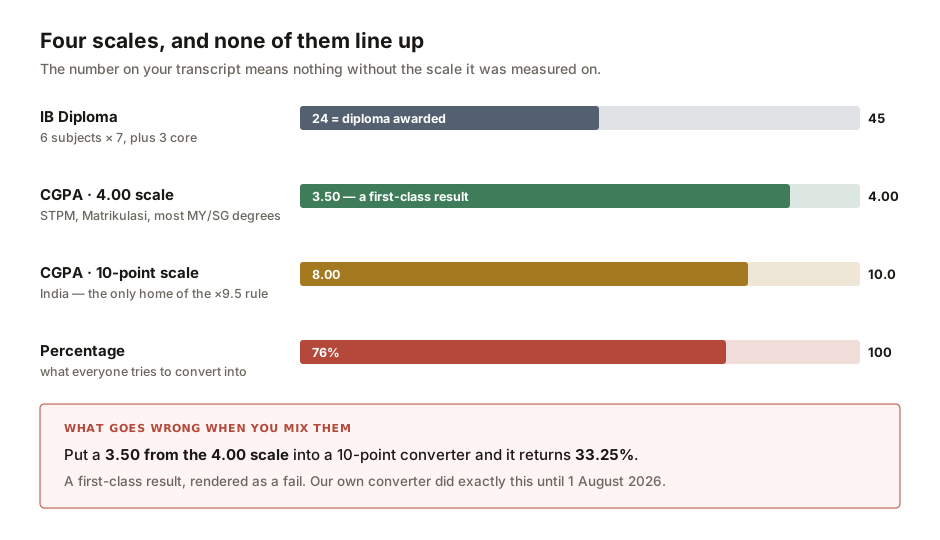
The IB Diploma runs to 45: six subjects graded 1–7 giving 42, plus up to 3 from the core — theory of knowledge and the extended essay, each graded A–E. Creativity, activity, service is required but not graded. The diploma is awarded from 24 points, subject to further conditions.
CGPA on the 4.00 scale is what STPM, Matrikulasi and most Malaysian and Singaporean degrees use. STPM reports A down to F with points from 4.00 to 0.00, cumulated across three penggal.
CGPA on the 10-point scale is Indian, and it matters here for one specific reason.
If you are computing a GPA rather than converting one, our GPA calculator lets you pick the 4.0, 4.3 or 5.0 scale explicitly — which is the right shape for this problem, because the scale is an input rather than something to be guessed from the digits.
The ×9.5 rule, and who it is not for
Search for "CGPA to percentage" and you'll find the ×9.5 rule. It's a real formula, but its source is almost always missing: it comes from India's CBSE, for a 10-point CGPA.
Apply it to a 4.00-scale CGPA and the arithmetic still works. The answer is simply nonsense. A Malaysian first-class CGPA of 3.50 comes out at 33.25% — a fail. Nothing errors, because 3.5 is a perfectly valid number on a 10-point scale; it just isn't the number you have.
To be plain: there is no single conversion formula for a 4.00 CGPA. Institutions that need a percentage publish their own conversion table, and those tables disagree with each other. If you need the figure for an application, the only correct source is the institution asking for it.
First, establish which scale your number is on — that one check prevents most of the damage. Get any conversion formula from the institution that will use it, since theirs is the only one that counts. If it isn't published, ask for it in writing. Always submit results in their original form, not pre-converted. Treat any published equivalence table as a planning aid to help you judge whether to apply. It decides nothing. And if a tool gives you a number that looks wrong, trust that feeling. An operation that completes isn't necessarily the right one.
What this audit found in our own tools
Every guide here starts by reading the source of the tools it will link to, and this one found us making the exact mistake it warns about.
Our CGPA to percentage converter applies the ×9.5 rule, and its explainer is honest about the provenance — it names CBSE, calls the rule an approximation, and tells readers that universities publish their own tables. The input said none of that. The field was capped at 10 with no scale in the label, so a 4.00-scale value went straight through.
Entering 3.50 returned 33.25%. Entering 3.75 returned 35.63%. On an ASEAN-first site, where 4.00 is the ordinary scale, the commonest possible input produced a first-class student's result rendered as a fail, silently.
The tool now detects this input and raises a warning. Any value up to 4.3 entered for conversion raises a warning that names the 4.0 scale, states that no single formula exists for it, and directs the reader to their institution.
We deliberately did not add a 4.0 conversion, which would have been the easier fix. There is no defensible multiplier to use, and inventing one would have meant answering a question with false precision in a tool attached to a guide arguing against exactly that. A warning that stops you is more useful than a number that misleads you.
We're also recording a gap we aren't fixing. This guide covers SPM, STPM, O and A levels and IB, but our education tools support none of them. There is a Singapore PSLE calculator and a GPA calculator supporting the 4.0, 4.3 and 5.0 scales, and nothing for the qualifications most of this region actually sits. Fixing that is a tool-building job, not a guide-writing one.
- The NUS quotations — the separate A-Level and Polytechnic grade profiles, the explanation for publishing no IB profile, and the statement that meeting a previous year's profile does not guarantee admission — are verbatim from the NUS Office of Admissions Indicative Grade Profile pages, read 1 August 2026.
- The UPU applicant grouping "Lepasan STPM / Matrikulasi / Asasi / STAM" and its single Kalkulator Merit were read directly from upu.mohe.gov.my on 1 August 2026. ⚠️ The merit formula — (CGPA ÷ 4.00) × 90 plus co-curricular marks to a maximum of 10 — is widely reported but is NOT quoted from that source: the landing page is a navigation shell, and the policy documents behind it were not retrieved. Treat it as reported rather than official.
- IB Diploma figures — a maximum of 45 points from six subjects graded 1–7 plus up to 3 core points from theory of knowledge and the extended essay, and a minimum of 24 points for the award of the diploma — are from the International Baccalaureate Organization, read 1 August 2026.
- ⚠️ STPM grade points (A = 4.00 down to F = 0.00, cumulated across three penggal) are from secondary sources. The Malaysian Examinations Council site at mpm.edu.my responds, but its landing page carries no grade table and the linked regulations documents were not retrieved.
- The ×9.5 multiplier is India's CBSE formula for a 10-point CGPA. The figures showing what it does to a 4.00-scale value — 3.50 returning 33.25% and 3.75 returning 35.63% — were measured in our own converter on 1 August 2026, before the fix described above. Full audit detail in docs/guide30-grades-gpa-sources.md.
General information about grading scales and how institutions compare them, not admissions advice. No conversion table between qualifications appears here on purpose: the argument of the piece is that such a table would be a judgement presented as arithmetic. For any application that matters, the only conversion worth having is the one published by the institution deciding on you — and every figure above carries the date it was read, because entry requirements and scales both change.

View author profile → · Editorial policy