
Key points
- Since 15 March 2026 a publicly trusted TLS certificate may be issued for at most 200 days. The cap falls to 100 days for certificates issued from 15 March 2027 and to 47 days from 15 March 2029 (TLS Baseline Requirements v2.3.1, §6.3.2).
- The cap applies on the day a certificate is issued. A 397-day certificate issued before the change stays valid until it expires, so a long certificate served today is not a breach.
- Of 56 certificates that ASEAN CERT, government and bank hosts served us on 25 November 2026, 16 were issued under the old 398-day rule and 40 under the 200-day rule.
- 42 of the 56 run longer than 100 days, so none of those could be reissued at the same length from 15 March 2027. All 56 run longer than 47 days. Fourteen run 91 days or less, 11 of them on a CDN or cloud-edge network.
- Domain-validation reuse falls further than validity, from 398 days to 10 by March 2029. By our arithmetic, a certificate renewed every few weeks will then need a fresh domain check each time.
A TLS certificate is the file a website presents to prove its name to your browser, and each one carries an expiry date set by the certificate authority (CA) that issued it. On 25 November 2026 we read the certificates served by 60 national computer emergency response team (CERT), government and bank hosts across ten ASEAN member states, and 56 had a chain we could verify. Forty-two of those 56 run longer than 100 days, and none is as short as 47. Since 15 March 2026 a public certificate may be issued for at most 200 days, from 15 March 2027 for 100 and from 15 March 2029 for 47, under CA/Browser Forum ballot SC-081v3. Each limit applies on the day of issue, so the 16 certificates in our sample issued under the old 398-day rule are still valid.
Maximum validity falls in three steps by issue date
The ballot SC-081v3, proposed by Clint Wilson of Apple, passed on 11 April 2025. Certificate issuers voted 25 for, none against, with 5 abstaining, and the four certificate consumers that voted, Apple, Google, Microsoft and Mozilla, all voted for it.
The text in force today is the TLS Baseline Requirements (BR) version 2.3.1, dated 4 October 2026 and read on 25 November 2026. Section 6.3.2 sets a hard limit and a slightly lower recommended one for each period: 398 and 397 days before 15 March 2026, then 200 and 199, 100 and 99, and finally 47 and 46. Every step is keyed to the date a certificate is issued, never to the date it is served.
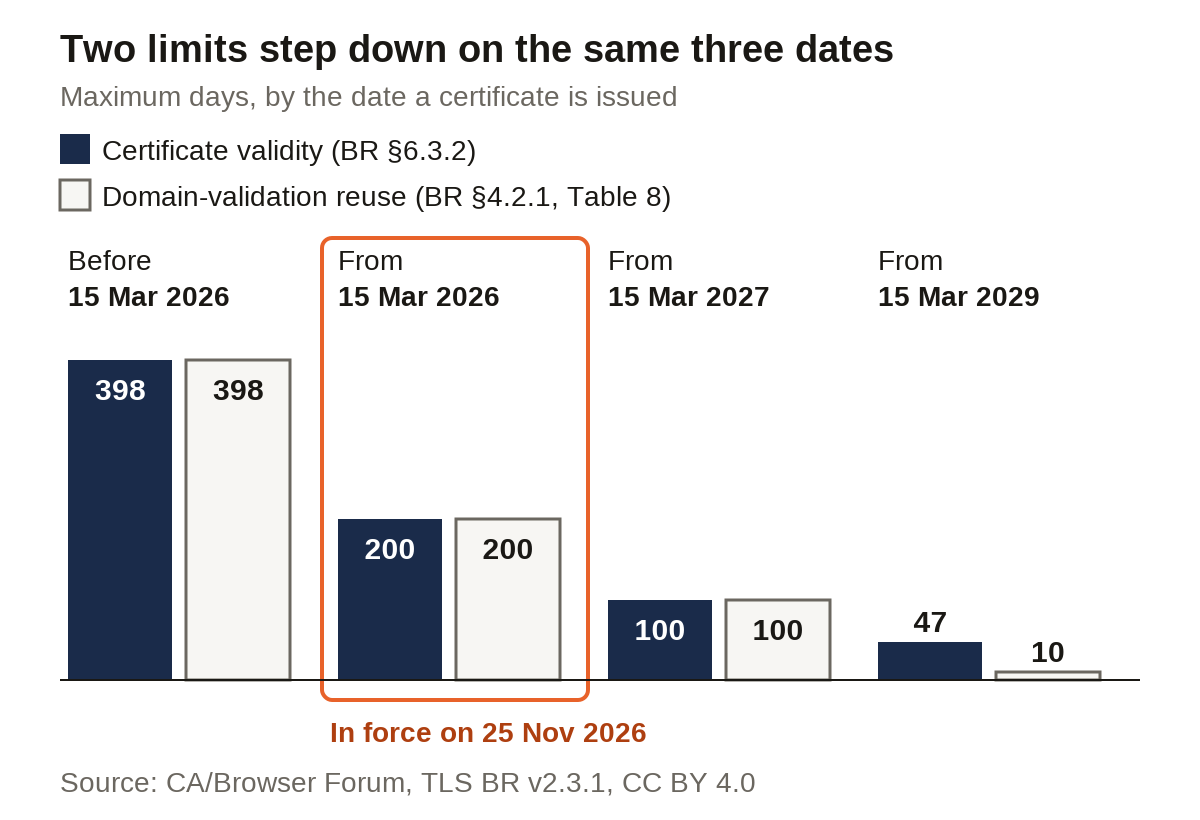
Apple had set the 398-day figure in 2020, before the Baseline Requirements did. Its support article About upcoming limits on trusted certificates says certificates "issued on or after September 1, 2020 00:00 GMT/UTC must not have a validity period greater than 398 days", and that connections to servers breaking the rule fail on its platforms. Our guide to what the padlock proves covers what a certificate shows in the first place.
Counting days the way the Baseline Requirements do
Section 1.6.1 borrows its definition from RFC 5280: the validity period runs from notBefore through notAfter, inclusive. Section 6.3.2 then fixes a day at 86,400 seconds and counts any excess, even a fraction of a second, as another day. So a certificate whose two timestamps sit exactly 90 days apart counts as 91, while one whose notAfter is a second earlier counts as 90.
“Subscriber Certificates SHOULD NOT be issued for the maximum permissible time by default, in order to account for such adjustments.” TLS Baseline Requirements v2.3.1, section 6.3.2
We counted lifetimes that way. All 5 certificates in our sample that came out at exactly 200 days were 199 days and one second long by the inclusive count, inside the hard limit. Of the 9 at 91 days, 2 were 90 days plus one second and 7 ran about an hour past 90 days.
Our own site as a control
recatools.com sat outside the sample and was read first. Its certificate ran from 08:17:42 on 19 October 2026 to 08:17:41 on 17 January 2027 (UTC). Add the inclusive second and that is 7,776,000 seconds, exactly 90 days.
Lifetimes served across 56 regional sites
We reused the 60-host sample from our security.txt survey: in each of ten ASEAN member states, the national CERT, three government sites and two large domestic banks. Timor-Leste is outside it. The list was frozen in writing at 07:44 Singapore time on 25 November, before the first handshake. From one Singapore address we made a single TLS handshake per host with openssl s_client (LibreSSL 3.3.6), eight seconds apart, with no retries and no web request, between 07:44 and 07:53, and checked each chain against the root certificate bundle macOS ships for LibreSSL. Two hosts timed out, one sent no certificate and one chain did not verify, which leaves 56. Every figure below is pooled, and we name no host or country.
| Verified certificates | CERT (9) | Government (27) | Bank (20) | All (56) |
|---|---|---|---|---|
| Issued before 15 March 2026 | 1 | 8 | 7 | 16 |
| Issued on or after 15 March 2026 | 8 | 19 | 13 | 40 |
| Lifetime over 100 days | 3 | 20 | 19 | 42 |
| Lifetime 91 days or less | 6 | 7 | 1 | 14 |
| Expiring on or after 15 March 2027 | 2 | 12 | 4 | 18 |
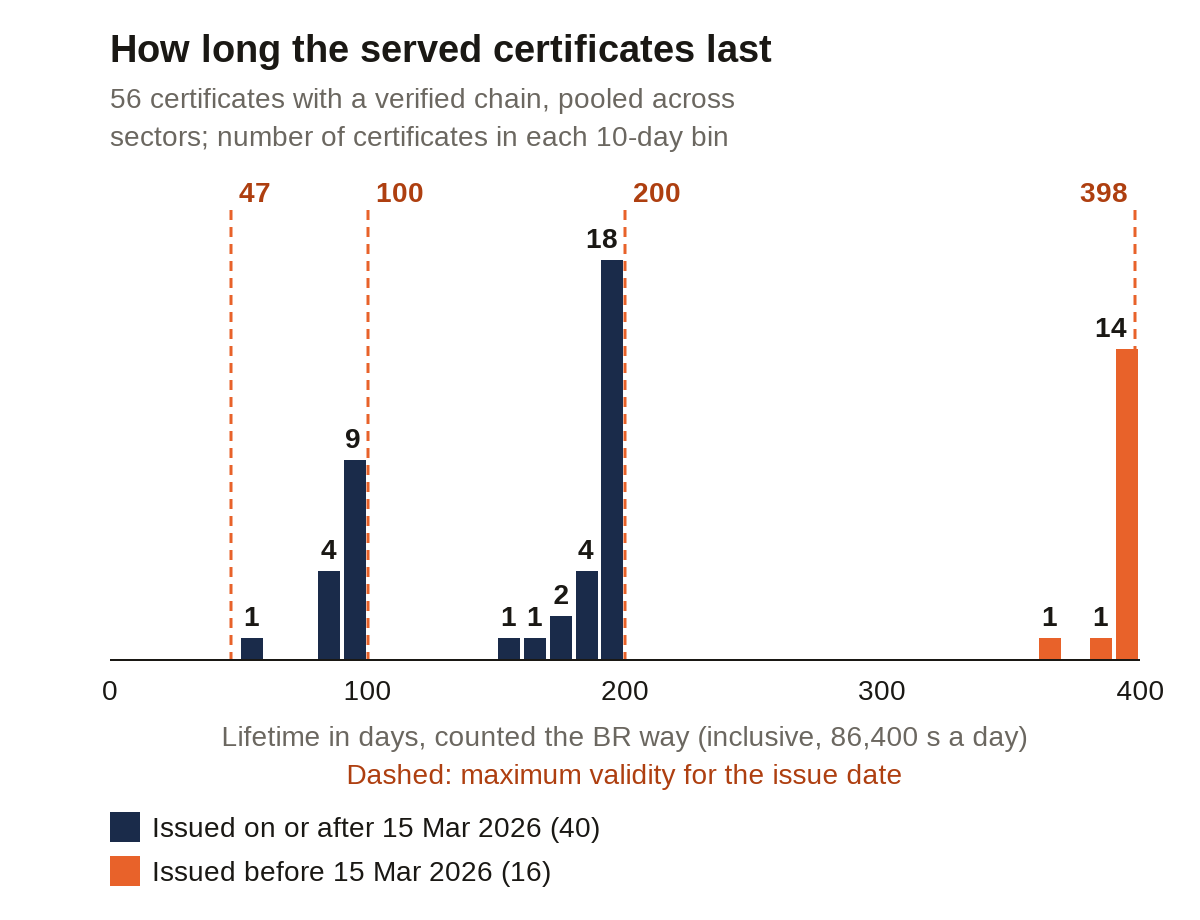
The histogram has two spikes, and both sit at a cap. Eighteen of the 40 certificates issued since March run 198 to 200 days, and the 16 older ones run 365 to 397 days, so all of them expire by mid-April 2027 at the latest. On the day we looked, the median certificate had 83 days left and 5 had 30 days or fewer.
Long does not mean non-compliant
The limits bind the CA when it issues a certificate. The 16 older certificates were within the 398-day rule when issued and stay valid until their expiry dates, though none could be issued at that length today. The other 26 over 100 days could be replaced at the same length only before 15 March 2027.
If the 18 certificates expiring on or after 15 March 2027 are replaced when they expire, their successors fall under the 100-day limit. The other 38 expire before that date, so their replacements can still run up to 200 days if issued before 15 March 2027.
Behind a CDN, visitors get the edge’s certificate
A content delivery network (CDN) terminates the connection at its own edge servers, and the certificate configured there is the one a browser checks. By network name, looked up through Team Cymru’s IP-to-ASN service, 40 of the 57 hosts that sent a certificate connected us to a CDN or cloud-edge network, with Cloudflare’s the largest at 15. Eleven of the 14 certificates of 91 days or less were on such networks. Among the 15 Cloudflare-network hosts, 7 presented a 91-day certificate from one CA and 8 presented longer certificates from four other CAs. A handshake cannot say who obtained any of them. For our own domain, the Cloudflare edge serves a Let’s Encrypt certificate.
Domain validation shrinks further than the certificate
Before issuing a certificate, a CA must confirm that the applicant controls the domain. Section 4.2.1 of the Baseline Requirements, Table 8, limits how old that evidence may be: 398 days before 15 March 2026, then 200, 100 and finally 10 days from 15 March 2029. Table 7 cut reuse of organisation details from 825 days to 398 on 15 March 2026.
By our arithmetic, a site whose certificates are issued at the cap and replaced at expiry needs about 2 a year at 200 days, rising to about 8 a year at 47. Once evidence lasts only 10 days, each of those issuances needs a fresh domain check.
One CA’s own policy runs ahead of the Baseline Requirements. In a post of 2 December 2025, Decreasing Certificate Lifetimes to 45 Days, Let’s Encrypt set its opt-in profile to 45-day certificates from 13 May 2026. Its default profile moves to 64-day certificates with 10-day authorisation reuse on 10 February 2027, and to 45 days with 7-hour reuse on 16 February 2028. These are one CA’s choices, while the Baseline Requirements’ reuse limits bind every CA.
Checking the dates on your own certificate
Two commands read the dates a server presents. The output below is what our own domain returned on 25 November 2026; yours will differ.
openssl s_client -connect recatools.com:443 -servername recatools.com </dev/null 2>/dev/null | openssl x509 -noout -startdate -enddate
notBefore=Oct 19 08:17:42 2026 GMT
notAfter=Jan 17 08:17:41 2027 GMT
Subtract notBefore from notAfter, add one second, and divide by 86,400, rounding any remainder up. The notBefore date tells you which cap applied, and the result tells you whether a successor of the same length could still be issued.
A site owner’s checklist for the shorter caps
For watching expiry dates, our Uptime Kuma guide covers monitoring.

View author profile → · Editorial policy
Go further
More from Cybersecurity