Key points
- GitHub, GitLab and Bitbucket all document Ed25519 keys, and it is what
ssh-keygenmakes when given no type. On our pinned OpenSSH 10.6p2 build its public key file is 82 bytes. - OpenSSH 8.8 (26 September 2021) switched off RSA signatures that use SHA-1. Its release notes say there is “no need to replace ssh-rsa keys”, because the same key signs with SHA-256 or SHA-512.
- The hosts’ pages set different RSA rules. GitLab recommends at least 4096 bits, Bitbucket lists a 2048-bit minimum and also lists DSA, and GitHub states no minimum. Our 10.6p2 build no longer knows DSA.
- OpenSSH 10.6 enabled a post-quantum hybrid key,
ssh-mldsa44-ed25519. Its public key file is 1,850 bytes, 22.6 times an Ed25519 one by our arithmetic, and none of the three hosts’ pages mention it as of 25 November 2026. - NIST IR 8547, final since October 2026, deprecates RSA, ECDSA and EdDSA signatures after 2030 and disallows them under NIST standards and guidelines after 2035.
An SSH key is the pair of files that lets git push reach a code host without a password. You keep the private half and paste the public half into GitHub, GitLab or Bitbucket. All three document Ed25519 keys, which ssh-keygen makes when given no type. On 25 November 2026 we generated each key type a pinned OpenSSH 10.6p2 would make. Its Ed25519 public key file came to 82 bytes, against 1,850 for the post-quantum hybrid OpenSSH switched on in October, which none of the three hosts’ pages mention.
RSA keys survived the 8.8 signature change
Search results for SSH errors are full of pages tying “Their offer: ssh-rsa” to OpenSSH 8.8, released on 26 September 2021. Its notes say it disables RSA signatures using SHA-1 by default, since chosen-prefix SHA-1 collisions could be made “for <USD$50K”. They also say there is “no need to replace ssh-rsa keys”, because OpenSSH has supported RSA signatures with SHA-256 or SHA-512 since release 7.2.
The name ssh-rsa covers two things, and 8.8 changed only one of them. The key type, the word that starts an RSA .pub line, is still listed by ssh -Q key on our 10.6p2 build. The signature algorithm of the same name, RSA with SHA-1, is missing from the client’s defaults, which hold rsa-sha2-512 and rsa-sha2-256 instead. Why SHA-1 went is in our guide to which hash to use for what.
GitHub set its own dates. Its key-generation page says DSA keys have not been supported since 15 March 2022, and that RSA keys with a valid_after before 2 November 2021 may use any signature algorithm, while keys “generated after that date” must use SHA-2. Its announcement of 1 September 2021 says “uploaded after”.
Sizes and refusals from a pinned ssh-keygen
We ran Alpine’s openssh 10.6_p2-r0 packages in an alpine:edge container pinned by digest, under Docker Desktop on an Apple silicon Mac. Each type was generated 20 times (RSA 8192 five times) with an empty passphrase and comment, in three separate runs. Public key files came out the same size in every run. ECDSA private files came in two sizes 12 bytes apart: 480 or 492 bytes for P-256, and 590 or 602 for P-384.
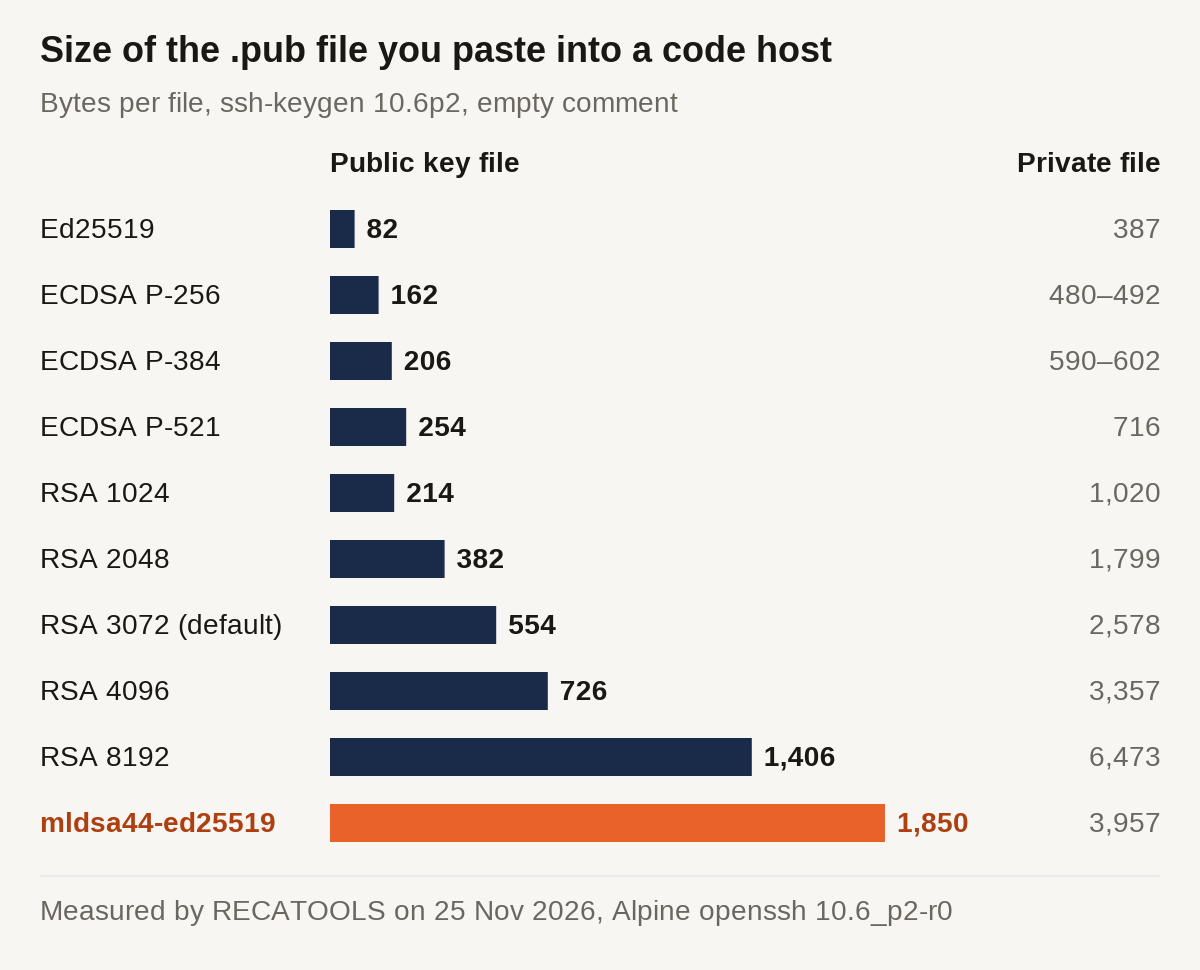
Ed25519, ECDSA and the hybrid took a median of 2 to 6 ms in every run. RSA times scatter because the prime search is random, so the 4096-bit median ran 136 to 295 ms across the runs and single 4096-bit keys took from 37 ms to just over a second, all on one Mac under Docker. The build also refused several requests.
ssh -V
OpenSSH_10.6p2, OpenSSL 3.5.7 9 Jun 2026
ssh-keygen -q -N '' -C '' -t rsa -b 768 -f k
Invalid RSA key length: minimum is 1024 bits
ssh-keygen -q -N '' -C '' -t dsa -f k
unknown key type dsa
ssh-keygen -q -N '' -C '' -t ed25519 -b 4096 -f k
ssh-keygen -l -f k.pub
256 SHA256:EXAMPLExxxxxxxxxxxxxxxxxxxxxxxxxxxxxxxxxxxx no comment (ED25519)
RSA under 1,024 bits has been refused since OpenSSH 7.6 in 2017, and the ceiling is 16,384. DSA was compiled out by default in 9.8 and removed in 10.0.
A size flag that does nothing
Ed25519 has one size, so on 10.6p2 ssh-keygen -t ed25519 -b 4096 quietly makes a 256-bit key. Bitbucket’s Linux setup page pairs -t ed25519 with -b 4096, and its configuration page uses -b 256; both give the same key.
Each host’s pages, read side by side
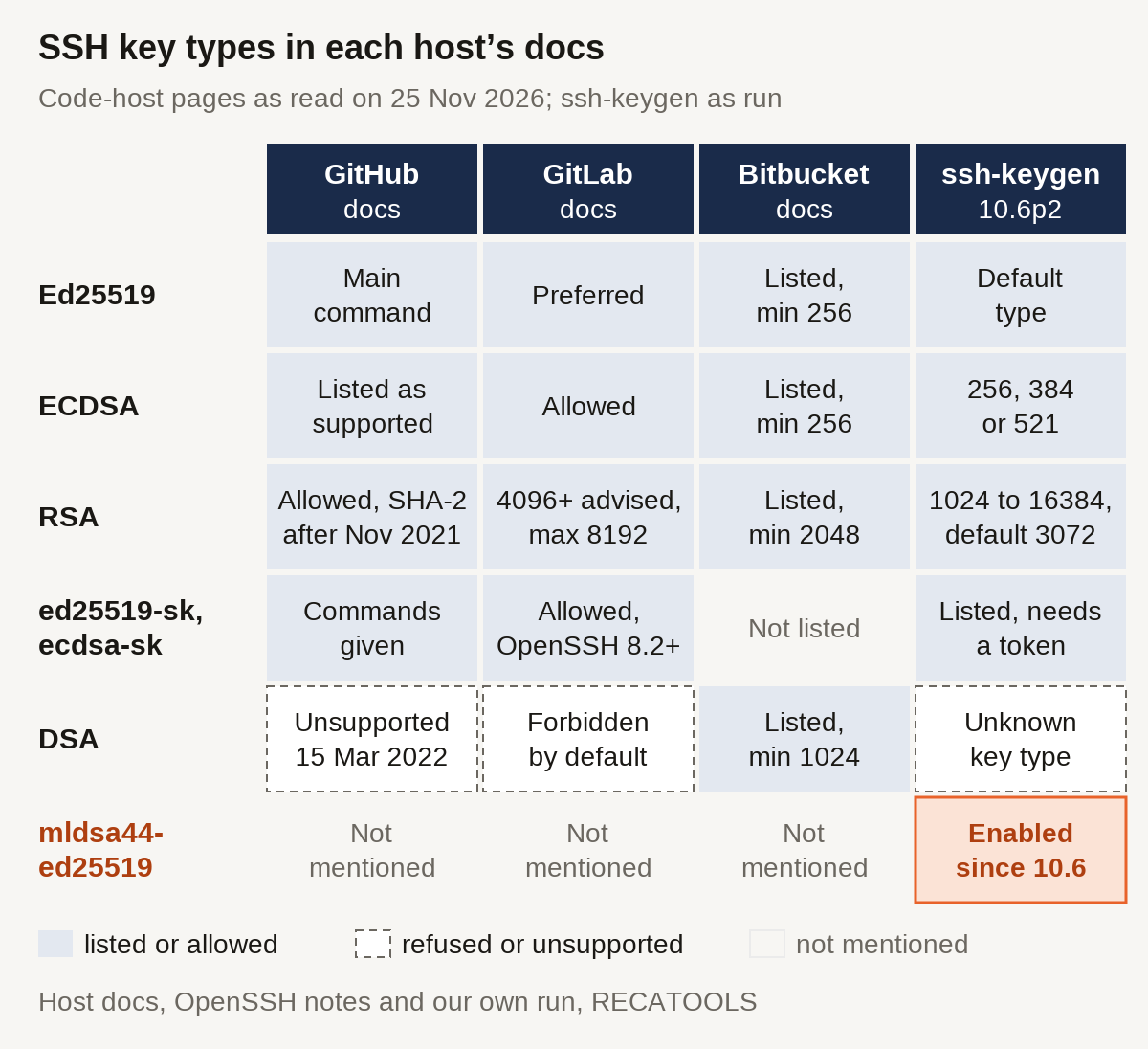
GitLab’s SSH page marks ED25519 as preferred and, in its own assessment, says “Security issues related to DSA also apply to ECDSA keys”. Its key restrictions page forbids DSA by default and says ssh-keygen allows RSA keys “with as few as 768 bits”, where the build we ran refuses anything under 1,024.
Bitbucket Cloud’s SSH configuration page lists Ed25519, ECDSA, RSA and DSA for client keys, each with a minimum size, and accepts public keys only in OpenSSH’s authorized_keys format. On GitHub’s side, its fingerprint page lists a host key labelled “DSA - closing down” beside the RSA, ECDSA and Ed25519 ones.
FIDO security keys need the token attached
OpenSSH 8.2, released on 14 February 2020, added the ecdsa-sk and ed25519-sk types for FIDO hardware security keys. They work “so long as the hardware token is attached when the keys are used”. GitHub gives ssh-keygen -t ed25519-sk, with ecdsa-sk as the fallback. GitLab allows both and needs OpenSSH 8.2 or later on the client and on its server. The two Bitbucket pages we read do not mention them. With no token attached, our run could not enrol either type.
Minimum RSA sizes differ by host
GitHub states no RSA minimum and gives ssh-keygen -t rsa -b 4096 as its legacy command. GitLab recommends at least 4096 bits and caps keys at 8192 “due to Go limitations”, and Bitbucket’s floor is 2048. With no -b, 10.6p2 made a 3,072-bit key, and its client refuses RSA under 1,024 bits through RequiredRSASize, added in 9.1.
For RSA keys in other wrappers, our RSA key pair generator makes 2048-, 3072- or 4096-bit pairs with the browser’s Web Crypto API, as PEM and JWK, and shows how long your device took in milliseconds. It makes RSA keys only, so it is not an SSH key generator, and the page says so. Its public PEM imports with ssh-keygen -i -m PKCS8. In our check, a pair exported by the same Web Crypto calls imported as an ssh-rsa line, and ssh-keygen -y read the private PEM to the same fingerprint.
Post-quantum hybrid keys reached OpenSSH in October
OpenSSH 10.4, on 6 July 2026, added a signature scheme combining ML-DSA 44 with Ed25519, experimental and off by default. OpenSSH 10.6, on 6 October, enabled it as ssh-mldsa44-ed25519 and dropped the old @openssh.com suffix, adding that keys made under the experimental support “must be regenerated”. Our build answered the old name with “unknown key type”.
The hybrid’s public key file, at 1,850 bytes, is 22.6 times an Ed25519 one by our arithmetic. Our guide to how big post-quantum keys are measures the same growth in TLS. ssh-keygen prints the hybrid’s size as 512 bits, a display figure; NIST IR 8547 rates ML-DSA-44 at 128 bits of classical security.
The 10.6p2 client accepts the hybrid by default, last in its list. None of the three hosts’ pages mention it as of 25 November 2026, and we did not test whether their servers accept one. Key exchange is a separate negotiation from the key type, and how it is moving to post-quantum is in our account of the post-quantum migration.
OpenSSH releases and NIST’s deadlines
-
OpenSSH 7.2
RSA signatures with SHA-256 and SHA-512.
-
OpenSSH 7.6
RSA keys under 1,024 bits refused.
-
OpenSSH 8.2
The ecdsa-sk and ed25519-sk types for FIDO hardware keys.
-
OpenSSH 8.8
RSA signatures with SHA-1 off by default; ssh-rsa keys keep working.
-
OpenSSH 9.1
RequiredRSASize sets a minimum RSA key length.
-
OpenSSH 9.8 and 10.0
DSA compiled out by default, then removed.
-
OpenSSH 10.4
ML-DSA-44 and Ed25519 hybrid added, experimental and off by default.
-
OpenSSH 10.6
The hybrid enabled as ssh-mldsa44-ed25519.
-
NIST IR 8547
RSA, ECDSA and EdDSA signatures deprecated.
-
US federal date
The most sensitive US government systems adopt post-quantum signatures.
-
NIST IR 8547
RSA, ECDSA and EdDSA signatures disallowed.
Every classical key type above signs with an algorithm that NIST classes as quantum-vulnerable. NIST IR 8547, published in final form in October 2026, lists RSA, ECDSA and EdDSA in its Table 2 of those signature algorithms, each deprecated after 2030 and disallowed after 2035. Section 4.1.1 says this replaces an earlier projection that would have disallowed 112-bit schemes on 1 January 2031. Table 2 covers RSA from 112 bits of security up, so a larger key does not move either date.
The same report carries a separate 31 December 2031 date, from Executive Order 14412 and OMB memorandum M-26-15, for the US government’s most sensitive systems to adopt post-quantum signatures, a federal deadline for those systems alone. What Shor’s algorithm needs to break RSA is set out in our guide to what it actually breaks. On the replacement side, IR 8547’s Table 3 puts ML-DSA-44, the post-quantum half of OpenSSH’s hybrid, in security category 2.

View author profile → · Editorial policy
Go further
Relevant tools
More from Cybersecurity