
Key points
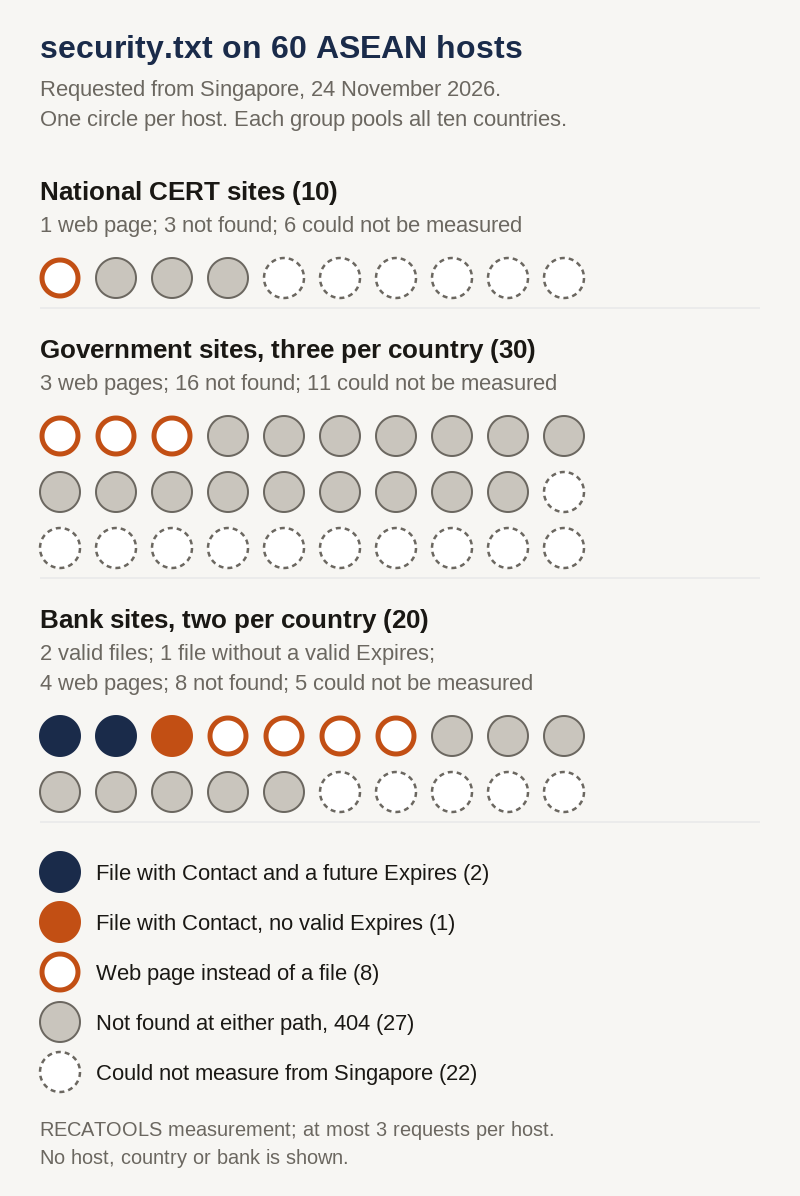
- Of 60 ASEAN hosts we requested on 24 November 2026, 22 could not be measured from Singapore with a plain request: refusals, network failures, bot-challenge pages, server errors and one redirect loop.
- Of the 38 that answered, 3 served a security.txt file and 2 of those carried a future Expires date. All three were on bank sites.
- None of the 23 national CERT and government hosts that answered served a file, and 8 hosts returned a web page at the file’s address.
- RFC 9116 is an Informational RFC with two required fields, Contact and Expires, served as
text/plainover https under/.well-known/. - Singapore’s and Malaysia’s CERTs publish a vulnerability-reporting route on their own pages, and incident-reporting channels are published for Indonesia, Cambodia and Myanmar.
A security.txt file is a few lines of plain text at a fixed address, /.well-known/security.txt, that tell anyone who finds a flaw on a website where to report it. On 24 November 2026 we asked for that file from a 60-host sample across ten ASEAN countries, taking from each one its national computer emergency response team (CERT), three government sites and two large domestic banks. Twenty-two of the 60 could not be measured from Singapore with a plain request. Of the 38 that answered, 3 served a file, all on bank sites, and 2 of those carried a future Expires date. None of the 23 CERT and government hosts that answered had one. Several national CERTs also publish a reporting route on their own pages.
What RFC 9116 asks a publisher for
The format is RFC 9116, A File Format to Aid in Security Vulnerability Disclosure, by E. Foudil and Y. Shafranovich (April 2022). It is an Informational RFC, and the document describes itself as "not an Internet Standards Track specification". We did not establish whether any ASEAN government requires the file.
Two fields are required. Section 2.5.3 says Contact "MUST always be present", written as a URI (a web address or similar identifier), so an email address takes mailto:; for the mailbox itself it points to the security@ convention in RFC 2142. Section 2.5.5 says Expires "MUST always be present and MUST NOT appear more than once", and recommends a date "less than a year into the future to avoid staleness". Section 3 puts the file under /.well-known/, the path prefix defined in RFC 8615, and requires https and a Content-Type of text/plain. Section 3.1 limits each file to the exact host it was fetched from, so example.com and www.example.com each need one.
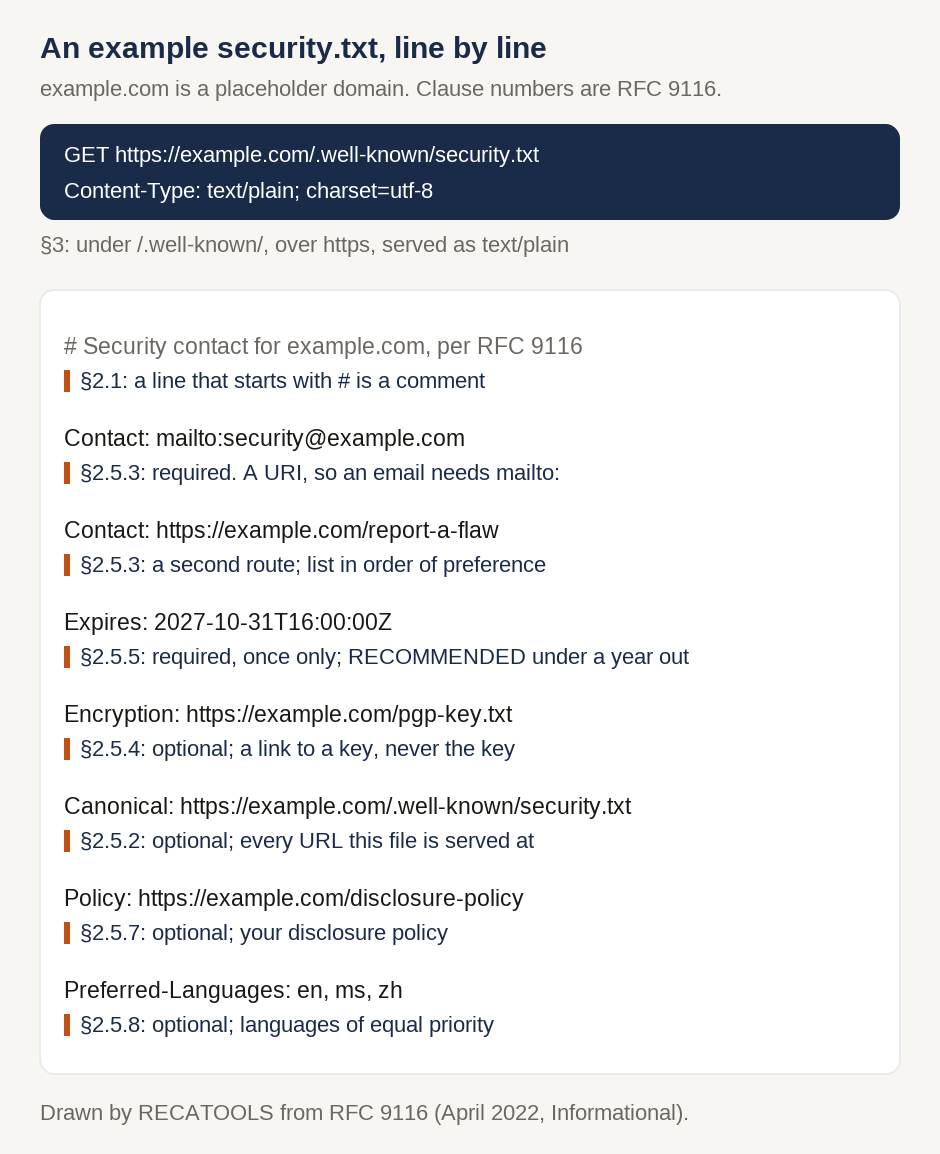
Every other field is optional, and section 2.3 recommends an OpenPGP signature.
Three files among the hosts that answered
We fixed the sample in writing before the first request. Each country gave six hosts. The CERT’s site came from the member list of the Asia Pacific Computer Emergency Response Team (APCERT), or from the CERT itself where it has no entry. The three government hosts were the national portal and two central ministries, and the two banks were large domestic ones. Timor-Leste, an ASEAN member since October 2025, is outside the sample. We name none of the hosts, and every result below is pooled across all ten countries.
Our earlier guide to three DNS records nobody publishes checked 18 institutions in six countries on 19 August 2026. This sample adds four countries, the CERTs and two more government sites per country, and leaves out the telcos.
One Singapore address made at most three requests per host between 21:10 and 21:37 Singapore time, at least eight seconds apart, under a User-Agent naming RECATOOLS, 177 requests in all. A file counted only with status 200, text/plain and a Contact line.
| Result | Hosts | Share of 60 |
|---|---|---|
| File with Contact and a future Expires | 2 | 3% |
| File with Contact, no valid Expires | 1 | 2% |
| Web page instead of a file | 8 | 13% |
| Not found at either path | 27 | 45% |
| Could not measure | 22 | 37% |
Of the 38 measurable hosts, 3 served a file (8%) and 2 a valid one (5%), by our definition. The three files came from 15 measurable bank sites, while none came from the 4 measurable CERT sites or the 19 measurable government sites. For scale, the reporting company URIports, in Follow-Up on Security.txt Adoption: Progress and Pitfalls in 2025 (24 January 2025), found the file on 1.25% of the top one million domains, a different population.
Hosts that would not answer a plain request
Twenty-two hosts, 37% of the sample, gave us nothing to classify. Nine refused every request with a 403, robots.txt included. Of the other thirteen, six failed at the network level, and the rest served a bot-challenge page, returned a server error or, in one case, looped on a redirect. For 21 of the 22, robots.txt failed the same way, so the block covered the whole host and had nothing to do with this file.
That result belongs to one vantage point, a Singapore address with an honest automated User-Agent on one evening. A firewall that challenges unknown clients is ordinary hygiene, and a browser elsewhere may well get the file. We count these hosts as unmeasured, never as missing.
Web pages served where the file should be
Eight hosts answered the file’s address with HTML. Six redirected to a home page, an app landing page or an error page, one of them dropping from https to plain http. Two answered status 200 with an HTML page at the file’s own URL. A check of the status code alone would score those two as files. A check of the content type alone fails the other way, as one of our control hosts showed by returning 404 for the file with the reply still labelled text/plain.
Inside the three files that exist
All three sat under /.well-known/ as text/plain. We report the rest without saying whose file is whose.
- One file listed a contact on the host’s own registered domain. Two listed contacts only on another domain. Section 5.3 asks that contacts be "controlled by the organization"; we did not check who controls those two domains, which a group domain or a hosted service can satisfy.
- One Contact value was a bare email address with no
mailto:, which the URI rule in section 2.5.3 does not allow. - One file had no Expires line. The other two ran 280 and 1,406 days ahead; the one-year limit is a recommendation, so both count as valid here.
- Two of the three linked a Policy and two listed Preferred-Languages. One carried Canonical, listing the URL we fetched among others. None was signed.
“Not having a "security.txt" file may be preferable to having stale information in this file.” RFC 9116, section 5.3
Reporting routes the national CERTs publish
After the survey we read, by hand, the reporting pages that national CERTs and cyber agencies publish. In Singapore, CSA’s page CSA as a CVE Numbering Authority (CNA), last updated 11 September 2026, says SingCERT coordinates between people who find a suspected vulnerability and the organisation responsible, manages the disclosure policy, and links a Responsible Vulnerability Disclosure Policy and a report form. GovTech’s Vulnerability Disclosure Programme, last updated 19 October 2026, covers government systems. Two of our news stories show the route in use, a coordinated disclosure and a CSA alert.
Malaysia’s MyCERT, on its page CVD - Coordinated Vulnerability Disclosure (CVD), asks reporters to email its CVD address with the affected product and version, and whether they have tried to contact the vendor. Indonesia’s national cyber agency BSSN, Cambodia’s CamCERT and Myanmar’s mmCERT publish incident-reporting routes. BSSN’s national cyber contact centre lists vulnerability information among the details to supply, and CamCERT and mmCERT each publish a PGP encryption key. For the other member states we have no route to quote.
Publishing a file for your own domain
For a small organisation the work is one text file and a renewal date. Each step cites its RFC 9116 clause, except one that comes from our own soft-404 finding. Check only your own domain, because section 5.5 says a file, present or absent, grants no permission for security testing.
Three requests confirm the setup. The outputs illustrate a correct answer, with example.com standing in for your domain.
curl -sS -o /dev/null -w '%{http_code} %{content_type}\n' https://example.com/.well-known/security.txt
200 text/plain; charset=utf-8
curl -sS https://example.com/.well-known/security.txt | grep -E '^(Contact|Expires):'
Contact: mailto:[email protected]
Expires: 2027-10-31T16:00:00Z
curl -sS -o /dev/null -w '%{http_code}\n' https://example.com/.well-known/no-such-file
404Download
security.txt template
The example file above, with a comment naming its RFC 9116 section before each field. Replace every example.com value and set Expires to a date under a year ahead before serving it.
If a site you depend on has no file, the national CERT is the next place to look. In Singapore that is the SingCERT report form and in Malaysia MyCERT’s CVD address; for Indonesia, Cambodia and Myanmar it is the published incident channel.

View author profile → · Editorial policy
Go further
More from Cybersecurity