
Key points
- On 590 CVEs where one scorer gave both vectors (NVD, 5–11 October 2026), the 4.0 base score averaged +0.39 against 3.1, with 156 band changes.
- The new scoring method explains the move. A mechanical translation of each 3.1 vector, scored the 4.0 way, reproduces 143 of the 156 band changes.
- Attack Requirements is mostly the old high complexity under a new name. In 4.0, AC:H alone and AT:P alone give the same score in all 26,244 combinations of the other base metrics.
- Some 4.0 numbers filed as base scores include Exploit Maturity. As published, 4.0 averaged −0.09 against 3.1; base to base it was +0.39.
- All 918 CVSS 4.0 scores in the week came from the CNA that filed the record. None was by NVD.
CVSS, the Common Vulnerability Scoring System maintained by FIRST (the Forum of Incident Response and Security Teams), has two versions in use, 3.1 and 4.0, and a record in the US National Vulnerability Database (NVD) can show a score in each. With one scorer, most of the base-score gap comes from how 4.0 calculates a score, and little from the metrics it added. We recomputed the 590 CVE (Common Vulnerabilities and Exposures) records published on NVD from 5 to 11 October 2026 (UTC) where one scorer had supplied both vectors. The 4.0 base score came out higher on 366 and lower on 215, by +0.39 points on average, and 156 changed severity band. Scoring the old 3.1 vectors under the 4.0 method reproduces 143 of those band changes. None of the week's 4.0 numbers was scored by NVD.
Each 4.0 number in the sample came from the CNA that filed the record
We pulled that week from the NVD API 2.0 on 24 November 2026. Of 3,209 records not rejected, 2,824 carried a 3.1 score, 918 a 4.0 score and 695 both. Each of the 918 4.0 scores names as its source the CVE Numbering Authority (CNA) that published the record, and none came from NVD's own account, which wrote 271 of the 3.1 rows. NVD's Primary and Secondary labels do not settle who scored what. That week 17 CNA scores were labelled Primary, and 606 Secondary 3.1 scores came from the data-publisher account of CISA, the US Cybersecurity and Infrastructure Security Agency, which adds scores to other CNAs' records. So one record can pair NVD's 3.1 number with a CNA's 4.0 number. NVD's site says it supports CVSS 4.0, yet it wrote 0 of the 918 4.0 rows here and 0 of 1,075 in four other weeks we checked, from June 2024 to August 2026. This guide uses data from the NVD API but is not endorsed or certified by the NVD.
FIRST's CVSS 4.0 specification (version 1.2, 18 June 2024) says base metrics are "provided by the organization maintaining the vulnerable system, or a third party assessment on their behalf." Of our 590 same-scorer CVEs, VulnCheck scored 360 and VulDB 130, and Arista, CISA's industrial control systems team, MongoDB and 12 others scored the other 100. Our 3.1 scorer and FIRST's unmodified 4.0 code matched every published score. CVSS is owned by FIRST and used by permission.
Same scorer and same CVE, scored both ways
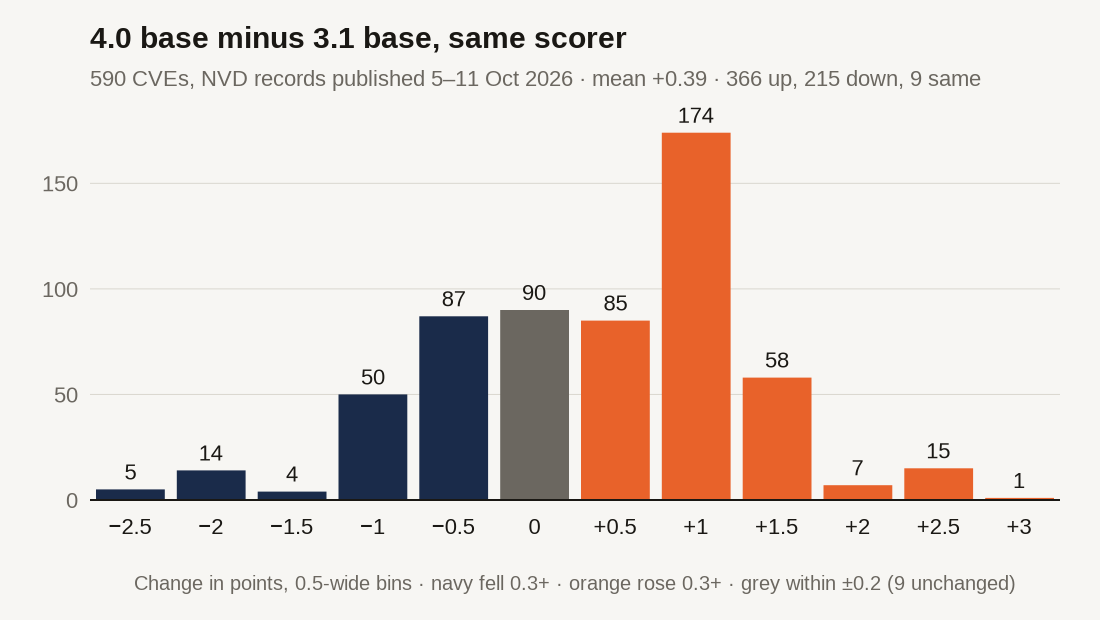
The median change was +0.6, the range ran from −2.6 to +3.2, and 304 CVEs moved by a point or more. Bands changed in both directions, 88 up and 68 down.
| 3.1 band | 4.0 Low | 4.0 Medium | 4.0 High | 4.0 Critical |
|---|---|---|---|---|
| Low | 9 | 19 | 0 | 0 |
| Medium | 17 | 310 | 49 | 1 |
| High | 0 | 46 | 79 | 19 |
| Critical | 0 | 0 | 5 | 36 |
VulnCheck's CVEs rose by +0.51 on average, the 100 from the other 15 scorers by +0.45, and VulDB's by +0.02, with 40 of its CVEs dropping a band. VulDB's 39 High 3.1 vectors were all low-impact bugs needing no privileges or interaction, 38 of them AV:N/AC:L/PR:N/UI:N/S:U/C:L/I:L/A:L at 7.3 and one with Scope Changed at 8.3. All 39 score 6.9 in 4.0. The direction matches Mend.io's "CVSS 3.1 vs CVSS 4.0: A Look at the Data" (13 January 2025), the earliest measurement we found, which counted customer alerts and found the average went up "by nearly 0.8".
Rescoring the old vectors reproduces most band changes
To separate the method from the scorers' choices, we translated each 3.1 vector mechanically. Shared metrics stay, Attack Requirements is None, User Interaction Required becomes Passive, and impact is copied to the subsequent system only where 3.1 had Scope Changed. FIRST publishes no such mapping; this one is our measuring device. We then swapped in the scorer's real 4.0 values one group at a time.
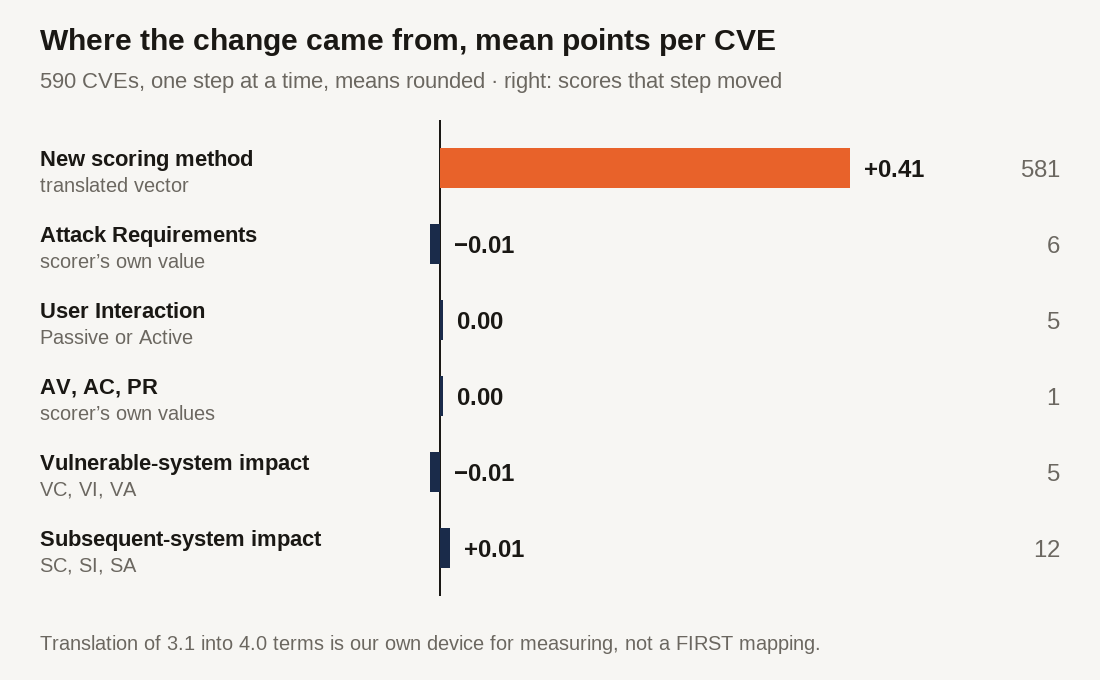
The method alone moved 581 of the 590 scores. Version 4.0 replaces the 3.1 equations with a lookup table of MacroVectors, groups of vectors the specification treats as equivalent, and interpolates within each group. Many 3.1 vectors that scored differently therefore land on one 4.0 number. The five commonest low-impact vectors with low privileges all score 5.3.
| 3.1 impact (AV:N/AC:L/PR:L/UI:N/S:U) | 3.1 score | 4.0 score | CVEs at base 5.3 |
|---|---|---|---|
| C:L/I:N/A:N | 4.3 | 5.3 | 61 |
| C:N/I:L/A:N | 4.3 | 5.3 | 54 |
| C:N/I:N/A:L | 4.3 | 5.3 | 8 |
| C:N/I:L/A:L | 5.4 | 5.3 | 32 |
| C:L/I:L/A:L | 6.3 | 5.3 | 26 |
By our count the whole 4.0 base space of 104,976 vectors produces 63 distinct scores, and 30.3% of pairs differing in one metric value share a score. Averaged over every non-zero 3.1 vector with Scope Unchanged, the same translation shifts the score by +0.01, so the sample's +0.39 reflects the vectors real CVEs use, mostly low-impact network bugs.
One CVE worked through metric by metric
VulnCheck scored CVE-2026-107829 in both versions. Its 3.1 vector is CVSS:3.1/AV:N/AC:H/PR:N/UI:N/S:U/C:H/I:N/A:N, 5.9 Medium. Its 4.0 base vector is CVSS:4.0/AV:N/AC:H/AT:P/PR:N/UI:N/VC:H/VI:N/VA:N/SC:N/SI:N/SA:N, 8.2 High. On the NVD record the 4.0 vector continues with unset threat, environmental and supplemental metrics, marked X.
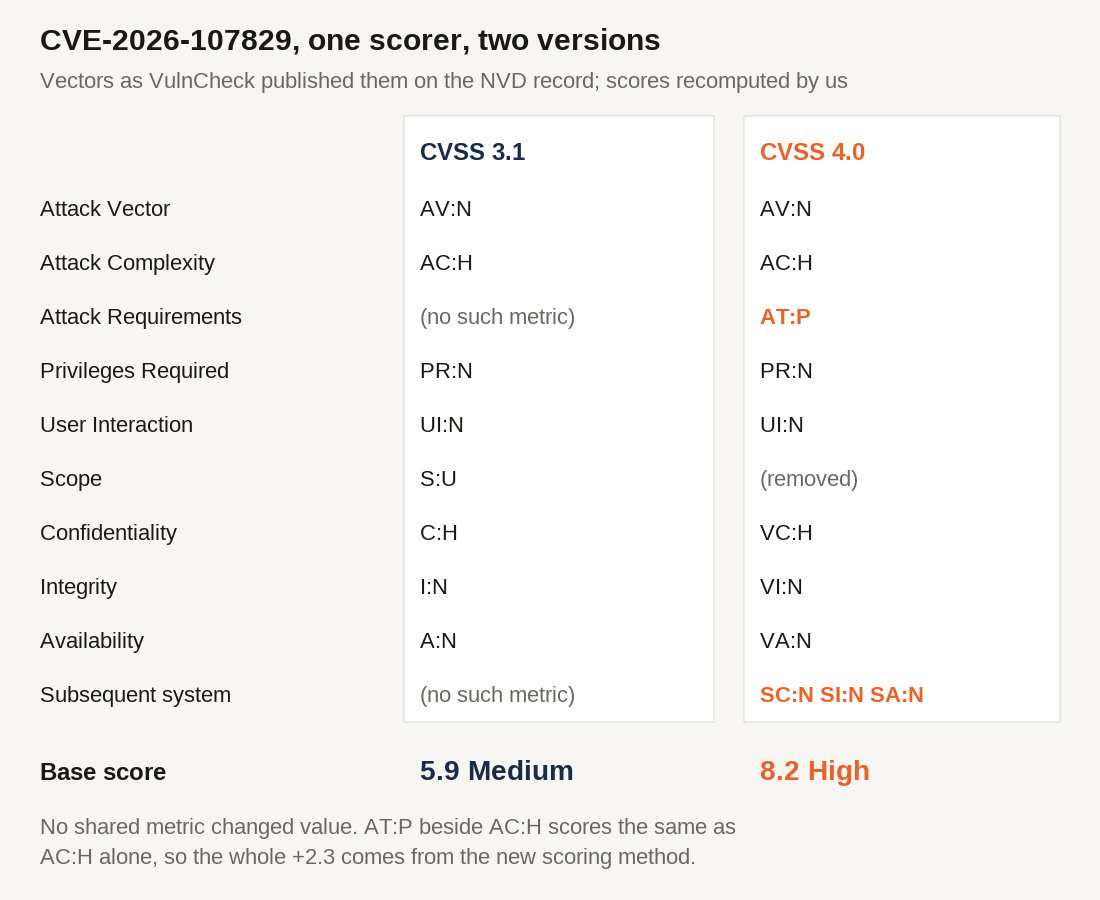
No shared metric changed, and Attack Requirements Present (AT:P) has no effect beside high Attack Complexity (AC:H), so the whole +2.3 is method. Our CVSS 3.1 calculator takes the pasted 3.1 vector, sets the eight base metrics and returns 5.9. Given the 4.0 vector, it says it scores 3.1 only and links FIRST's CVSS 4.0 calculator, which returns 8.2. Before a fix on 24 November 2026, our page had buttons only and no field for a vector.
Attack Requirements mostly relabels high complexity
FIRST's 4.0 User Guide describes Attack Requirements (AT) as "splitting the current AC definition in two metrics". AT:P means the attack depends on how the target is deployed or running, as with a race condition. Of our 590 vectors, 100 used AT:P. In 65 the 3.1 vector had AC:H and the 4.0 vector AC:L with AT:P, and in 29 more the 4.0 vector set both AC:H and AT:P.
The specification puts AC and AT in one equivalence group with two levels. Over all 26,244 combinations of the other nine base metrics, AC:L with AT:P, AC:H with AT:N and AC:H with AT:P scored identically, so moving a judgement between the two metrics cannot change a score. Leaving the easiest level costs from nothing to 3.0 points, depending on impact.
| AC and AT (with AV:N, UI:N) | VC/VI/VA:H, PR:N | VI:L only, PR:L |
|---|---|---|
| AC:L/AT:N | 9.3 | 5.3 |
| AC:L/AT:P | 9.2 | 2.3 |
| AC:H/AT:N | 9.2 | 2.3 |
| AC:H/AT:P | 9.2 | 2.3 |
MongoDB's CVE-2026-103546 is the second column's AC:L/AT:P case, 4.3 in 3.1 with AC:L and 2.3 in 4.0.
Impact moved to a subsequent system is rare but large
Version 4.0 drops Scope and rates impact on the vulnerable and subsequent systems separately. Of 41 vectors with Scope Changed in 3.1, 29 put impact on both systems in 4.0 and 10 on the subsequent system only. The two impact steps moved just 17 of the 590 scores. Arista's CVE-2026-101156 went from 8.4 to 6.2 when its impact moved entirely to the subsequent system, which alone took off 3.1 points, while the method added 0.9. CVE-2026-32645, scored by CISA's industrial control systems team, went from 6.0 to 9.2, +2.3 from the method and +0.9 from added subsequent impact.
Threat metrics can sit inside the published number
Of VulDB's 130 4.0 vectors, 116 carry E:P, Exploit Maturity set to proof of concept, yet NVD's data files the result as the base score. Against its own base, E:P lowered those scores by 2.45 points on average and moved the band in 72. The User Guide says assessment providers such as NVD "typically provide only the Base Scores", and the specification treats an unset Exploit Maturity as the worst case. FIRST's labels for these mixtures, CVSS-B and CVSS-BT, are explained in why FIRST says not to prioritise patches by CVSS alone.
The sign can flip
Comparing the two numbers as NVD lists them, 4.0 averaged −0.09 against 3.1 across our 590 CVEs, with 210 band changes. With E:P removed and both scored as base, it averaged +0.39. For VulDB’s records alone the published comparison was −2.17, with 119 of 130 lower.
Different scorers disagree more than the versions do
That week 166 CVEs carried both an NVD 3.1 vector and a 3.1 vector from another scorer. The two differed on 149, their scores were 1.39 points apart on average, and the band differed on 96. Only 9 of them are in the 590, so the comparison is indicative, but the same-scorer change from 3.1 to 4.0 averaged 0.85 points in either direction.
Reading both numbers on an NVD record
Our counts cover one week, and VulnCheck scored 61% of the same-scorer pairs. These checks separate a change of version from a change of scorer or a threat adjustment.

View author profile → · Editorial policy
Go further
Relevant tools
More from Cybersecurity