
Key points
- Thailand and Viet Nam have a national cybersecurity statute in force. Indonesia’s cyber security and resilience bill (RUU KKS) was still in committee on 17 November 2026, and the Philippines’ House Bill 9605 has passed the House only, according to secondary reports.
- Neither statute in force sets an incident-reporting deadline in hours. Thailand’s 24 hours sit in a 2023 committee notification, Viet Nam’s 72 hours in Decree 331/2026, and Indonesia’s 1×24 hours in Presidential Regulation 82/2022.
- Viet Nam’s 24 hours are an initial notice for a serious incident only. The full report is due 72 hours from detection, and at once where national security or public order is touched.
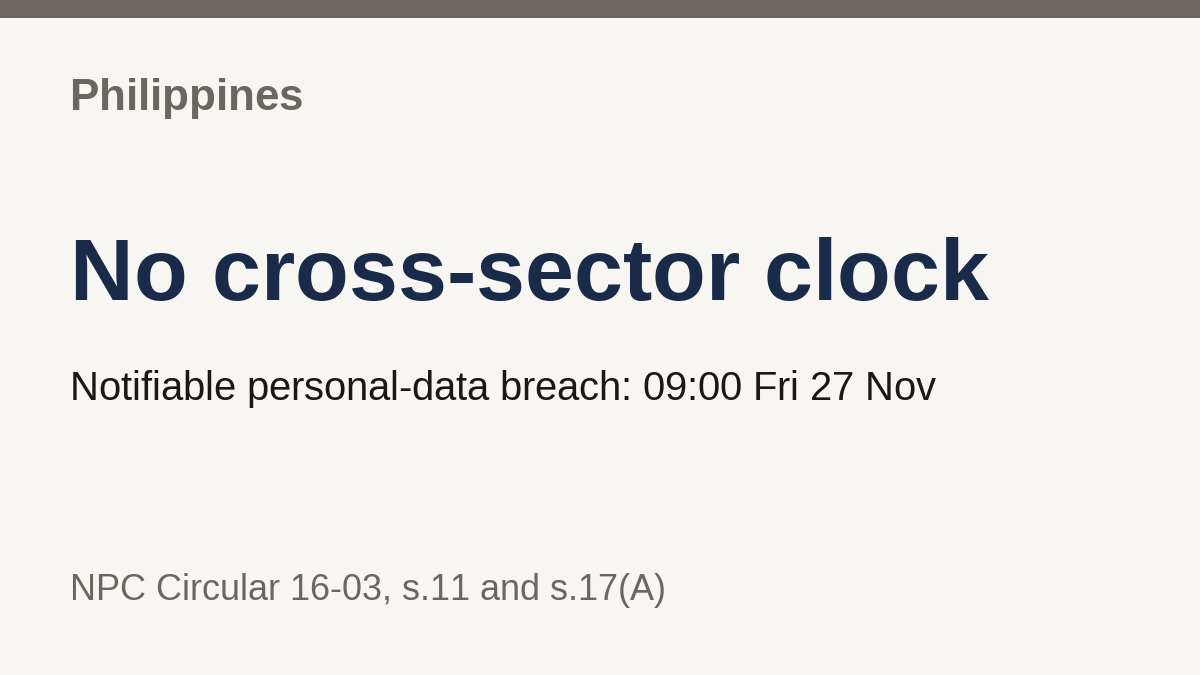
- We found no national, cross-sector cyber-incident clock in the Philippines. The privacy regulator’s 72 hours (NPC Circular 16-03) cover only breaches meeting its notice conditions (s.11); a 2018 central-bank circular, status unconfirmed, gives supervised institutions two hours.
- The International Telecommunication Union’s 2024 index places Indonesia, Thailand and Viet Nam in Tier 1 and the Philippines in Tier 2, so the tier does not follow whether a cybersecurity act exists.
An organisation hit by a cyber incident in Thailand, Viet Nam, Indonesia or the Philippines finds its reporting deadline in rules ranked below statute. Reading the texts at source on 24 November 2026, we found Thailand’s 24 hours in a 2023 committee notification and Viet Nam’s 72 hours, with a 24-hour initial notice for a serious incident, in a 2026 government decree. Indonesia has no cybersecurity law; its 24 hours, for vital-infrastructure operators, are in a presidential regulation. The Philippines has no national, cross-sector clock, only the National Privacy Commission’s (NPC) 72 hours for notifiable personal-data breaches and a 2018 central-bank circular, current status unconfirmed, giving supervised financial institutions two hours.
Statutes in force and bills still in committee
Thailand’s Cybersecurity Act B.E. 2562 was published in the Royal Gazette on 27 May 2019 and took effect the next day (s.2). Viet Nam’s Law on Cybersecurity No. 116/2025/QH15, from the government’s Official Gazette, has applied since 1 July 2026 (Art. 44(1)) and on that date ended the 2018 Law on Cybersecurity and the 2015 Law on Network Information Security (Art. 44(2)).
Indonesia’s Bill on Cyber Security and Resilience (RUU KKS) was still with a working committee of the House’s Commission I on 17 November 2026, according to the House’s news service the next day. The Philippines’ national cybersecurity bill, House Bill 9605, passed the House on 12 August 2026, according to secondary reports; we found no Senate vote. In force there is the Cybercrime Prevention Act of 2012 (Republic Act 10175), a criminal statute that sets up the Cybercrime Investigation and Coordinating Center (s.24) and places no incident-reporting duty on organisations. Singapore and Malaysia are covered in our guide to reporting deadlines in the US, EU, Singapore, Malaysia and India.
Quotations from Thai, Vietnamese and Indonesian texts carry our own unofficial English. We offer a reading of the published texts rather than legal advice; your own case needs a lawyer qualified in the country concerned.
Which instrument carries each clock
| Country | Cybersecurity statute | Where the hours are | Deadline and trigger |
|---|---|---|---|
| Thailand | Act B.E. 2562; s.58 says “promptly” | Committee notification B.E. 2566, clause 5 | 24 hours after detection or occurrence |
| Viet Nam | Law 116/2025/QH15; no reporting deadline in hours | Decree 331/2026, Art. 31(2)(d) | 72 hours from detection; 24-hour initial notice if serious |
| Indonesia | None; RUU KKS is a bill | Presidential Regulation 82/2022, Art. 13(1) | 1×24 hours after the incident is found |
| Philippines | None; HB 9605 is a bill | NPC Circular 16-03, s.17(A), notifiable personal-data breaches only (s.11) | 72 hours from knowledge or reasonable belief |
Download
The four regimes on one page
Statute, instrument, deadline and trigger, coverage, regulator, penalty and ITU tier for Thailand, Viet Nam, Indonesia and the Philippines, as read on 24 November 2026. A4 landscape, made for print or a desktop screen.
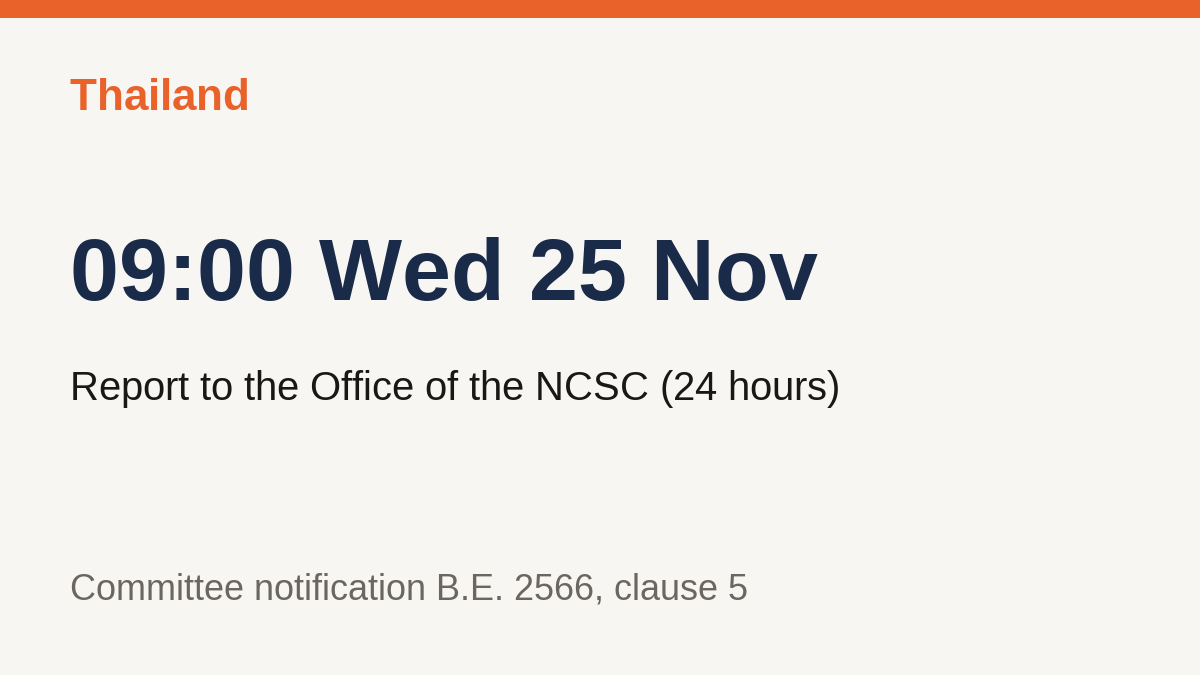
Thailand’s Act asks a critical information infrastructure (CII) organisation facing a significant threat to report to the Office of the National Cyber Security Committee and to its regulator (s.57), and to give notice โดยเร็ว (promptly, s.58). The hours are in the Cybersecurity Regulating Committee’s notification on reporting cyber threats (gazetted 9 May 2023), whose clause 5 gives 24 hours for the report to the Office and lets the regulator set its own deadline. A law-firm summary says a notification of 22 February 2024, in force from 20 June 2024, requires a report to both within 24 hours; we could not obtain its text.
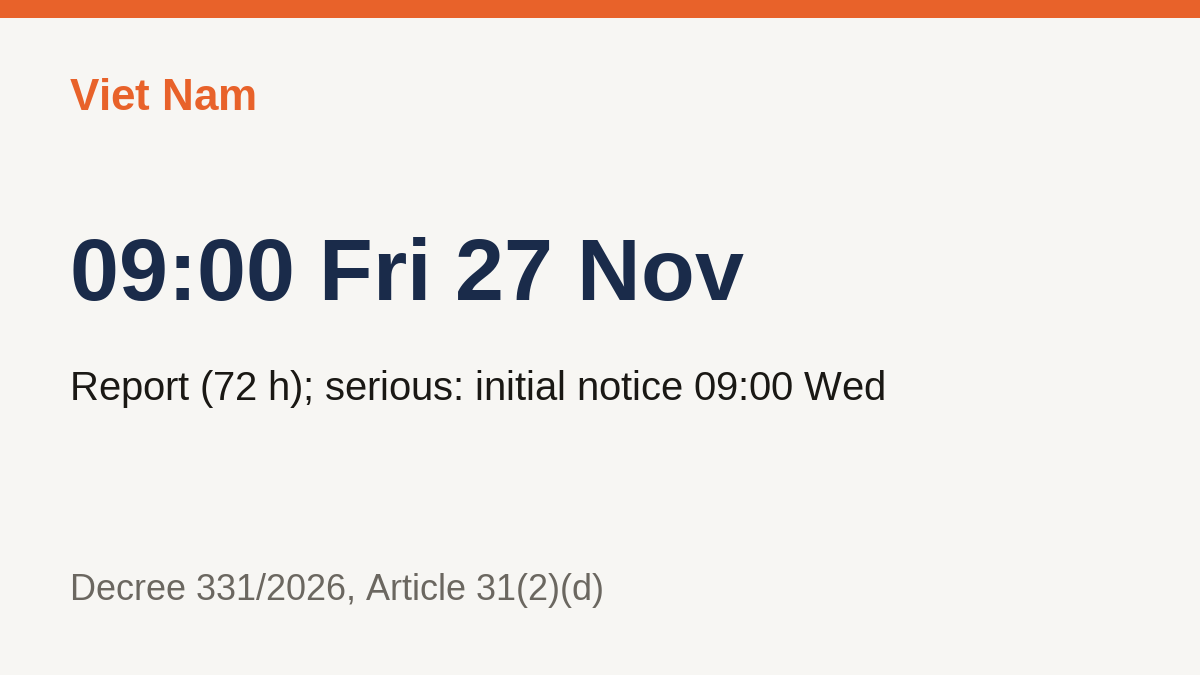
Viet Nam’s Law tells information-system owners to report incidents to the specialised body of the Ministry of Public Security or of Defence (Art. 40(1)(c)) without giving hours. Decree 331/2026/NĐ-CP, in force since 19 August 2026, requires a report “trong thời hạn 72 giờ kể từ thời điểm phát hiện sự cố” (within 72 hours of detecting the incident) and, for a serious incident, an initial notice within 24 hours; the decree does not define a serious incident. Where national security or public order is involved, or the system is seriously disrupted, the report is due on detection.
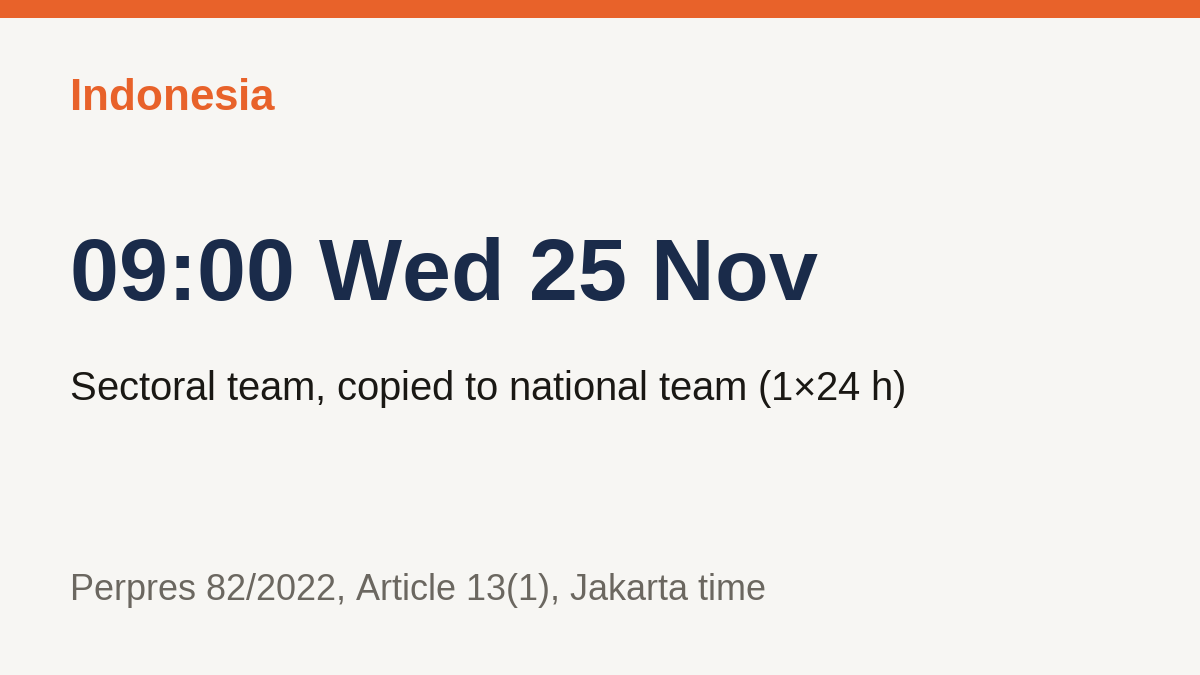
Indonesia’s Presidential Regulation 82/2022 on vital information infrastructure tells an operator to report “paling lambat 1 x 24 (satu kali dua puluh empat) jam setelah ditemukan” (within 1×24 hours of the incident being found) to its sector’s response team, copying the national one (Art. 13(1)). The national cyber and crypto agency, BSSN, coordinates. The regulation names no time zone, and Indonesia spans three.
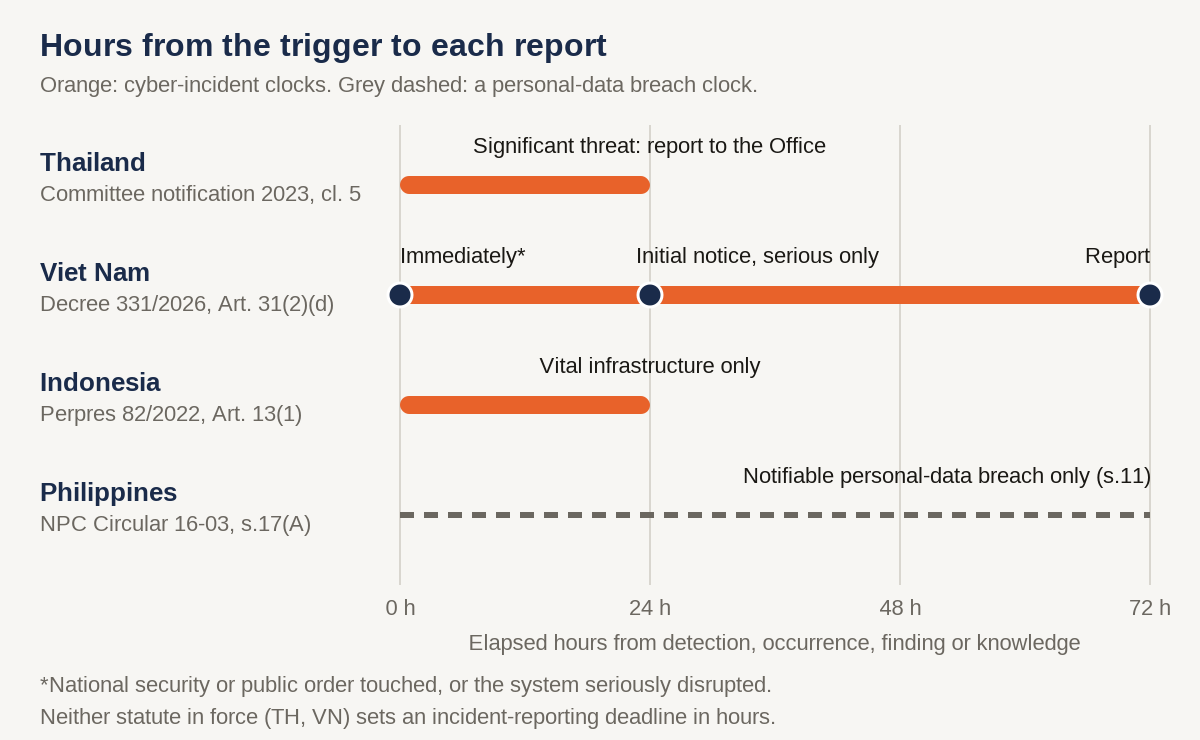
Indonesia sits in ITU’s top tier without a cybersecurity act.
Detection, occurrence and knowledge as starting points
Thailand’s 24 hours and Indonesia’s 1×24 look alike but start from different moments. Thailand’s clause counts from detection or occurrence (หลังจากการตรวจพบหรือเกิดภัยคุกคาม), Indonesia’s from the moment the incident is found, and Viet Nam’s from detection. The Philippine privacy rule runs from knowledge or reasonable belief that a breach has occurred. When a threat is found days after it began, the Thai clause does not say which of its two starting points governs.
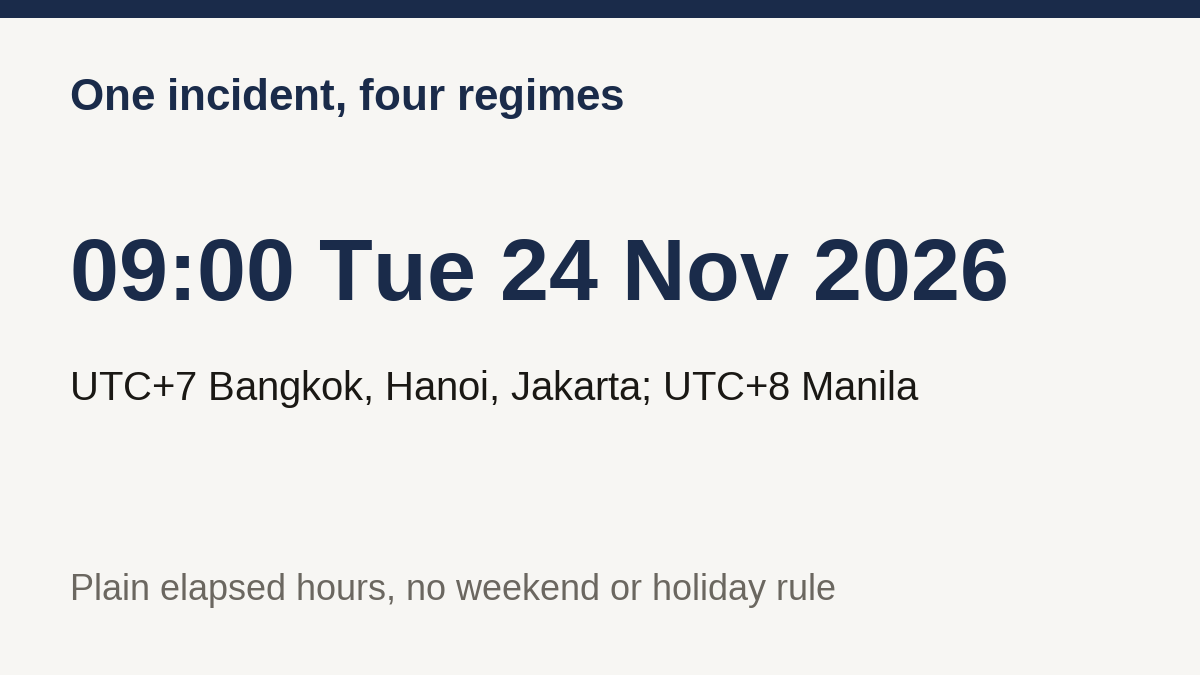
The slides work through one incident detected at 09:00 local time on Tuesday 24 November 2026. For any other start time, our Incident Reporting Clock returns the Thai, Vietnamese and Indonesian deadlines with the clause behind each, and lists the Philippines as not included.
Hours in Viet Nam’s law that answer requests
Article 25(2) of Viet Nam’s Law sets four deadlines, each counted from a request by the Ministry of Public Security. User data is due within 24 hours, or 3 in an emergency, and blocking or removal within 24 hours, or 6 in an emergency.
Organisations each regime reaches
Thailand’s Act covers state or private bodies with a CII mission or service (s.3) in the fields section 49 names; the 2023 notification also reaches state agencies. Viet Nam’s Law reaches agencies, organisations and individuals in Viet Nam, foreign ones included (Art. 1(2)), but Decree 331 covers systems serving state bodies’ use of IT and online services to citizens and businesses, and others are khuyến khích (encouraged) to apply it (Art. 2). Indonesia’s regulation reaches vital-infrastructure operators in eight named sectors plus any the President adds (Art. 4(1)).
In the Philippines, Executive Order 58 of 2024 (as reproduced by the Arellano Law Foundation’s LawPhil Project) directs national agencies and government-owned or -controlled corporations to adopt plans under the National Cybersecurity Plan 2023–2028 and places no duty on private firms. Sector regulators can add clocks of their own. Bangko Sentral ng Pilipinas Circular No. 1019 of 2018, Technology and Cyber-Risk Reporting and Notification Requirements, gives the financial institutions it supervises two hours from discovering a reportable major cyber-related incident to notify the central bank. We read it in an archived copy from February 2024 and could not confirm from a primary source that it still applies unchanged.
Penalty ceilings as each text writes them
- In Thailand, a CII organisation that fails to report under s.57 without reasonable cause faces a fine of up to 200,000 baht (s.73).
- Viet Nam’s Decree 330/2026 caps cybersecurity fines at 200 million đồng for an organisation (Art. 7(3)) and fines an individual 20–30 million đồng for not reporting a detected incident (Art. 21(2)(a)); an organisation pays double (Art. 7(1)), which is 40–60 million by our arithmetic.
- Indonesia’s Regulation 82/2022 has no sanction clause that we could find.
- In the Philippines, concealing a breach of sensitive personal information carries 1 year 6 months to 5 years in prison and a fine of 500,000 to 1,000,000 pesos (Data Privacy Act, s.30).
Data-protection law runs separate clocks. Besides NPC Circular 16-03, which we read in an archived copy from March 2023, Indonesia’s Personal Data Protection Law (Law 27/2022) gives a controller 3×24 hours to notify in writing (Art. 46(1)) and sets fines of up to 2% of annual income or receipts (Art. 57(3)).
Global Cybersecurity Index tiers beside the statutes
The International Telecommunication Union’s Global Cybersecurity Index 2024 puts Indonesia, Thailand and Viet Nam in Tier 1, “Role-modelling”, and the Philippines in Tier 2, “Advancing”. The index scores five pillars of national commitment, and legal measures are only one of them.
Pending bills and a Thai draft amendment
Indonesia’s RUU KKS was still in committee on 17 November, when a working-committee session discussed a periodic evaluation mechanism for it (House news service, 18 November). HB 9605 needs the Philippine Senate next. In Thailand, law-firm summaries describe a draft amendment to the 2019 Act put to public hearing; we saw nothing enacted. Viet Nam’s general decree under the Law, 333/2026, adds no incident-reporting hours. It asks for notice ngay (immediately) when an incident on a system important to national security exceeds the owner’s capacity to handle it (Art. 9(3)(c)), and its hour figures govern the ministry’s requests and inspections.

View author profile → · Editorial policy
Go further
Relevant tools
More from Cybersecurity