
Key points
- By our reading, 27 of the 56 measures under the SingHealth inquiry’s 16 recommendations are now required in substance by a binding Singapore text, 24 are covered in part and 5 have no text we could find.
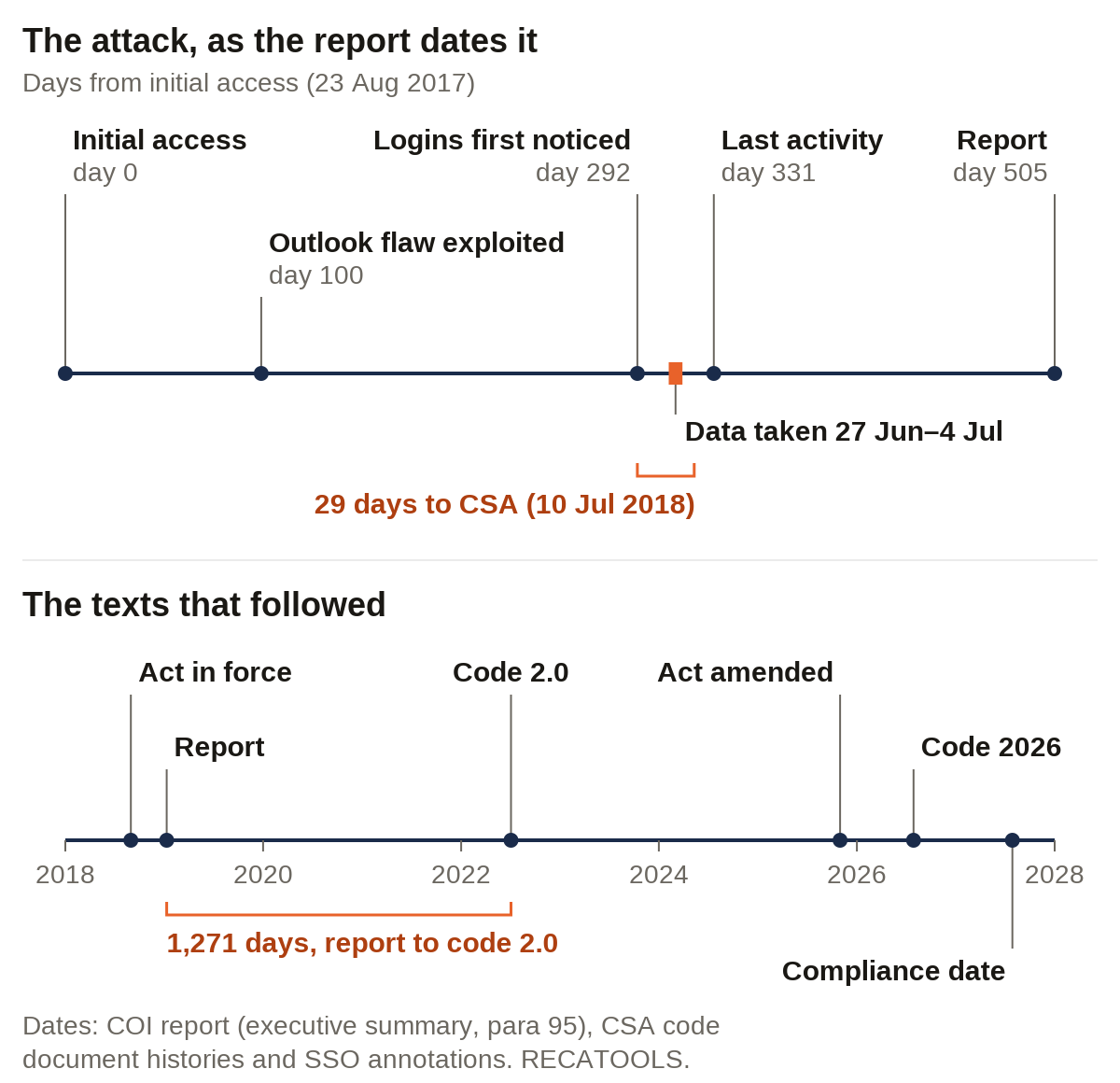
- Edition 2.0 of the code of practice for critical information infrastructure, in force from 4 July 2022, is where 30 of the 51 covered measures first appear, 1,271 days after the report.
- The word “email” appears in none of the three code editions we read, although the report called email attacks the most common vector for initial intrusions.
- The code asks for security patches to be applied “in a timely manner” and prioritised by risk, with no number of days. The only Singapore day count we found is in a draft policy of IHiS, SingHealth’s IT operator, cited in the report: two weeks for endpoint machines.
- Since 31 October 2025 the Cybersecurity Act has also required a CII owner to report prescribed incidents on other systems it controls and on a supplier’s interconnected systems.
In January 2019 a Committee of Inquiry reported on the cyber attack in which the personal particulars of almost 1.5 million SingHealth patients were taken in 2018, and closed with 16 recommendations. We set each of the 56 measures under them against Singapore’s Cybersecurity Act 2018 and three editions of the code of practice for critical information infrastructure (CII). By our reading, 27 are now required in substance by a binding text, 24 are covered in part and 5 have no text we could find. Most of that text arrived with the code’s July 2022 edition, three and a half years after the report.
The report is the Public Report of the Committee of Inquiry into the Cyber Attack on Singapore Health Services Private Limited’s Patient Database on or around 27 June 2018 (10 January 2019). None of the texts we matched it against mentions SingHealth or the inquiry, so a match means a text now covers the same ground and says nothing about why it was written.
Our reading of the 56 measures against the law
The texts are the Cybersecurity Act 2018 on Singapore Statutes Online, the CII regulations (S 519/2018) and three editions of the Cybersecurity Code of Practice for Critical Information Infrastructure from the Cyber Security Agency of Singapore (CSA): the first as amended in December 2019, edition 2.0 Revision 1 (December 2022) and the 2026 edition of 29 July 2026. For the first edition we counted only the main text, which applies to every CII, and left out its 2019 annex for operational-technology systems. A similarity ranking suggested clauses; we decided every status by hand. Reflected means a binding “shall” or “must” asks for substantially the same thing; partly means a clause covers some of it, or only in general terms.
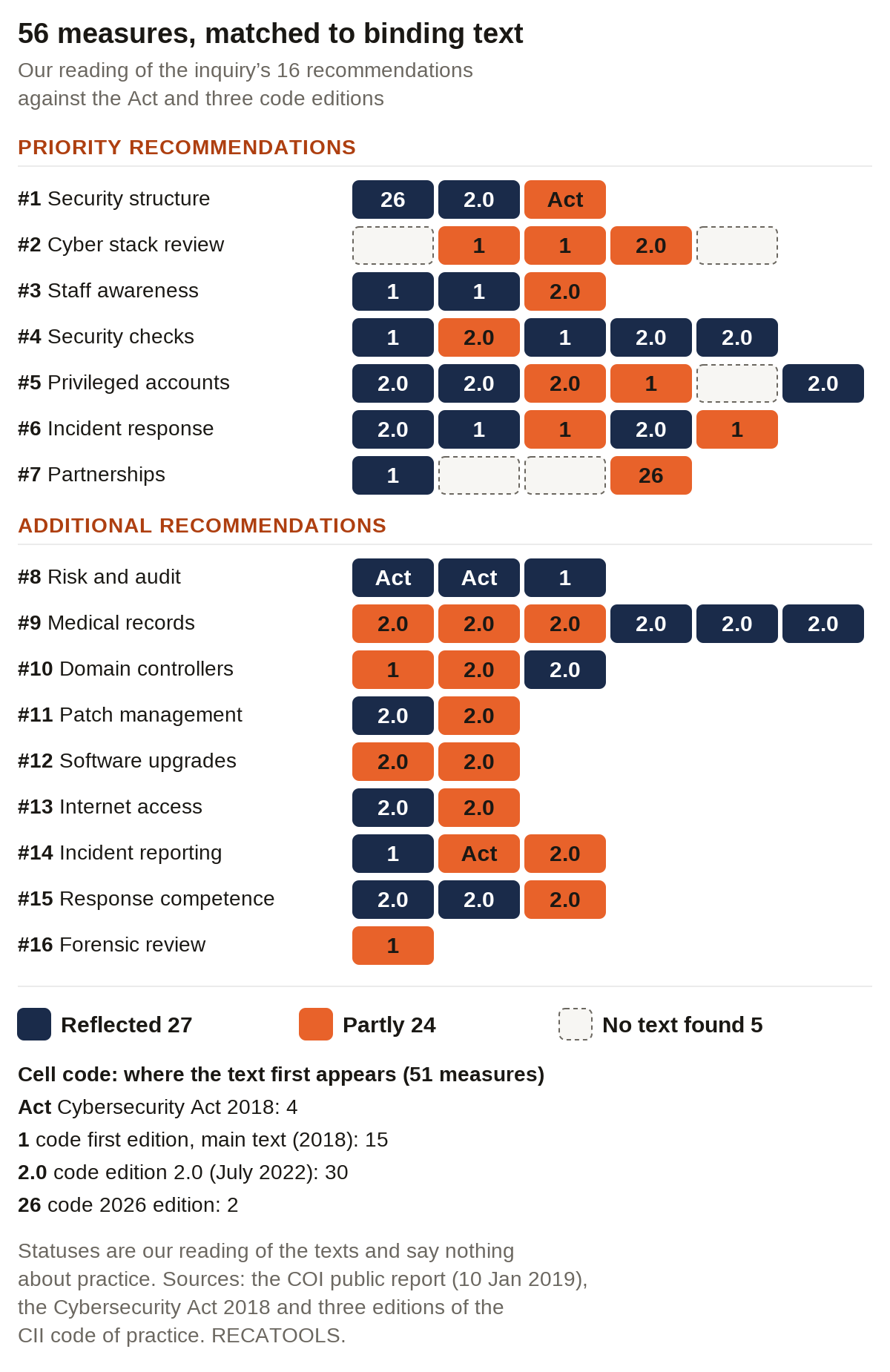
Only recommendation 8, on risk assessment and audit, is reflected in every measure, and all five gaps sit in the seven Priority Recommendations. Partial cover is often a matter of scope. The report asked for databases holding patient data to be “monitored in real-time”; the 2026 code asks for anomaly monitoring of databases (5.13.4), with no timing and nothing specific to medical records.
all measures (56)      reflected 27  partly 24  no text 5
priority (31)          reflected 15  partly 11  no text 5
additional (25)        reflected 12  partly 13  no text 0
first appears in (51)  Act 4  code 1st ed. 15  code 2.0 30  code 2026 2
A reading of texts
A reflected measure means a binding text now requires that thing of a designated CII owner. It says nothing about whether any organisation does it, and the code reaches only designated CII, while several recommendations covered other systems too.
The July 2022 code carried most of the text
The first code edition, issued on 1 September 2018 according to the report, already carried 15 measures, and the Act as it stood in 2018 carried four, chiefly the two-yearly audit and yearly risk assessment in section 15. Edition 2.0, effective 4 July 2022, is where 30 first appear. The first edition mentions privileged accounts only through its December 2019 addendum, which defined them and added an annex for operational-technology CII asking for multi-factor authentication on them; the word “privileged” is on 23 lines of the 2026 code.
One phrase lines up closely, though no text we read explains the overlap. Recommendation 5 says privileged administrator accounts “must be subject to tighter control and greater monitoring”; the 2026 code says privileged access “must be subject to tighter access control and greater monitoring”.
Gaps that no text we read covers
Two of the five unmatched measures concern partnerships, with internet service providers and across borders and sectors, which the texts we read do not place on CII owners. The others are mapping the IT stack against security technologies, managing server local-administrator accounts centrally, and heightening application security for email. The report gave email special weight, in its patching advice too: “Special focus must be placed on patching of email applications, as email attacks are now the most common vector for initial intrusions into systems” (paragraph 1095). The word “email” is on no line of any of the three code editions.
Singapore’s patch clause names no day count
An Outlook patch released in late 2017 “was not installed on workstation A as at 1 December 2017”, and the report found that “the failure to patch in a timely fashion essentially led to the success of this phase of the attack” (paragraph 1083).
| Text | What it says about timing |
|---|---|
| Draft IHiS policy, version 4.0, cited in the report (paragraph 1093) | Two weeks for patches on endpoint machines |
| CII code, first edition, 5.2.2(g); its 2019 annex for operational-technology CII, A.6.1(c) | “Timely update of software and security patches”; “a systematic and timely approach” |
| MOH Cybersecurity Advisory 1/2019, annex item 5(b) | “In a timely and rigorous manner” |
| CII code 2.0 and 2026, 5.10.1(d) and (e) | Prioritise “based on the level of risk”; apply “in a timely manner” |
| CISA BOD 26-04, US federal agencies, 10 June 2026 | 3 or 14 calendar days for flaws in the KEV catalogue |
The US Cybersecurity and Infrastructure Security Agency (CISA) runs a dated clock. Its Known Exploited Vulnerabilities (KEV) catalogue began under Binding Operational Directive (BOD) 22-01 in November 2021, nearly three years after the report, and BOD 26-04, its replacement, gives listed flaws 3 or 14 calendar days. It binds US federal civilian agencies, nobody in Singapore. Our KEV deadline calculator counts the working days left in such a window once weekends and Singapore or Malaysia public holidays come out, and can fill the dates from a local copy of the catalogue by CVE number. A three-day window added on Thursday 26 November 2026, with Singapore holidays selected, falls due on Sunday 29 November and leaves one working day.
Passwords from the report to the current code
The report records that a local administrator account’s password was ‘P@ssw0rd’ (paragraph 235). Recommendation 5 asked for passphrases to be considered and password policies “implemented and enforced across both domain and local accounts”. The first code edition listed “Enforcement of password complexities and policies”; edition 2.0 and the 2026 code replaced it with changing default passwords and storing passwords and passphrases as hashes (5.9.2(b)). Our password strength tester rates the report’s password Very weak, because it is on the page’s own list of common passwords.
Download
The 56 measures with our status, the clause matched and where its text first appears
One row per measure, numbered by recommendation as in the report’s executive summary, with the text and clause we matched, the edition where that text first appears and a short note. Every status is our reading of the texts.
What MOH and IHiS said they had done
On 15 January 2019 the government accepted all of the inquiry’s findings and recommendations (Government’s response to the report of the COI into the cyber attack on SingHealth, published by the Ministry of Digital Development and Information). The Ministry of Health’s Ministerial Statement on the Committee of Inquiry into the Cyber-Attack on SingHealth’s IT System, made that day, listed measures taken by Integrated Health Information Systems (IHiS), among them temporary internet surfing separation, database activity monitoring on SingHealth’s medical record database and two-factor authentication for domain controllers, a measure it called “fully implemented”. On 5 March 2020, in a published speech to Parliament’s Committee of Supply Debate 2020, the health minister said that “close to 80% of the control measures recommended have been implemented or mitigated”, the rest by 2022. We found no later statement that they were.
Private clinics received advice. MOH’s Cybersecurity Advisory 1/2019 (7 February 2019, since removed from MOH’s site) adapted the recommendations into best practices that licensees under the Private Hospitals and Medical Clinics Act were “strongly advised” to review, including two-factor authentication and passphrases for privileged accounts.
Suppliers and other systems enter the Act
The 2025 amendments to the Act never mention the report, though two reach arrangements it dealt with. Since 31 October 2025, under amending Act 19 of 2024, section 14(1) has a CII owner report prescribed incidents on any other system it controls and on a supplier’s interconnected system, besides the CII and its own interconnected systems. A new Part 3A covers providers responsible for CII owned by a third party, the split the report described between SingHealth, which owned the system, and IHiS, which administered and operated it (executive summary, paragraph 3).
Today the first report on a prescribed incident is due within two hours of the owner becoming aware of it (S 519/2018, regulation 5), a clock set out in our guide to cyber incident reporting deadlines. The Act came into force on 31 August 2018, after the attack had ended, so that clock did not apply to it. The 2026 code’s compliance timeline gives existing owners until 29 July 2027 for its new governance, asset, detection, exercise and interconnected-system clauses.

View author profile → · Editorial policy
Go further
Relevant tools
More from Cybersecurity