Malaysia's Employees Provident Fund (EPF, or KWSP) and Singapore's Central Provident Fund (CPF) are both mandatory retirement schemes, but the similarities end there. Both are mandatory, employer-and-employee-funded retirement schemes built on the same provident-fund idea, but the mechanics have diverged so far that crossing the causeway for work means stepping into a system that shares almost nothing with the one at home beyond the deduction line on the payslip.
With recent changes to both systems, 2026 is a good time for a comparison. Singapore's Ordinary Wage ceiling completed its climb to S$8,000 a month on 1 January 2026, the same day contribution rates for workers above 55 took effect at their new levels. Malaysia's Third Schedule, effective for October 2025 wages, made EPF mandatory for non-Malaysian workers at 2% employee plus 2% employer. EPF declared a 6.15% dividend for 2025, and CPF's 4% floor on Special/MediSave/Retirement Accounts was extended to the end of 2026.
This guide puts the two side by side using primary sources only, all accessed 21 July 2026: kwsp.gov.my, cpf.gov.sg, iras.gov.sg, and LHDN's Form BE explanatory notes. It is written for people who work, or are weighing work, across the causeway, and the HR and payroll folks who process them.
The side-by-side
One table, seven dimensions, each expanded in its own section below. All figures are as at 21 July 2026.
| Dimension | EPF (Malaysia) | CPF (Singapore) |
|---|---|---|
| Contribution rates | Wage-banded: employee 11% + employer 13% (wage RM5,000 and below) or 12% (above RM5,000), below age 60. Malaysians 60+: 0% + 4% | Age-banded: 37% total (20% + 17%) at 55 and below, stepping down to 12.5% total above 70 — rates from 1 Jan 2026 |
| Wage ceiling | None — mandatory contributions on full wages; Third Schedule bands apply, exact-percentage calculation only above RM20,000/mo | Ordinary Wage ceiling S$8,000/mo from 1 Jan 2026; annual salary ceiling S$102,000; Additional Wage ceiling = S$102,000 − OW subject to CPF |
| Account structure | Since 11 May 2024: Akaun Persaraan (75%) / Akaun Sejahtera (15%) / Akaun Fleksibel (10%); at 55 these consolidate into Akaun 55, with post-55 contributions going to Akaun Emas | Ordinary Account / MediSave, plus Special Account under 55 or Retirement Account from 55. SA closed for members 55+; their contributions go to RA up to the Full Retirement Sum, overflow to OA |
| Returns | Annual declared dividend: 6.15% for 2025, 6.30% for 2024 (both savings types); Simpanan Konvensional guaranteed minimum 2.50% | Floor-guaranteed interest: OA 2.5%, SA/MA/RA 4% (floor extended to 31 Dec 2026), plus extra interest of up to 2% on the first tranches of balances |
| Withdrawal ages | Akaun Fleksibel any time below 55 (min RM50/day); one-time Akaun Sejahtera withdrawal at 50; full access at 55 (Akaun 55); Akaun Emas at 60. No forced annuity | From 55: at least $5,000 unconditionally, plus savings above the FRS (or above the BRS with a property pledge); the rest funds CPF LIFE monthly payouts from 65 |
| Foreign workers | Mandatory 2% + 2% for non-Malaysians registered from 1 Aug 1998, effective October 2025 wages, all ages, no wage limit | None — CPF contributions have been exempted for foreign employees since 1 January 2003; CPF is payable only for Citizens and SPRs |
| Tax relief on contributions | YA 2025: RM4,000 relief for EPF/approved-scheme contributions; RM3,000 for life insurance plus additional voluntary EPF; combined cap RM7,000 (LHDN Form BE, item G17) | Compulsory employee contributions relieved automatically, computed within the OW and AW ceilings; overall personal relief cap $80,000/YA; no relief on voluntary top-ups beyond compulsory (IRAS) |
Contribution rates: wage bands vs age bands
The two systems take different approaches to member contributions. EPF's Third Schedule cares mainly about your wage: below age 60, a Malaysian employee contributes 11% and the employer adds 13% on monthly wages of RM5,000 and below, or 12% above RM5,000 — 24% or 23% in total. Contributions are computed from banded Third Schedule amounts (exact-percentage calculation only above RM20,000 a month), paid by the 15th of the following month, and can continue to a maximum age of 75. From 60, Malaysian employees stop contributing while employers continue at 4%.
CPF cares about your age. From 1 January 2026, for wages above $750 a month: 37% total (20% employee, 17% employer) at 55 and below; 34% (18% + 16%) above 55 to 60; 25% (12.5% each) above 60 to 65; 16.5% (7.5% + 9%) above 65 to 70; and 12.5% (5% + 7.5%) above 70. The senior bands are the moving part — the Board has already announced 1 January 2027 rises to 35.5% (above 55–60) and 26% (above 60–65), fully allocated to the Retirement Account up to the FRS.
You can see both engines in action on our CPF Contribution Calculator (already on the 2026 rates and $8,000 ceiling, with a 2027 preview toggle) and our EPF, SOCSO & EIS Calculator for the Malaysian side.
Ceilings: none vs a hard cap
EPF has no wage ceiling. A director on RM80,000 a month contributes on all of it, at the same 11% + 12% as someone on RM8,000. The only wage threshold in the schedule is RM5,000, and all it does is switch the employer rate between 13% and 12%.
CPF caps hard. Ordinary Wages attract CPF only up to S$8,000 a month from 1 January 2026 — the final step of a climb that went S$6,000 → S$6,300 (September 2023) → S$6,800 (2024) → S$7,400 (2025) → S$8,000. The annual salary ceiling stays at S$102,000, and bonuses fall under the Additional Wage ceiling: S$102,000 minus the year's Ordinary Wages subject to CPF, per employer per calendar year. The consequence: a high earner in Singapore sees their effective CPF savings rate fall past the ceiling, while a Malaysian's EPF rate stays flat all the way up.
Account structure: three Malay-named accounts vs the OA/MA/RA machine
EPF restructured on 11 May 2024. For members under 55, every new contribution splits three ways: Akaun Persaraan (75%), locked for retirement — transfers in, never out; Akaun Sejahtera (15%), tappable pre-retirement for housing, education, health, insurance/takaful and Hajj; and Akaun Fleksibel (10%), withdrawable any time below 55, minimum RM50, once per day. At 55, all three consolidate into Akaun 55; later contributions land in Akaun Emas, unlocking at 60.
CPF splits by purpose rather than accessibility: the Ordinary Account (housing, some investments), MediSave (healthcare), and — under 55 — the Special Account. The Special Account no longer exists for members 55 and up: per the Board's 2026 allocation table, their contributions go fully to the Retirement Account up to the Full Retirement Sum, overflow to the Ordinary Account. For a worker aged 35 and below in 2026, each contribution dollar splits 0.6217 OA / 0.1621 SA / 0.2162 MA, with the MediSave share climbing steeply at older ages.
Returns: a declared dividend vs guaranteed floors
EPF pays a single dividend rate declared after each financial year: 6.15% for 2025 and 6.30% for 2024, in both cases identical for Simpanan Konvensional and Simpanan Shariah. Konvensional carries a statutory minimum of 2.50%; Shariah simply follows its portfolio's actual performance, with no floor.
CPF pays tiered, floor-guaranteed interest: 2.5% on the Ordinary Account and 4% on Special, MediSave and Retirement Accounts — and for the July–September 2026 quarter the pegged formulas sit below the floors, so the floors are what members actually earn. The 4% SMRA floor has been extended to 31 December 2026. On top of that, members under 55 earn an extra 1% on the first $60,000 of combined balances (capped at $20,000 from OA), while members 55 and up earn an extra 2% on the first $30,000 and 1% on the next $30,000 (same OA cap).
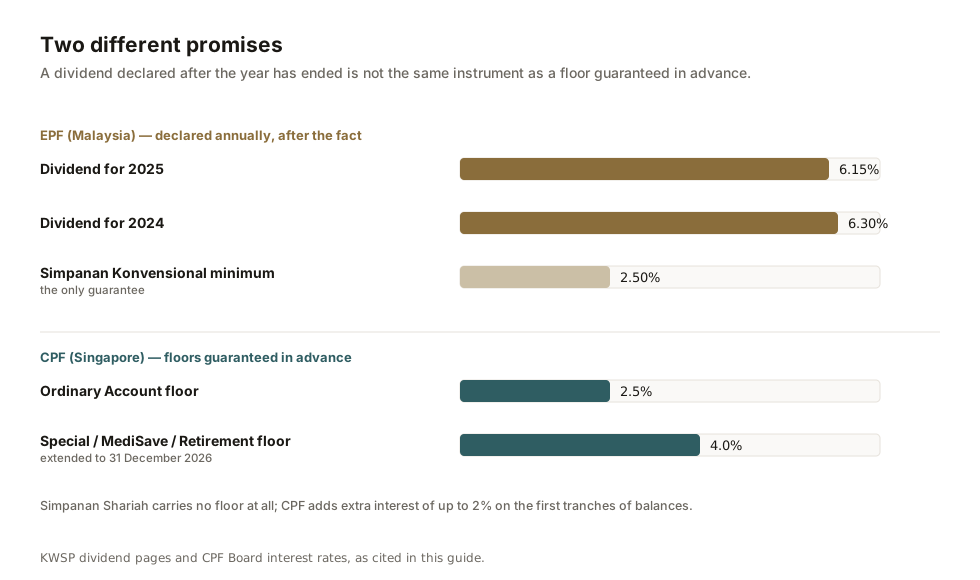
The 6.15% EPF dividend and the 2.5–4% CPF interest floors are not directly comparable; they represent different approaches to risk and return.
Withdrawals: flexibility vs longevity insurance
EPF's design philosophy after the 2024 restructure is graduated access. Below 55 you can already draw from Akaun Fleksibel (min RM50, once a day); at 50 comes a one-time withdrawal of part or all of Akaun Sejahtera. At 55, Akaun 55 opens completely: full lump sum, partial withdrawals with no minimum, or the optional i-Emas monthly payout (minimum RM100 a month, payable up to age 100). No compulsory annuity, no minimum sum left behind. At 60, Akaun Emas is released too.
CPF runs the other way: it converts savings into a lifelong income stream. At 55, you can withdraw at least $5,000 unconditionally, plus anything above the Full Retirement Sum — or above the Basic Retirement Sum if you pledge a property with a lease lasting to age 95. The rest forms your Retirement Account. For members turning 55 in 2026 the sums are BRS $110,200, FRS $220,400, ERS $440,800. From 65, CPF LIFE pays a monthly income for life — deferrable to 70 for up to 7% more per year of deferral — with the Board's educational estimates for the 2026 cohort at roughly $950 a month (BRS), $1,780 (FRS) and $3,440 (ERS).
Tax: reliefs on the way in, and what we can and cannot say about the way out
On contributions, Malaysia gives relief in fixed ringgit amounts. For YA 2025, LHDN's Form BE explanatory notes (item G17) allow RM4,000 for EPF or approved-scheme contributions, RM3,000 for life insurance premiums together with additional voluntary EPF, capped at RM7,000 combined. IRAS relieves compulsory employee CPF contributions automatically under the Auto-Inclusion Scheme, computed on wages within the OW and AW ceilings and subject to the $80,000 overall personal relief cap — with no relief for voluntary contributions beyond the compulsory amount.
On payouts, the Singapore side is explicit. IRAS states that annuities received in Singapore are generally not taxable, and names CPF LIFE monthly payouts as its example. On the Malaysian side, the BE notes verify that pensions from approved schemes paid at 55 or on ill-health are tax-exempt. The tax treatment of EPF lump-sum withdrawals is widely discussed, but we could not confirm it on a current LHDN page during this research pass, so we are deliberately not stating it here — confirm with LHDN or a tax agent before planning around it.
2026 changes at a glance
- EPF becomes mandatory for non-Malaysian workers registered from 1 Aug 1998, at 2% employee + 2% employer (Third Schedule Part F), all ages, no wage limit — first contribution month November 2025.
- CPF Ordinary Wage ceiling reaches S$8,000/month, completing the four-step raise from S$6,000. Annual salary ceiling unchanged at S$102,000.
- CPF senior-band rates rise: above 55–60 to 34% total (18% employee + 16% employer) and above 60–65 to 25% (12.5% each).
- EPF declares a 6.15% dividend for financial year 2025 — the same rate for Simpanan Konvensional and Simpanan Shariah. Separately, CPF's 4% SMRA floor runs to 31 December 2026.
- Announced CPF increases: above 55–60 to 35.5% total (19% + 16.5%) and above 60–65 to 26% (13% each), fully allocated to the RA up to the FRS. The 2027 retirement sums are also set: BRS $114,100 / FRS $228,200 / ERS $456,400.
Working across the causeway
Malaysian in Singapore. On a work pass, you are outside CPF entirely. The CPF Board's own wording: "From 1 January 2003, CPF contributions are exempted for foreign employees" — CPF is payable only for Citizens and SPRs, so there is no employer retirement contribution at all and self-provision is on you (the Board points foreigners to the SRS). One route home: EPF's voluntary i-Simpan channel stays open to Malaysian citizens and PRs below 75, from RM1 up to RM100,000 a year across all voluntary channels combined, so you can keep feeding your KWSP account while earning in Singapore. Take Singapore PR later and CPF becomes mandatory — graduated rates in the first two PR years, full rates from year three (exact graduated percentages are in the Board's rate tables).
Singaporean in Malaysia. Since October 2025 wages, EPF is no longer optional for you: non-Malaysians registered as members from 1 August 1998 contribute a mandatory 2% with a 2% employer match, at any age and with no wage limit. It is a thin rate by design, but it creates a real KWSP account with real dividends.
Leaving for good. Both systems pay out in full on permanent exit. EPF's Leaving Country Withdrawal releases the entire savings at any age — for Malaysians or PRs who renounce their status, and for expatriates and foreign workers whose employment has ended and who are leaving Malaysia (Form KWSP 9K (AHL); foreign workers should apply about two months before the permit expires). On the CPF side, once you are no longer a Citizen or SPR the account is closed and the full balance transferred to your bank account: Malaysians apply through an online form, processing averages around 12 weeks, and savings left uncollected after closure earn only 0.05% p.a. (April 2024 to 31 March 2027).
Honesty box. Our CPF and EPF calculators are simplified estimators, not payroll engines — edge cases like SPR graduated rates and Additional Wage interactions need the official calculators. Rates and ceilings change; check kwsp.gov.my and cpf.gov.sg before acting. This guide is general information, not financial advice.
How to compare fairly
A direct currency conversion is misleading. The two systems serve different wage levels and policy goals, so a structural comparison of percentages, guarantees, and access rules makes more sense. Three useful points of comparison:
- Savings rate: Malaysia banks 23–24% of an uncapped wage; Singapore banks 37% up to the S$8,000/month OW ceiling — so the effective CPF rate declines for high earners while EPF's does not.
- Returns: compare risk profiles, not headlines. EPF's dividend is variable and declared after the fact; CPF's floors are guaranteed in advance. Neither number predicts the other's future.
- Purpose: CPF's Retirement Sums and CPF LIFE target a Singapore-cost-of-living income floor; EPF deliberately leaves the drawdown decision to the member. Different bets on human nature, both defensible.
For the deeper single-country mechanics, see our guides CPF Contributions Explained (2026) and How to Calculate EPF, SOCSO & EIS Deductions in Malaysia — or browse all RECATOOLS guides, including Singapore vs Malaysia income tax if the tax side of the causeway question matters to you.
FAQ
Can a foreigner contribute to CPF?
No. The CPF Board is categorical: "From 1 January 2003, CPF contributions are exempted for foreign employees" — CPF is payable only for Singapore Citizens and SPRs, and employers cannot contribute for foreign staff even on request; long-stayers are pointed to the SRS instead. Becoming an SPR changes everything: graduated CPF rates for the first two years, full rates from the third.
Do Singaporeans working in Malaysia pay EPF?
Yes, since October 2025 wages. Non-Malaysian workers registered as EPF members from 1 August 1998 contribute a mandatory 2%, matched by a 2% employer share, at all ages with no wage limit. The small group of non-citizens registered before August 1998 stays on the standard 11% / 12–13% schedule below age 60 instead.
Which fund earns more interest?
The question compares two different instruments. EPF declared 6.15% for 2025 and 6.30% for 2024, but its only guarantee is Simpanan Konvensional's 2.50% minimum. CPF guarantees 2.5% (OA) and 4% (SA/MA/RA, floor extended to 31 December 2026) up front, plus extra interest of up to 2% on the first tranches of balances. Recent EPF dividends have beaten CPF's floors; CPF's floors will never surprise you on the downside. That is a risk preference, not a scoreboard.
What happens to my fund if I leave the country permanently?
Both pay out in full. EPF's Leaving Country Withdrawal (Form KWSP 9K (AHL)) releases all savings at any age once you renounce Malaysian citizenship/PR — or, for expatriates and foreign workers, once employment ends and you are leaving. CPF closes the account once you are no longer a Citizen or SPR and transfers the entire balance to your bank account; Malaysians apply online, and processing averages about 12 weeks.
- Mandatory Contribution (Third Schedule rates) — KWSP (accessed 21 Jul 2026)
- EPF Dividend Rates — KWSP (accessed 21 Jul 2026)
- Account Restructuring Guide (Akaun Persaraan/Sejahtera/Fleksibel) — KWSP (accessed 21 Jul 2026)
- Age 50 Withdrawal — KWSP (accessed 21 Jul 2026)
- Age 55 & 60 Withdrawals (Akaun 55, Akaun Emas, i-Emas) — KWSP (accessed 21 Jul 2026)
- Leaving Country Withdrawal — KWSP (accessed 21 Jul 2026)
- i-Simpan Voluntary Contribution — KWSP (accessed 21 Jul 2026)
- How much CPF contributions to pay (2026 rates) — CPF Board (accessed 21 Jul 2026)
- New contribution rates from 1 Jan 2027 — CPF Board (accessed 21 Jul 2026)
- What is the Ordinary Wage (OW) ceiling? — CPF Board (accessed 21 Jul 2026)
- CPF Allocation Rates from January 2026 (PDF) — CPF Board (accessed 21 Jul 2026)
- CPF interest rates, 1 Jul–30 Sep 2026 — CPF Board (accessed 21 Jul 2026)
- What is the CPF retirement sum? (2026 cohort BRS/FRS/ERS) — CPF Board (accessed 21 Jul 2026)
- Withdrawing from 55 — CPF Board (accessed 21 Jul 2026)
- CPF LIFE — CPF Board (accessed 21 Jul 2026)
- CPF and foreign employees — CPF Board (accessed 21 Jul 2026)
- On leaving Singapore — CPF Board (accessed 21 Jul 2026)
- CPF Relief for employees — IRAS (accessed 21 Jul 2026)
- Annuity (recurring annual payments) — IRAS (accessed 21 Jul 2026)
- Form BE 2025 Explanatory Notes, item G17 (PDF) — LHDN (accessed 21 Jul 2026)

View author profile → · Editorial policy