
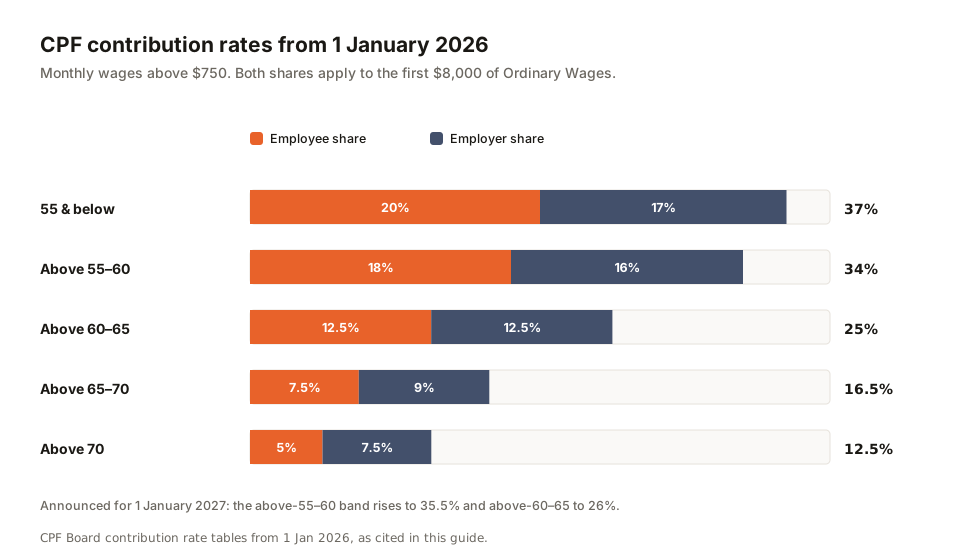
For an employee aged 55 or below earning over $750 a month, the 2026 CPF rates are 20% from the employee and 17% from the employer, applied to the first $8,000 of monthly salary. That is 37% of your Ordinary Wages — up to $2,960 a month — flowing into your CPF accounts before you see a cent of take-home pay.
Your payslip changed twice in 2026. Workers aged above 55 to 65 got a rate increase on 1 January 2026 — the latest step in a multi-year plan to close the gap with younger workers' rates (CPF Board). Second, the monthly salary ceiling completed its climb from $6,000 to $8,000, the final step of the schedule announced at Budget 2023 (CPF Board). If you earn between $7,400 and $8,000 a month, more of your salary attracts CPF this year than last, reducing your cash payout in favor of a bigger CPF inflow.
This guide covers Singapore Citizens and Permanent Residents from their third year of PR status, in private-sector or non-pensionable employment. PR graduated rates get their own section below.
The 2026 rate table
These are the rates from 1 January 2026 for monthly wages above $750, straight from the CPF Board's contribution rate tables (PDF). "Max on OW" is the rate applied to the $8,000 Ordinary Wage ceiling.
| Age band | Employer | Employee | Total | Max on OW (total / employee) |
|---|---|---|---|---|
| 55 & below | 17% | 20% | 37% | $2,960 / $1,600 |
| Above 55–60 | 16% | 18% | 34% | $2,720 / $1,440 |
| Above 60–65 | 12.5% | 12.5% | 25% | $2,000 / $1,000 |
| Above 65–70 | 9% | 7.5% | 16.5% | $1,320 / $600 |
| Above 70 | 7.5% | 5% | 12.5% | $1,000 / $400 |
Lower earners are treated differently. Wages of $50 or less attract no CPF at all. From above $50 to $500, only the employer contributes — the employee pays nothing. From above $500 to $750, the employee's share phases in gradually rather than landing at the full rate.
Payroll rounding follows three official steps: the total contribution is rounded to the nearest dollar, the employee's share is rounded down to the nearest dollar, and the employer's share is whatever remains.
Ordinary Wage ceiling, Additional Wage ceiling
CPF has two separate caps that are frequently confused.
The Ordinary Wage ceiling: $8,000 a month
The OW ceiling caps the monthly salary that attracts CPF. Earn $9,500 a month and CPF is computed on $8,000; the remaining $1,500 escapes both the 20% deduction and the 17% employer top-up. The ceiling reached $8,000 on 1 January 2026 after a four-step climb:
| Effective date | OW ceiling |
|---|---|
| Up to 31 Aug 2023 | $6,000 |
| 1 Sep 2023 | $6,300 |
| 1 Jan 2024 | $6,800 |
| 1 Jan 2025 | $7,400 |
| 1 Jan 2026 | $8,000 |
The Additional Wage ceiling: $102,000 minus your annual OW
Bonuses, and anything else not paid as a regular monthly wage, are Additional Wages. They have their own annual cap, per employer, per calendar year (CPF Board):
AW ceiling = $102,000 − total Ordinary Wages subject to CPF for the year
The $102,000 annual ceiling did not move during the OW phase-up. So someone on $5,000 a month has $102,000 − $60,000 = $42,000 of bonus that can attract CPF; someone maxing the OW ceiling at $8,000 a month has only $102,000 − $96,000 = $6,000. A lower monthly salary leaves more headroom under the Additional Wage ceiling, so more of a bonus attracts CPF.
Where the money goes
Your contribution is split across accounts by age-banded ratios, published in the CPF Board's allocation rate tables (PDF). At 35 and below, roughly 62% goes to the Ordinary Account, 16% to the Special Account and 22% to MediSave — the Board's own example: a $100 contribution at age 30 lands as OA $62.17, SA $16.21, MA $21.62. The split shifts with age; by the above-60-to-65 band, MediSave takes 42% and the Retirement Account 44%.
For these members, contributions go to the Retirement Account (RA), not the Special Account (SA). On 19 January 2025 the Special Accounts of around 1.4 million members aged 55 and above were closed. SA savings moved to the Retirement Account up to the Full Retirement Sum; anything beyond that went to the Ordinary Account, where it earns 2.5% a year and stays withdrawable. Members under 55 keep their SA until they turn 55. So in the 2026 allocation tables, the former SA column for 55-plus members is now the RA column.
The January 2026 senior-worker rate increase follows the same routing: the extra 1.5 percentage points for the 55-to-65 bands is allocated fully to the RA, up to the FRS. Members who have already set aside the FRS see it channelled to the OA instead.
MediSave contributions also stop once a member's balance reaches the Basic Healthcare Sum, which is $79,000 in 2026 (up from $75,500). And the Government has extended the 4% a year interest floor on Special, MediSave and Retirement Account monies until 31 December 2026.
Worked example: $6,500 a month plus a $13,000 bonus
Take a 30-year-old Singapore Citizen earning $6,500 a month with a $13,000 year-end bonus, one employer all year, 2026 rates.
| Step | Calculation | Result |
|---|---|---|
| OW ceiling check | $6,500 ≤ $8,000 | Full salary attracts CPF |
| Monthly total CPF | 37% × $6,500 | $2,405 |
| Monthly employee share | 20% × $6,500 | $1,300 (deducted) |
| Monthly employer share | $2,405 − $1,300 | $1,105 (paid on top) |
| Monthly take-home | $6,500 − $1,300 | $5,200 |
| AW ceiling | $102,000 − ($6,500 × 12) | $24,000 |
| Bonus CPF check | $13,000 ≤ $24,000 | Full bonus attracts CPF |
| Bonus total CPF | 37% × $13,000 | $4,810 |
| Bonus cash received | $13,000 − $2,600 | $10,400 |
| Full-year CPF | 37% × $91,000 | $33,670 |
In a bonus month, the payslip looks stark. The total CPF contribution would be $2,405 + $4,810 = $7,215, with $3,900 deducted from the employee and $3,315 paid by the employer. Across the year, $91,000 of wages attract CPF (comfortably inside the $102,000 annual ceiling), producing $33,670 in contributions — $18,200 from the employee, $15,470 from the employer.
Where does a $2,405 monthly contribution land at age 30? Computed MediSave-first, then SA, remainder to OA: about $519.96 to MediSave, $389.85 to the Special Account, and $1,495.19 to the Ordinary Account.
Want these numbers for your own salary, age band and bonus? Run them through our CPF Contribution Calculator — it applies the 2026 rates, both ceilings and the official rounding rules, and shows the account-by-account split.
Common confusions
Gross salary vs. take-home pay The 20% employee share comes out of your gross pay; the 17% employer share is paid on top and never appears in your gross at all. A $6,500 salary means $5,200 in cash and $2,405 into CPF. If you are comparing offers across the Causeway, our SG–MY income tax calculator and our Singapore vs Malaysia salary comparison both work from take-home, not gross.
Bonuses and commissions. These, along with overtime pay, allowances (meal, transport) and cash incentives, are all CPF-able wages (CPF Board) — non-monthly payments are simply capped by the AW formula rather than the $8,000 monthly ceiling.
New Permanent Residents. First- and second-year PRs contribute at graduated rates rather than the full ones: a first-year PR aged 55 and below pays a 5% employee share against a 9% total, and a second-year PR in the same band 15% against 24%. Employer and employee can jointly apply for higher rates — full employer with graduated employee, or full citizen rates. From the third year of PR status, full rates apply automatically.
Not everything on the payslip is CPF-able. Reimbursements of actual business expenses, termination and retrenchment benefits (they are not payment for services rendered), and non-cash benefits-in-kind attract no CPF.
What changed in 2026 — and what's next
The 1 January 2026 changes in one list:
- OW ceiling: $7,400 → $8,000 — the final step of the Budget 2023 schedule. The annual ceiling stays $102,000, so higher monthly OW now means less AW headroom.
- Senior-worker rates up 1.5 points: above 55–60 went from 32.5% to 34% (employer +0.5 to 16%, employee +1 to 18%); above 60–65 from 23.5% to 25% (12.5% each). The increase goes to the RA, up to the FRS.
- Allocation tables updated, with the RA replacing the SA column for members 55 and above — the follow-through from the January 2025 SA closure.
- Basic Healthcare Sum: $75,500 → $79,000 for members below 65; fixed for life at 65.
- 4% interest floor on Special, MediSave and Retirement Account monies extended through 31 December 2026.
And the next step is already legislated. From 1 January 2027, announced at Budget 2026, the above-55-to-60 total rises from 34% to 35.5% (employer 16.5%, employee 19%) and the above-60-to-65 total from 25% to 26% (13% each), with no change for other bands (CPF Board). That increase again flows fully to the RA, up to the FRS. Employers budgeting 2027 headcount costs for older workers should pencil these in now.
Where this stops
This guide describes employee CPF for Singapore Citizens and third-year-onwards PRs in private-sector or non-pensionable employment. It does not cover self-employed persons, platform workers, or pensionable civil servants, all of whom follow different tables. The account allocation figures are illustrative to the cent; the CPF Board applies its own computation and rounding order, so payslip figures can differ by a few cents.
This is general information, not financial advice. Rates and figures were verified in July 2026 against CPF Board publications, including the official 2026 contribution and allocation rate tables. CPF parameters change on a regular cycle — if you are reading this after 1 January 2027, check the senior-worker rates above against the CPF Board's current tables first.

View author profile → · Editorial policy