If you earn S$60,000 in Singapore, your income tax bill this year is S$200 higher than last year's on identical income.
No rate changed. No bracket moved. No relief was withdrawn. The 60% rebate for YA2025, capped at S$200, was not extended to YA2026. A lapsed rebate generates no announcement, no circular, and no change to any published rate table.
Most statutory changes are not headlines, but quiet differences in the arithmetic from one year to the next. This is the annual audit of what actually moved across Singapore and Malaysia — and, because we ran it against our own calculators first, what our tools had right and wrong.
Singapore: a rise by omission
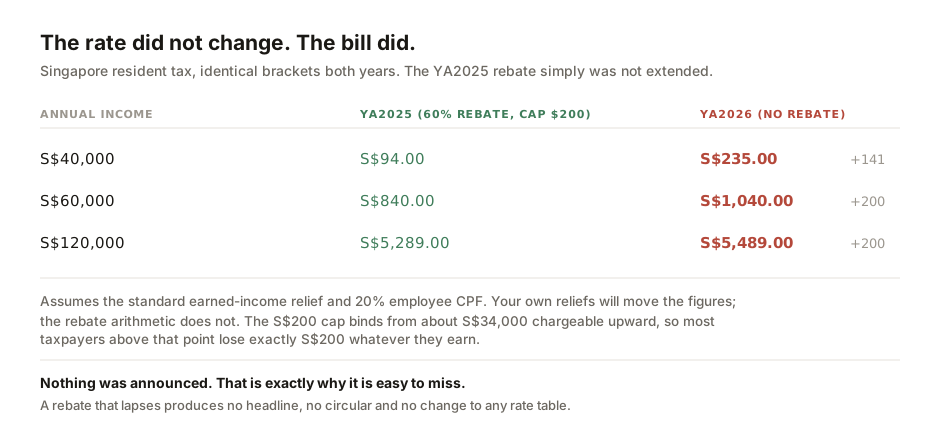
Budget 2026 announced no personal income tax rebate for YA2026. The rebate existed for YA2024 and YA2025 and simply stopped.
Because it was capped at S$200, the effect is regressive in an unusual direction: the cap binds from about S$34,000 of chargeable income upward, so almost every taxpayer above that point loses exactly S$200 regardless of income, while someone on S$40,000 total income loses about S$141. In proportional terms the smaller earner is hit harder relative to their bill — their tax rises by 150%, from S$94 to S$235, while the S$120,000 earner sees a rise of under 4%.
This is not a critique of the policy. It is simply to say that "no change to income tax" is a misleading description of this year, and the single most common reason for a surprise when comparing payslips.
Singapore: the CPF staircase reached the top
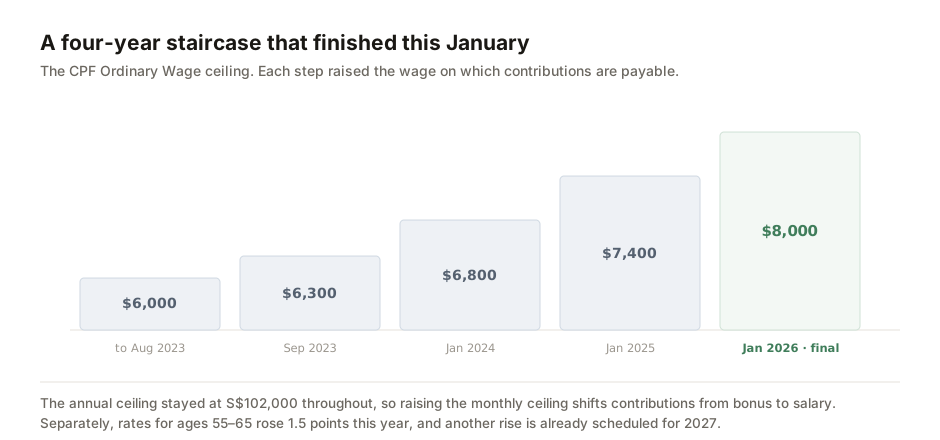
From 1 January 2026 the monthly Ordinary Wage ceiling rose from S$7,400 to S$8,000. This was the fourth and final step of a raise that began in September 2023, ending this series of increases.
Two consequences of this are easy to misread.
- The annual ceiling did not move. It stayed at S$102,000. Raising the monthly ceiling while holding the annual one constant shifts contributions from bonus to salary rather than simply adding them. This happens because the Additional Wage ceiling is S$102,000 minus the year's OW subject to CPF.
- Rates rose for 55 to 65 only. Up 1.5 percentage points in total this year — one point from the employee, half a point from the employer. Under 55 is unchanged at 37%. And another rise is already scheduled for 2027, so this is not finished.
If you are over 55, your take-home fell slightly this year through a rate change, and it will fall slightly again next year. Our CPF contribution calculator carries both the 2026 rates and the announced 2027 ones, so you can see next year's position now.
Malaysia: the changes landed earlier than you think
Malaysia's significant moves did not happen in January. They landed across the previous eighteen months and are only now showing up in a full year of payslips.
| What | When it took effect | What it does |
|---|---|---|
| SOCSO / EIS wage ceiling | 1 Oct 2024 | Raised from RM5,000 to RM6,000, so contributions now scale further up the wage table before flattening |
| EPF for foreign workers | Oct 2025 | Became mandatory, at a reduced 2% employee and 2% employer rate |
| SST expansion | 1 Jul 2025 | Widened the scope of taxable services; the service-tax rate is 6% or 8% depending on category |
| Electricity tariff restructure | 1 Jul 2025 | Five-block domestic tariff abolished; replaced by energy, capacity, network and retail components plus a monthly fuel adjustment |
Income tax brackets for YA2026 are unchanged from YA2025. So for a Malaysian employee, the arithmetic that moved is in the deductions rather than the tax — and, if the household is above 600 kWh a month, in the electricity bill, which we covered in house calculations for a tropical climate.
The charge that moved most, the last one in the table, is not a tax. The fuel adjustment is reset monthly: it was +3.59 sen per unit in July 2026, with the official projection for August to October running between +8.04 and +8.94. A statutory charge that changes twelve times a year behaves nothing like an annual rate, so no calculator that stores a single number can represent it.
What we found when we audited our own calculators
Our audit of these figures turned up something more interesting than the usual statutory round-up.
Four times this month we have read the source of one of our own tools before citing it, and four times we found something wrong: a two-year-old electricity tariff, a repealed solar scheme, a public holiday on the wrong day, and a password meter rating Summer2026 as "Fair".
We ran the same audit over the payroll and tax calculators — CPF, EPF, SOCSO, EIS, PCB, SST and both income taxes — checking the arithmetic rather than the sourcing, because a sourcing check will not catch a wrong sum. Every figure matched: CPF at the ceiling and below it, at every age band, for 2026 and the announced 2027 rates; EPF at the RM5,000 employer-rate threshold; the full 65-row PERKESO band table; the Singapore bracket walk; Malaysian PCB.
The difference is visible in the source code, and it comes down to discipline, not talent. Every constant in that engine sits in a block with a verification date and a link to the gazette or agency page it came from. Where a value was unknown — whether a YA2026 rebate would be announced — the code said so in a comment, treated it as zero, and named it a watch item rather than guessing.
That watch item is the one we were most likely to have got wrong. It resolved correctly, because Budget 2026 announced no rebate. But we could check it in a minute because somebody had written down what they did not know.
- Date every constant. Not "EPF rates" but "EPF rates as at Oct 2025, kwsp.gov.my, verified 2026-06-10". A number without a date cannot be audited, only believed.
- Write down what you do not know. An explicit "not yet announced — treated as zero" is worth more than a confident guess, because it tells the next person exactly where to look.
- Check the arithmetic separately. Correct sources and wrong sums are a common combination. Test a handful of hand-computed cases against the code, at the boundaries especially.
What to actually check on your own payslip
Our EPF, SOCSO and EIS calculator and Malaysian PCB calculator use the official band tables rather than the percentage approximations most online tools apply, and the Singapore and Malaysia income tax comparison now reflects the absent YA2026 rebate.
The biggest change to a Singapore tax bill is a lapsed rebate. The 60% rebate (capped at S$200) for YA2024 and YA2025 was not extended to YA2026, so identical income now produces up to S$200 more tax. The CPF Ordinary Wage ceiling completed its four-step climb at S$8,000 in January while the annual ceiling stayed at S$102,000 — which shifts contributions from bonus to salary rather than simply adding them — and rates for ages 55 to 65 rose 1.5 points with a further rise already scheduled for 2027.
Malaysia's changes landed earlier and are only now visible across a full year. The SOCSO and EIS ceiling has been RM6,000 since October 2024; EPF for foreign workers became mandatory in October 2025; and the SST was expanded in July 2025. Income tax brackets are unchanged for YA2026. The charge that moved most is not a tax at all — the electricity fuel adjustment, reset monthly, which no calculator storing a single number can represent.
- IRAS — Personal Income Tax Rebate, and Singapore Budget 2026 summaries confirming no rebate was announced for YA2026. Accessed 29 July 2026.
- CPF Board — how much CPF contributions to pay: the S$8,000 Ordinary Wage ceiling from 1 January 2026 as the final step of the raise begun September 2023, the S$102,000 annual ceiling, and the 1.5-point rise for ages 55 to 65. Accessed 29 July 2026.
- PERKESO contribution schedules for Act 4 (SOCSO) and Act 800 (EIS), ceiling RM6,000 since 1 October 2024; KWSP for EPF rates including the foreign-worker requirement from October 2025; LHDN for YA2026 resident brackets. These are the sources our payroll engine cites in-line, each with a verification date. Accessed 29 July 2026.
- Single Buyer Malaysia — Automatic Fuel Adjustment: +3.59 sen/kWh for July 2026, with August to October projected at +8.04 to +8.94. Accessed 29 July 2026.
- Our own arithmetic audit of the payroll engine, 29 July 2026: CPF at and below the ceiling across every age band for 2026 and 2027, the EPF employer-rate threshold at RM5,000, the 65-row PERKESO table, the Singapore bracket walk and Malaysian PCB. No discrepancies found — the first clean result in five tool audits this month.
This is general information, not tax advice, and it is deliberately about what changed rather than what you owe. Reliefs, residency and employment type all move the answer. For anything with a filing deadline attached, check the agency's own figures for your assessment year.

View author profile → · Editorial policy